

橄榄蛏蚌(Solenaia oleivora)属软体动物门(Mollusca)、双壳纲(Bivalvia)、蚌目(Unionoida)、蚌科(Unionidae)、蛏蚌属(Solenaia)珍稀淡水蚌类。其主要分布在我国东部及中南部等具有一定流速的河流,营穴居生活,栖息于泥质或泥沙质底部[1]。橄榄蛏蚌贝壳大型,体型扁长、壳质薄脆,具有发达的斧足,蚌肉味道鲜美,营养丰富,有较高的食用价值,深受广大消费者喜爱[2]。同时,橄榄蛏蚌作为滤食性生物,以水中的微小生物如藻类和细菌及有机碎屑等为食,在自然界的物质能量循环和天然的水体净化中具有重要的地位[3]。
近年来,受河流生境发生变化及过度捕捞等因素的影响,橄榄蛏蚌的适宜生境面积锐减,野外数量明显下降[4-5]。因此,研究人员对橄榄蛏蚌进行了一些研究和保护工作,建立自然保护区和国家水产种质资源保护区[5]。目前,相关学者在橄榄蛏蚌的形态与生长[6]、营养成分分析[7]、生理生化[8-9]、人工驯化和繁殖[10-12]以及种群分布[13]等方面进行了大量研究,为开展该生物的人工繁育奠定了一定基础。孙光兴[11]使用各类血清对橄榄蛏蚌钩介幼虫进行体外培养,发现使钩介幼虫变态率最高的是鲤鱼血清。然而,由于橄榄蛏蚌的繁殖和栖息特性,其特定寄主鱼种类及相关寄生机制尚未明确,限制了其人工繁育,影响了该珍稀淡水贝类的大规模人工养殖、资源开发利用及自然种群恢复。本文比较了橄榄蛏蚌钩介幼虫在鳙、鲢、草鱼、鲫与黄颡鱼5种寄主鱼上的寄生效果,并进行了稚蚌培育实验,以筛选出最佳寄主鱼,为橄榄蛏蚌的大规模人工繁育提供参考。
1 材料与方法
1.1 试验材料
试验所用橄榄蛏蚌样本采自安徽水韵环保股份有限公司河蚌繁育基地的亲蚌吊养塘。2022年4月,参照闻海波等[14]的方法,对雌性个体进行性腺成熟度检测,筛选出性成熟度较高的雌性个体作为繁殖亲蚌,并通过观察育儿囊发育状态评估其成熟度。
试验所用寄主鱼共5种,分别为鳙、鲢、草鱼、鲫与黄颡鱼,均采购自安徽亮源水产良种开发有限公司。试验前暂养于安徽水韵环保股份有限公司河蚌繁育基地的寄主鱼养殖塘,选取体质健康、规格一致的个体进行寄生试验。寄主鱼规格见表1。在寄生试验开始前,将寄主鱼提前捕捞放入装满清水的盆中暂养1 h,以清除鱼体和鳃上附着的污物,确保试验结果的准确性。
表1 寄主鱼规格 |
| 种类 | 数量/尾 | 体长/cm | 体重/g |
|---|---|---|---|
| 鳙 | 15 | 14.61±1.77 | 69.26±23.70 |
| 鲢 | 15 | 15.27±1.62 | 61.76±20.27 |
| 草鱼 | 15 | 12.86±1.98 | 38.83±13.07 |
| 鲫 | 15 | 14.84±1.79 | 18.61±6.09 |
| 黄颡鱼 | 15 | 12.13±2.92 | 54.70±36.90 |
1.2 试验方法
1.2.1 钩介幼虫采集与寄生
钩介幼虫采集和寄生的方法参照白志毅等[15]的方法。具体如下:选取钩介幼虫发育成熟的母蚌,首先对其外壳进行清洗并置于阴凉处干燥2 h,随后将母蚌放入容器中,注入适量清水至浸没蚌壳。10 min后,亲蚌开始释放絮状钩介幼虫。待幼虫排放量达到试验需求后,移出母蚌,轻柔搅拌水体使幼虫均匀分散,随后使用曝气自来水进行冲洗。最后,将制备好的钩介幼虫悬液平均分为5组,作为后续试验备用。
将清洗处理好的试验鱼移入钩介幼虫悬液中进行寄生实验,寄生时间为20 min。寄生结束后,使用清水冲洗鱼体表,去除未成功寄生的钩介幼虫;再将5种鱼分别放入玻璃缸中(长×宽×高为70 cm×40 cm×20 cm)养殖。为确保寄生效果,在寄生过程中需要持续搅拌和摇晃水体以提高寄生效率。养殖过程中均使用室温水,每天测量水温,对鱼的生长情况进行观察,及时清理死鱼。
1.2.2 脱落幼虫及稚蚌的收集
完成寄生后,每日定时采用虹吸法收集寄主鱼暂养箱底部的脱落钩介幼虫及变态稚蚌,直至箱内无钩介幼虫存在。收集的幼虫及稚蚌经200目筛绢过滤后,置于光学显微镜下进行观察和统计。通过统计脱落的未变态钩介幼虫与变态稚蚌数量之和获得钩介幼虫在鱼体各部位(包括鳃丝、鳍条及体表)的寄生总量。稚蚌变态的标准参照孙光兴[11]的方法。稚蚌变态率计算如式(1) 。
变态率(%)=变态稚蚌数量/钩介幼虫寄生总数量×100
1.2.3 稚蚌存活率及生长情况
试验从寄生于鳙、鲢、草鱼3种鱼类的钩介幼虫中获取变态发育后的稚蚌,每种寄主鱼来源的稚蚌随机选取100只,每组设置3个重复,分别放入塑料养殖箱(长×宽×高为40 cm×30 cm×16 cm)中培育。养殖箱中放置氧气头,保证水体溶氧充足。每天换出养殖箱中50%的水,换出水用200目筛网过滤,确保不因换水导致稚蚌丢失。换水后,投喂小球藻106个/mL,并添加池塘底泥,养殖箱底的底泥厚度以刚好盖住生长的稚蚌为宜。养殖60 d后测定各养殖箱中稚蚌成活率和壳长。
1.3 数据处理
采用Excel 2021和SPSS 26软件对试验数据进行处理统计,使用Origin 2021软件绘制图片。
2 结果与分析
2.1 橄榄蛏蚌钩介幼虫寄生量及变态率
由表2可知,钩介幼虫寄生量最高的为鳙,平均寄生量为1 349.67个/尾,其次为鲢(875.60个/尾),草鱼和黄颡鱼寄生量接近,分别为512.60和522.53个/尾,鲫的寄生量最低,为316.93个/尾。其中,鳙组钩介幼虫寄生量明显高于其他组(P<0.05),草鱼组与黄颡鱼组差异无统计学意义(P>0.05)。从变态率上来看,鳙组的变态率最高,为81.95%,其次为鲢组(64.24%),草鱼组较低,为36.02%,黄颡鱼组和鲫组未发现变态的稚蚌。鳙、鲢、草鱼组的钩介幼虫变态率差异存在统计学意义(P<0.05)。综合说明鳙是较适宜钩介幼虫寄生的鱼种。
表2 橄榄蛏蚌钩介幼虫在5种寄主鱼上的寄生量及变态率 |
| 寄生鱼种类 | 寄生总量/个 | 平均寄生量/(个/尾) | 变态率/% |
|---|---|---|---|
| 鳙 | 20 245 a | 1 349.67 a | 81.95 a |
| 鲢 | 13 134 b | 875.60 b | 64.24 b |
| 草鱼 | 7 689 c | 512.60 c | 36.02 c |
| 黄颡鱼 | 7 838 c | 522.53 c | 0 d |
| 鲫 | 4 754 d | 316.93 d | 0 d |
|
2.2 钩介幼虫脱落时间规律
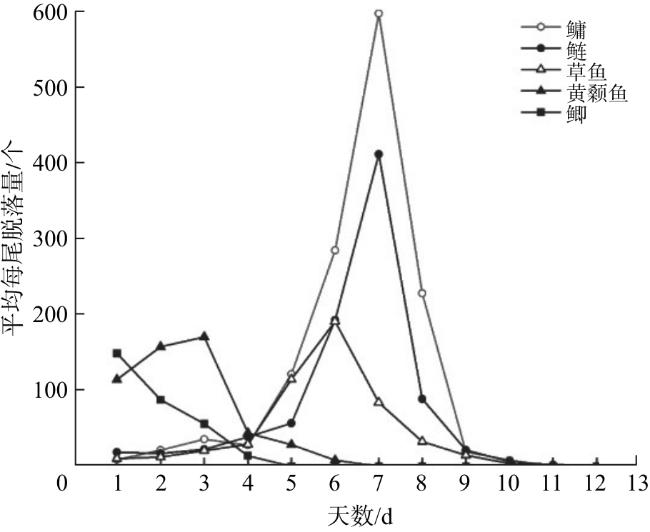
由图1可知,水温在22~28 ℃时,橄榄蛏蚌钩介幼虫的变态发育时间在5~11 d,从第5天开始,发现变态的稚蚌,第11天所有寄主鱼全部脱落完成。其中,鳙和鲢组的脱落高峰出现在第7天,草鱼组的脱落高峰出现在第6天。黄颡鱼和鲫组从第1天就开始大量脱落,黄颡鱼6天全部脱落,鲫4天全部脱落,未发现变态的稚蚌。


2.3 橄榄蛏蚌稚蚌存活率与生长情况
由表3可知,鳙组脱落的变态稚蚌存活率最高,达94.00%,鲢和草鱼组次之,分别为88.33%和89.67%。各组间的成活率和壳长差异无统计学意义(P>0.05)。说明3种鱼类脱落的变态稚蚌均能较好地生长。
表3 投喂60 d后稚蚌成活率及壳长 |
| 寄主鱼种类 | 存活数量/尾 | 存活率/% | 壳长/mm |
|---|---|---|---|
| 鳙 | 282 | 94.00±2.65 a | 7.12±0.70 a |
| 鲢 | 265 | 88.33±2.08 a | 7.10±0.60 a |
| 草鱼 | 269 | 89.67±1.53 a | 7.06±0.63 a |
3 结论与讨论
3.1 橄榄蛏蚌钩介幼虫对寄主鱼的选择性
橄榄蛏蚌作为一种经济和生态价值均较高的淡水贝类,开发利用价值较高。然而,在自然情况下,该生物的钩介幼虫寄生在鱼体上才能完成变态发育,独特的繁殖方式,导致其大规模人工繁育过程中会面临寄主鱼种类不清楚的问题。常规用于淡水贝类人工繁殖的寄主鱼有鳙、草鱼、黄颡鱼和鲫鱼等,钩介幼虫对寄主鱼的选择不同,导致其寄生量和变态率存在差异[16]。王玉凤等[17]研究发现,沙鳢、黄黝鱼、栉虾虎鱼、乌鳢和草鱼可使刻裂丽蚌的钩介幼虫成功发育。徐良等[18]研究认为,罗非鱼是背角无齿蚌的最佳寄主鱼。白志毅等[15]筛选发现,黄颡鱼和草鱼是三角帆蚌钩介幼虫的最佳寄主。闻海波等[19]研究表明,黄颡鱼与尼罗罗非鱼对三角帆蚌的寄生效果基本相同。本文比较了橄榄蛏蚌钩介幼虫在鳙、鲢、草鱼、鲫和黄颡鱼5种寄主鱼身上的寄生效果,结果表明,橄榄蛏蚌钩介幼虫可附着在5种鱼的鱼体上,其中鳙寄生量最高,鲫寄生效果最差。孙光兴[11]在对橄榄蛏蚌钩介幼虫的体外培养研究中发现,使用鲤、鳙等鱼类或牛、兔等哺乳动物的血清培养钩介幼虫均可使其变态率在60%以上,其中最高的是鲤,可达86.61%。本试验中,寄生在黄颡鱼和鲫身上的大量钩介幼虫会提前脱落,不能完成变态发育,草鱼也出现一定程度的早脱落现象,导致变态成功的稚蚌数量较少,推测其原因可能是钩介幼虫的寄生引起了寄主鱼的免疫反应[19]。有研究表明,寄主鱼的规格也会对寄生效果造成影响[20],本研究并未对寄主鱼的规格进行研究,可待后续进一步研究,以提高橄榄蛏蚌的人工繁殖效率。
3.2 钩介幼虫脱落时间
3.3 稚蚌培养存活率
综上,本试验分析了橄榄蛏蚌钩介幼虫在鳙、鲢、草鱼、鲫及黄颡鱼5种鱼类上的寄生效果,并在此基础上进行稚蚌培育试验。结果表明,钩介幼虫可以寄生在鳙、鲢、草鱼、鲫和黄颡鱼5种寄主鱼身上,其中寄生在鳙、鲢和草鱼身上的钩介幼虫可成功变态发育为稚蚌,变态率分别为81.95%、64.24%和36.02%,稚蚌存活率分别为94.00%、88.33%和89.67%。综合表明,在本试验条件下,鳙为橄榄蛏蚌的最佳寄主鱼。