

土壤作为陆地碳库和储存养分的载体,在控制区域碳平衡与气候变化中起着重要作用[1]。然而,气候变化,粮食需求的增加以及长期耕作一定程度上导致黑土肥力出现退化现象[2]。监测土壤特性,特别是土壤团聚体和有机碳的含量、组成和变化特征,对黑土保护具有重要作用[3]。土壤有机碳库主要来源于动植物残体、根系及凋落物等,其中易氧化有机碳(ROC)、可溶性有机碳(DOC)和可矿化有机碳(PMC)被广泛用于评价土壤有机碳的动态变化[4-5]。土壤团聚体具有稳定和保护土壤有机碳的作用,土壤表层储存约90%有机碳[6-7];其还可以协调土壤的水、肥、气、热等环境因子,这也突出了有机碳的积累、矿化与团聚体组成、稳定性密切相关[8-9]。Qi等[10]研究发现,土壤侵蚀直接导致土壤流失,从而使土壤有机碳含量降低。理想的团聚体组成可以促进土壤有机碳的固定,而有机质积累也可能增加孔隙度,从而改变土壤团粒结构。Li等[1]研究发现,土壤团聚体的空间异质性影响微生物群落的分布,其中大团聚体对土壤碳通量的贡献较大。
近年来,相关学者从不同土地利用方式[11]、长期保护性耕作[12]、耕作措施[13]、秸秆还田方式及还田量[14-15]、施肥[16-17]、离子添加[18]等方面开展土壤团聚体和有机碳含量的研究工作。相关研究探讨了长期耕作后黑土区土壤不同季节的水稳性团聚体组成和稳定性、有机质含量及微生物群落结构变化特征[2]。然而,目前尚未对长期耕作后黑土区土壤不同季节机械团聚体的稳定性和有机碳及其组分变化以及三者间的内在关联进行研究。因此,本文在相关研究基础上,开展不同季节未耕作土壤和长期耕作土壤团聚体的组成和稳定性参数变化以及有机碳及其组分含量变化研究,探讨长期耕作后黑土区土壤团聚体和有机碳组分的变化特征及主要影响因素,为深入研究黑土区农田土壤团聚体有机碳的周转循环和固定机制提供参考。
1 材料与方法
1.1 采样点基本情况
采样地点位于克山农场(48°12′—48°23′ N,125°8′—125°37′ E),于2022年5月(春季)、7月(夏季)和10月(秋季)分别采集长期耕作旱田土壤和未耕作土壤。土壤类型为黑土,长期耕作旱田土壤(JD)为大豆—玉米—马铃薯轮作,采样期种植玉米;未耕作土壤(WJD)为未开垦土壤。WJD的基本理化性质:pH 6.47,有机质含量45.43 g/kg,全氮含量2.36 g/kg,有效磷含量5.37 mg/kg,速效钾含量233.67 mg/kg。JD的基本理化性质:pH 5.94,有机质含量38.67 g/kg,全氮含量2.09 g/kg,有效磷含量5.37 mg/kg,速效钾含量203.33 mg/kg
1.2 采样方法
在每个土壤区域,先去除表土,然后使用土钻采集原状土壤样品(0~20 cm),重复5次。采集的土壤样品密封在预冷的无菌塑料盒中,标记后带回实验室。在实验室内,去除土壤中可见的植物残体、石头及大型土壤动物等,自然风干。待完全干燥后,一部分用于土壤团聚体分级测定,另一部分用于土壤有机碳(SOC)及其组分的测定。
1.3 测定项目及方法
1.3.1 土壤团聚体
1.3.2 土壤有机碳
1.3.3 土壤理化性质
土壤含水率(WC)、pH、全氮(TN)、速效钾(AK)和有效磷(AP)含量均采用《土壤分析技术指南》[19]中常规测定方法进行测定。
1.4 数据处理
采用Excel 2019软件对土壤团聚体数据、有机碳及其组分和理化性质等原始数据进行整理。采用IBM SPSS Statistics 21软件对数据进行统计学分析,数据均用平均值±标准差表示。利用GraphPad Prism 8软件作图。利用Canoco 5.0软件分析对土壤水稳性团聚体组成及稳定性与土壤理化性质之间的相关性进行RDA冗余分析。土壤有机碳及其各组分与土壤理化性质之间的关系采用Pearson相关性分析。
2 结果与分析
2.1 长期耕作对黑土团聚体组成及稳定性的影响
长期耕作改变了黑土团聚体的组成和水稳定性。湿筛分析发现,长期耕作后,大粒径(>5、2~5、1~2 mm)水稳性团聚体的质量分数均低于未耕作土壤,分别下降63.5%~89.4%、38.3%~52.3%、32.4%~53.7%;小粒径(0.5~1.0、0.25~0.50、˂0.25 mm)水稳性团聚体质量分数均高于未耕作土壤,分别提高5.3%~47%、26.2%~82.6%、13.8%~46.9%(图1A)。说明长期耕作促进大粒径水稳性团聚体向小粒径水稳性团聚体转变。随着季节更替,长期耕作土壤中,大粒径水稳性团聚体的质量分数逐渐升高,小粒径水稳性团聚体的质量分数逐渐降低。说明季节对长期耕作土壤的水稳性团聚体组成有一定影响。
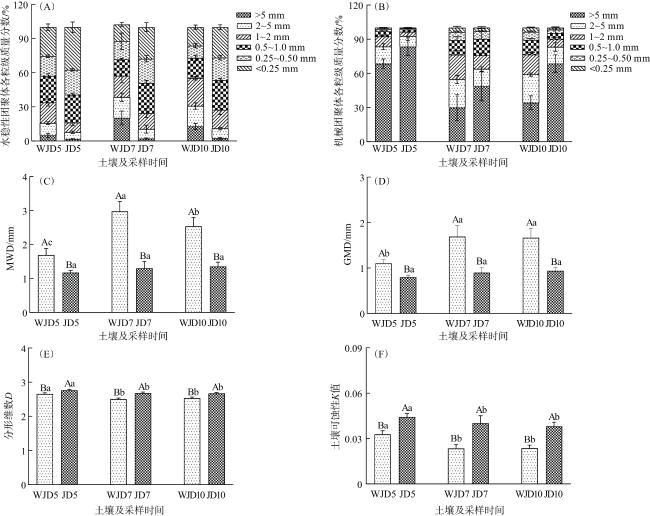
干筛分析发现,>5 mm粒级团聚体的质量分数在各个季节均占比最高,且长期耕作土壤均高于未耕作土壤,春季、夏季和秋季分别高出21.85%、62.28%和100.74%,不同季节之间表现为春季>秋季>夏季(图1B);而长期耕作土壤的其他粒级团聚体(0.5~1.0 mm除外)的质量分数均低于未耕作土壤。这说明长期耕作更易导致土壤板结。
长期耕作会改变土壤水稳性团聚体的组成,进而改变其稳定性。由图1(C~F)可知,长期耕作后,土壤团聚体水稳性参数MWD、GMD均明显低于未耕作土壤(P˂0.05),分别降低30.57%~56.33%和27.49%~46.91%,而分形维数D和土壤可蚀性K值均明显高于未耕作土壤(P˂0.05),分别提高3.95%~6.88%和35.06%~70.64%。随着季节变化,长期耕作土壤中MWD和GMD逐渐升高,而未耕作土壤中MWD和GMD均表现为夏季>秋季>春季。土壤分形维数D和土壤可蚀性K值均表现为春季明显高于夏季和秋季(P˂0.05),夏季和秋季之间差异无统计学意义(P>0.05)。
长期耕作后,机械团聚体WSA0.25(>0.25mm的团聚体相对质量分数,干筛)均高于未耕作土壤,不同季节之间表现为春季>秋季>夏季;而水稳性团聚体WSA0.25(湿筛)均明显低于未耕作土壤(P˂0.05),不同季节之间表现为夏季>秋季>春季(表1)。长期耕作后,土壤团聚体的破坏率均明显高于未耕作土壤(P˂0.05),春季、夏季、秋季分别高50.98%、127.66%和97.05%。说明长期耕作后,土壤团聚体更容易分散,保水保肥及抗水侵蚀能力下降,夏季尤为突出。
表1 不同季节长期耕作下土壤团聚体破坏率的变化 |
| 项目名称 | WJD5 | WJD7 | WJD10 | JD5 | JD7 | JD10 |
|---|---|---|---|---|---|---|
| WSA0.25(干筛) | 98.76±0.18 Aa | 95.94±0.61 Ab | 96.22±0.30 Bb | 99.39±0.15 Aa | 96.73±0.48 Ab | 98.28±0.37 Aa |
| WSA0.25(湿筛) | 74.51±1.27 Ab | 85.26±0.71 Aa | 83.80±0.85 Aa | 62.54±2.03 Bb | 72.29±1.77 Ba | 73.30±0.93 Ba |
| PAD | 24.56±1.29 Ba | 11.10±1.18 Bb | 12.90±0.86 Bb | 37.08±2.04 Aa | 25.27±1.71 Ab | 25.42±0.84 Ab |
|
2.2 长期耕作对黑土中有机碳及其组分的影响
由图2可知,长期耕作后,土壤SOC、ROC、DOC、PMC含量均低于未耕作土壤,分别下降9.23%~24.13%、0.93%~12.01%、41.79%~91.63%和22.66%~27.83%,其中春季和夏季SOC、DOC和PMC含量与未耕作土壤之间差异具有统计学意义(P˂0.05)。春季和夏季,长期耕作土壤中的LFOC含量低于未耕作土壤,而在秋季高于未耕作土壤;不同采样时间土壤的HFOC含量略有增减,差异无统计学意义(P>0.05)。
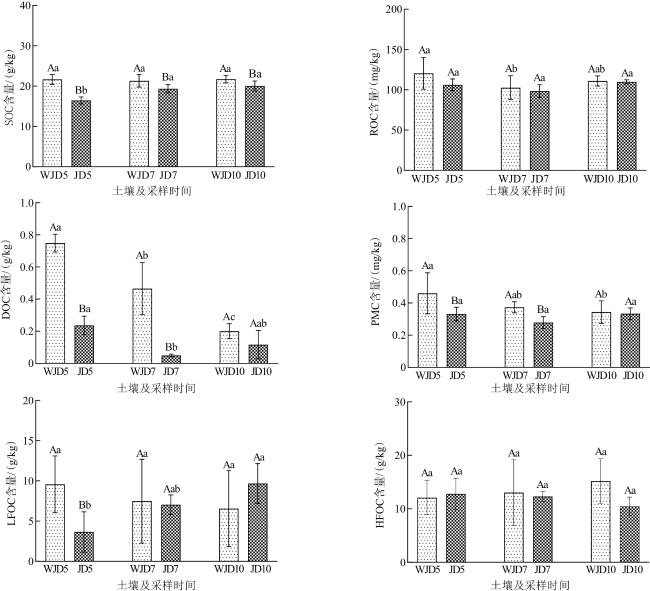
由图2可知,在未耕作土壤中,随着季节变化,SOC、LFOC、HFOC含量均未表现出明显差异(P>0.05),而ROC含量是呈先降低后升高的趋势,DOC和PMC含量呈逐渐降低趋势。在长期耕作土壤中,ROC、PMC和HFOC含量在季节间无明显差异,SOC和LFOC含量呈逐渐升高趋势,而DOC含量在春季土壤中最高。
2.3 长期耕作对黑土其他理化性质的影响
由表2可知,长期耕作后,土壤WC和pH均明显低于未耕作土壤(P˂0.05),说明长期耕作使土壤保水性降低,土壤酸化。长期耕作后,土壤TN含量除秋季略低外,春季和夏季均明显低于未耕作土壤(P˂0.05);而AP和AK含量均明显高于未耕作土壤(P˂0.05)。
表2 不同季节长期耕作下土壤理化性质的变化 |
| 理化性质 | WJD5 | WJD7 | WJD10 | JD5 | JD7 | JD10 |
|---|---|---|---|---|---|---|
| WC/% | 28.41±0.48 Aa | 22.20±0.61 Ab | 22.55±0.42 Ab | 25.04±0.15 Ba | 19.71±0.77 Bb | 20.75±0.59 Bb |
| pH | 7.11±0.22 Aa | 6.81±0.17 Aab | 6.57±0.06 Ab | 6.32±0.11 Ba | 6.04±0.11 Ba | 6.03±0.07 Ba |
| TN/(g/kg) | 2.30±0.12 Ab | 2.62±0.11 Aa | 2.32±0.02 Ab | 1.91±0.03 Bb | 2.24±0.05 Ba | 2.13±0.05 Aa |
| AP/(mg/kg) | 6.06±0.80 Ba | 7.64±1.12 Ba | 5.75±0.50 Ba | 14.56±1.79 Ab | 31.73±5.31 Aa | 22.64±2.34 Ab |
| AK/(mg/kg) | 460.64±21.51 Ba | 454.21±30.59 Ba | 433.76±24.12 Ba | 560.34±21.25 Ac | 778.11±46.61 Aa | 677.43±40.44 Ab |
由表2可知,随着季节变化,长期耕作土壤WC呈先降低后升高趋势;pH呈逐渐降低趋势;而TN、AP和AK含量均呈先升高后降低趋势。这说明季节对长期耕作土壤中的理化性质影响较大。
2.4 土壤有机碳及其组分之间的相关性
土壤有机碳及其各组分之间的相关性具有一定差异(表3)。其中,SOC与LFOC,DOC与PMC呈正相关(P˂0.01),DOC与ROC、SOC呈正相关(P˂0.05),而LFOC与HFOC呈负相关(P˂0.01)。
表3 土壤不同有机碳组分之间的相关性 |
| 有机碳组分 | ROC | DOC | PMC | LFOC | HFOC |
|---|---|---|---|---|---|
| SOC | 0.362 | 0.466* | 0.266 | 0.570** | 0.126 |
| ROC | 0.551* | -0.026 | 0.288 | -0.052 | |
| DOC | 0.743** | 0.351 | 0.028 | ||
| PMC | 0.077 | 0.123 | |||
| LFOC | -0.743** |
|
2.5 土壤水稳性团聚体与理化性质之间的关系
由图3可知,土壤大粒径水稳性团聚体质量分数、稳定性参数MWD、GMD与土壤pH、SOC呈正相关(P˂0.05),而土壤小粒径水稳性团聚体质量分数及稳定性参数D、K与土壤AK和AP之间呈正相关(P˂0.05)。
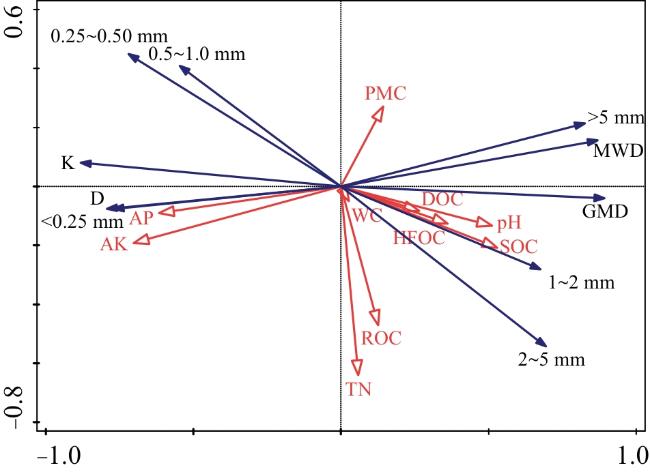


RDA分析表明,土壤的AK、AP、SOC、pH是影响土壤水稳性团聚体变化的环境因子,其环境解释分别为30.4%、23.2%、18.8%和16.4%(表4)。说明土壤水稳性团聚体对土壤环境变化较为敏感。理化因子共解释了73.7%水稳性团聚体变化,其中AK(P=0.003 33)、WC(P=0.008 00)和pH(P=0.014 00)是影响土壤水稳性团聚体及其稳定性发生变化的主要影响因子,环境解释分别为30.4%、15.2%和10.4%。长期耕作后土壤水稳性团聚体及其稳定性发生明显的变化,这主要是由土壤理化环境因子变化引起的。
表4 黑土水稳性团聚体变化的环境解释 |
| 理化因子 | 单独效应 | 条件效应 | ||
|---|---|---|---|---|
| 解释率/% | P | 解释率/% | P | |
| AK | 30.4 | 0.001 33** | 30.4 | 0.003 33** |
| AP | 23.2 | 0.012 00* | 1.0 | 0.651 33 |
| SOC | 18.8 | 0.033 33* | 5.1 | 0.088 67 |
| pH | 16.4 | 0.036 00* | 10.4 | 0.014 00* |
| HFOC | 8.8 | 0.158 00 | 0.8 | 0.732 00 |
| DOC | 4.5 | 0.371 33 | 1.7 | 0.441 33 |
| TN | 4.1 | 0.394 67 | 5.8 | 0.070 00 |
| ROC | 3.1 | 0.517 33 | 2.0 | 0.388 00 |
| LFOC | 2.5 | 0.602 67 | ||
| PMC | 2.2 | 0.620 00 | 1.3 | 0.558 00 |
| WC | 0.3 | 0.960 67 | 15.2 | 0.008 00** |
|
2.6 土壤有机碳及其组分与土壤理化性质之间的关系
由表5可知,pH和WC均与土壤中DOC、ROC含量呈正相关(P˂0.01),与PMC含量呈正相关(P˂0.05);而AP和AK与DOC含量呈负相关(P˂0.05)。说明pH、WC、AP和AK是影响土壤中有机碳及其组分的主要环境因子。
表5 土壤有机碳及其组分与土壤理化性质之间的相关性 |
| 土壤理化性质 | SOC | DOC | ROC | PMC | HFOC | LFOC |
|---|---|---|---|---|---|---|
| pH | 0.411 | 0.813** | 0.567** | 0.460* | -0.006 | 0.268 |
| WC | 0.128 | 0.780** | 0.658** | 0.512** | -0.154 | 0.228 |
| TN | 0.697** | 0.210 | -0.095 | 0.260 | 0.366 | 0.097 |
| AP | -0.359 | -0.511* | -0.405 | -0.359 | -0.154 | -0.080 |
| AK | -0.380 | -0.457* | -0.428 | -0.368 | -0.161 | -0.089 |
3 结论与讨论
季节会影响土壤团聚体的组成和稳定性。在本研究中,干筛后,夏季土壤中>5 mm粒径团聚体质量分数低于春季和秋季,可能是受夏季土壤中植被覆盖,植物根系穿插生长,以及降水等自然因素和除草、施肥、滴灌等人为因素影响。而对于水稳性团聚体,未耕作土壤中,夏季和秋季>1 mm粒径质量分数以及MWD、GMD均高于春季。说明春季土壤易结块板结,长期耕作土壤中水稳性团聚体组成和稳定性受季节影响较小。
长期耕作后土壤中SOC、DOC和PMC含量(除秋季外)均明显低于未耕作土壤。随着季节变化,未耕作土壤中DOC、PMC和LFOC含量均逐渐降低,而HFOC含量逐渐升高。这主要是因为长期耕作旱田土壤,大规模机械操作使土壤团聚体被破坏,有机质矿化速度加快,导致有机碳含量降低。未耕作土壤因无人为扰动,且杂草丛生,通过增加养分输入和促进团聚体形成,为微生物活动创造了有利的环境,这导致微生物生物量和酶活性大幅增加,最终增加土壤碳矿化程度[26]。
长期耕作后,大粒径水稳性团聚体组成比例降低,而小粒径水稳性团聚体含量升高,有机碳含量也降低。这可能是长期耕作导致大粒径水稳性团聚体破碎,使土壤颗粒与有机质结合,形成小粒径团聚体。小粒径团聚体比例增大可能会阻碍有机质的有效包裹和积累,限制其进入土壤,而小粒径团聚体比例降低影响了有机质和土壤颗粒整合和有机质的固存[8-9]。长期耕作后土壤全氮含量降低,会引起土壤C/N比改变,也会影响土壤微生物活性,从而减少土壤有机碳的固存。保护性耕作与有机耕作具有改善土壤质量和增加土壤有机碳的潜力[27]。在集约化稻麦系统下,焚烧或清除作物秸秆会降低碳的可持续性,从而对作物生产力和土壤质量产生不利影响[28]。在小麦收获与水稻种植之间设置合理间隔期,以减少耕作强度、保留作物残茬并种植豆科绿肥为核心的保护性农业模式,为农田生态系统碳库的可持续恢复提供了有效途径。因此,在黑土保护过程中,可以结合秸秆还田、有机耕作等方式提高土壤有机碳及其组分含量。
综上,本研究分析了长期耕作后黑土区土壤团聚体和有机碳组分变化特征,发现长期耕作降低了大粒径水稳性团聚体比例和水稳性参数MWD、GMD,从而改变了土壤团粒结构的稳定性,使土壤抗侵蚀能力下降。长期耕作还促进土壤酸化,有机碳及其组分含量明显降低。速效钾、含水率和pH是影响黑土水稳性团聚体以及有机碳组分变化的主要环境因子。本研究为黑土耕地土壤改良保护和合理高效施肥提供参考,对促进土壤养分可持续利用及区域生态环境建设具有重要意义。