

1 材料与方法
1.1 试验地基本情况
试验地位于湖南省益阳市桃江县灰山港镇灰山港村,该地属中亚热带大陆性季风湿润气候区,年平均降水量1 551.7 mm,无霜期270 d左右,年平均气温16.6 ℃,日照时数4 425 h,雨热同期。试验地土壤(0~20 cm)基本理化性质:pH 6.2,土壤阳离子交换量(CEC)14.70 cmol/kg,缓效钾含量537.00 mg/kg,速效钾含量497.00 mg/kg,速效磷含量90.50 mg/kg,碱解氮含量228.00 mg/kg,有机质含量53.10 g/kg,全钾含量13.50 g/kg,全磷含量1.81 g/kg,全氮含量2.60 g/kg。土壤总体肥力水平较高,养分水平不平衡,有机质含量较高,速效养分含量超标。
1.2 供试材料
供试辣椒品种:湘研2307。
供试肥料:有机肥(N∶P∶K为1.3∶2.3∶2.6,有机质含量>45%),复合肥(N∶P∶K为15∶15∶15),尿素(46% N),过磷酸钙(16% P2O5),硫酸钾(50% K2O),肥料均购自当地农贸市场。
1.3 试验设计
试验设置5个处理,分别为CK空白对照(不施肥)、T1常规施肥(施用复合肥100 kg/667 m2)、T2化肥优化施肥(减氮20%、减磷60%、减钾46.7%)、T3有机无机配施(在T2基础上有机肥替代15%化学氮肥)、T4有机无机配施(在T2基础上有机肥替代30%化学氮肥),具体施肥方案见表1。每处理设3次重复,随机区组排列,小区面积为13 m2。肥料全部作基肥施入。
表1 各处理具体施肥方案 |
| 处理 | 化学养分投入量 | 化学肥料施用量 | 有机肥用量 | |||||
|---|---|---|---|---|---|---|---|---|
| 氮 | 磷 | 钾 | 复合肥 | 尿素 | 过磷酸钙 | 硫酸钾 | ||
| CK | 0 | 0 | 0 | 0 | 0 | 0 | 0 | 0 |
| T1 | 15.00 | 15.00 | 15.00 | 100 | 0 | 0 | 0 | 0 |
| T2 | 12.00 | 6.00 | 8.00 | 0 | 26.09 | 37.50 | 16.00 | 0 |
| T3 | 10.20 | 6.00 | 8.00 | 0 | 22.17 | 37.50 | 16.00 | 138.00 |
| T4 | 8.40 | 6.00 | 8.00 | 0 | 18.26 | 37.50 | 16.00 | 277.00 |
1.4 测定项目及方法
1.4.1 作物生长指标
在辣椒结果盛期,每个小区选择5株长势一致的辣椒,用直尺测量植株株高、幅宽,用游标卡尺测量辣椒果实纵径、横径,用电子天平测量单果重,并计算产量。
1.4.2 作物品质指标
1.4.3 土壤理化性指标
在辣椒收获后进行土壤样品采集。取0~20 cm表层土壤,采集15个点,多点混合为1个样品。对土壤样品进行编号,自然风干后研磨过筛和分装。参照《土壤农化分析》[9]方法测定土壤全氮、全磷、全钾、碱解氮、速效磷、速效钾和有机质含量以及pH。
1.5 数据处理
基础数据的记录和处理使用Excel软件,处理间显著性差异分析使用SPSS 24软件,使用Origin 2021软件绘制图表。
2 结果与分析
2.1 有机肥替代化肥对辣椒生长及产量的影响
2.1.1 对辣椒生长发育的影响
有机肥替代化肥处理(T3、T4)的辣椒株高和幅宽均较其他处理明显提升(P<0.05);T1处理的植株幅宽最小,可能由地块养分差异引起。T4处理的辣椒果实纵径和横径与其他处理差异具有统计学意义(P<0.05)(表2)。综合来看,有机肥替代化肥对辣椒的生长发育有一定的促进作用,其中替代比例为30%(T4)的效果更佳。
表2 不同处理下辣椒生长发育情况差异 |
| 处理 | 植株株高/cm | 植株幅宽/cm | 果实纵径/cm | 果实横径/cm |
|---|---|---|---|---|
| CK | 88.28±0.16 e | 79.37±0.70 c | 12.07±0.12 c | 2.16±0.21 bc |
| T1 | 90.37±0.13 d | 67.85±1.48 e | 13.05±0.17 b | 1.92±0.63 d |
| T2 | 90.74±0.81 c | 74.39±0.77 d | 12.39±0.22 c | 1.94±0.75 cd |
| T3 | 91.62±0.12 b | 83.54±1.11 b | 13.34±0.20 b | 2.17±0.76 b |
| T4 | 92.13±0.93 a | 86.43±0.61 a | 13.75±0.12 a | 2.45±0.90 a |
|
2.1.2 对辣椒单果重及产量的影响
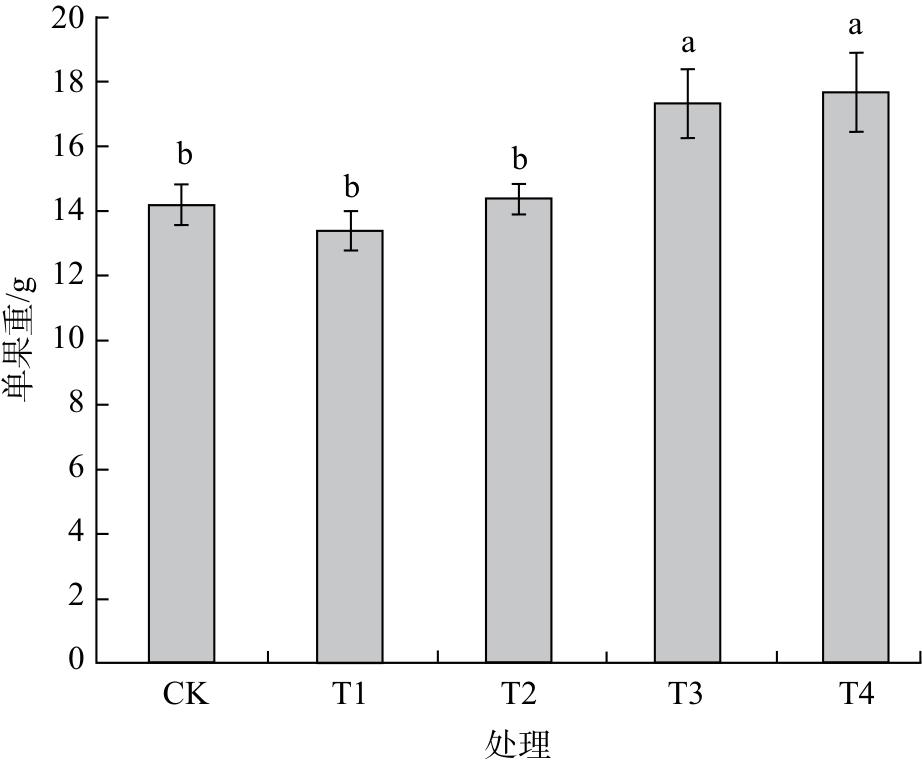
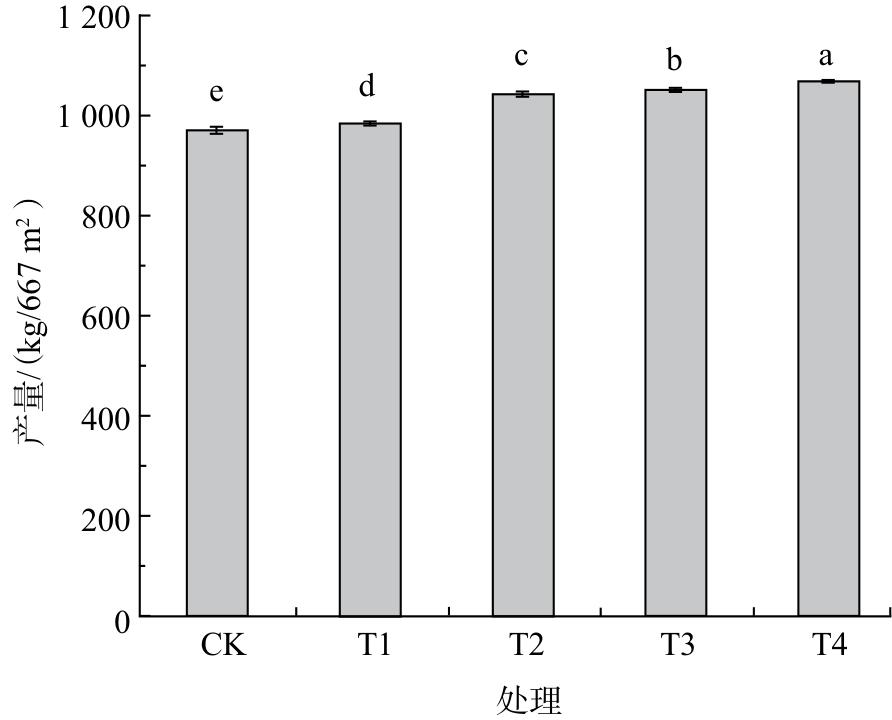
2.2 有机肥替代化肥对辣椒品质的影响
2.2.1 对辣椒维生素C含量的影响
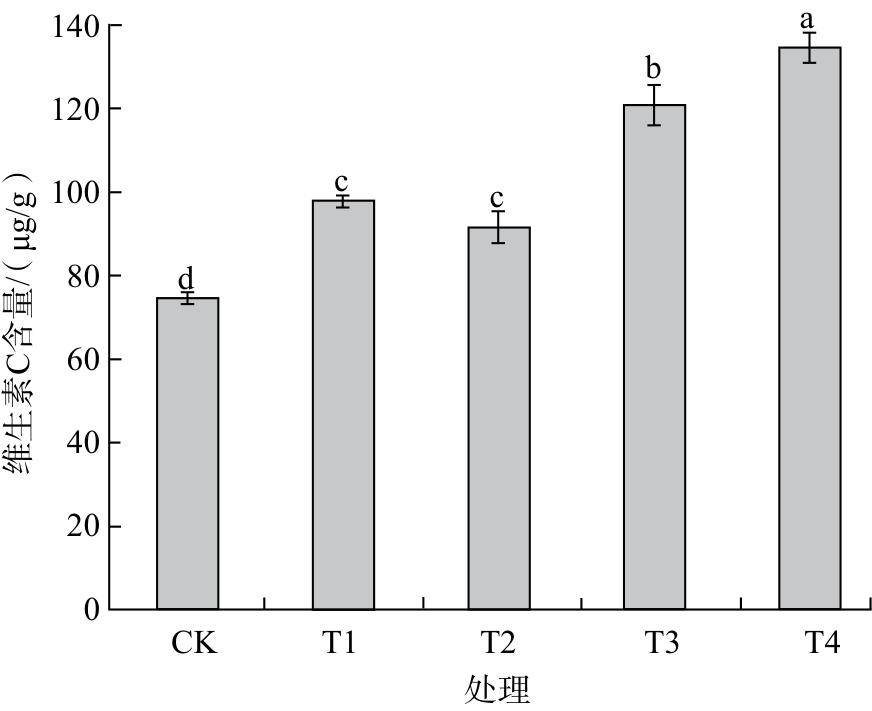
如图3所示,各处理辣椒果实的维生素C含量分别为74.57、97.73、91.44、120.69和134.48 μg/g,其大小关系为T4>T3>T1>T2>CK。有机肥替代化肥处理(T3、T4)的辣椒果实维生素C含量明显高于CK、T1和T2处理(P<0.05)。说明有机肥替代化肥能有效提升辣椒果实的维生素C含量,并在一定范围内,有机肥替代比例越高,辣椒果实的维生素C含量越高。
2.2.2 对辣椒可溶性蛋白含量的影响
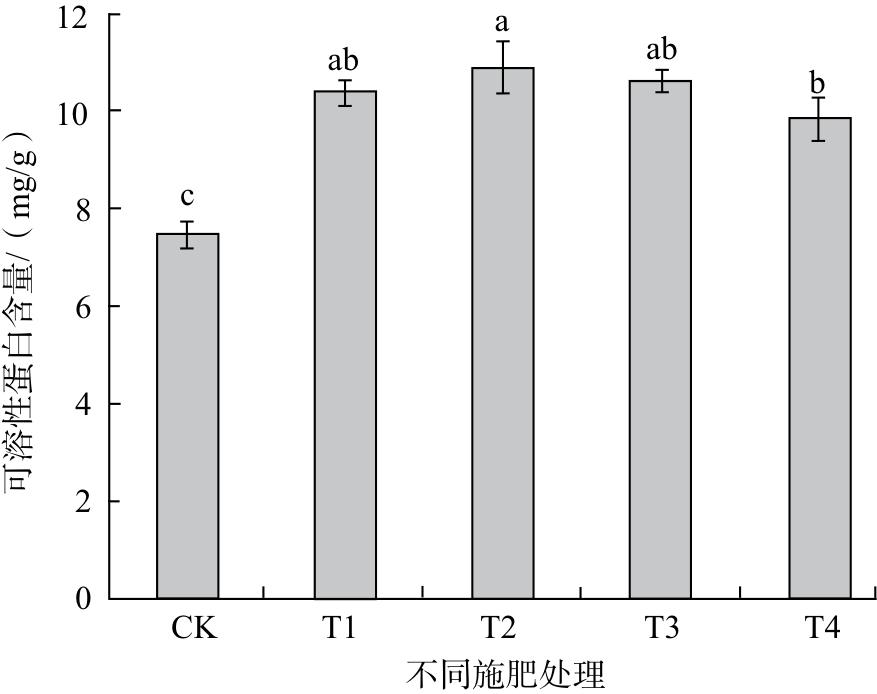
如图4所示,与CK相比,T1~T4施肥处理的辣椒果实可溶性蛋白含量均明显提高(P<0.05),分别提高了38.87%、45.44%、43.36%和31.77%。有机肥替代化肥处理(T3、T4)的辣椒可溶性蛋白含量与常规施肥处理(T1)差异无统计学意义(P>0.05),T4处理的辣椒可溶性蛋白含量较T3处理稍低,差异无统计学意义(P>0.05)。表明在一定范围内,有机肥替代化肥可以维持辣椒果实可溶性蛋白含量,与常规施肥无明显差异。
2.2.3 对辣椒可溶性糖含量的影响
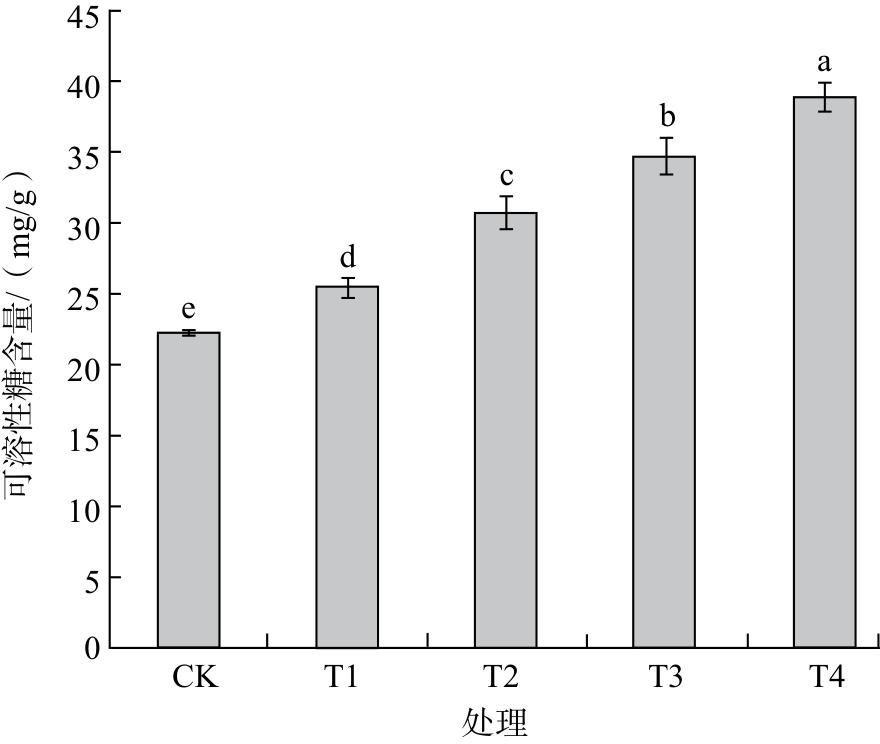
由图5可知,与CK相比,T1~T4处理的辣椒果实可溶性糖含量分别提高14.21%、37.86%、56.07%和74.78%,处理间差异具有统计学意义(P<0.05)。其中,有机肥替代化肥处理的辣椒果实可溶性糖含量均明显高于其他处理(P<0.05),且随有机肥替代化肥的比例增加而增加。
2.2.4 对辣椒硝酸盐含量的影响


2.3 有机肥替代化肥对土壤理化性质的影响
如表3所示,与常规施肥(T1)相比,有机肥替代化肥处理的土壤全氮、全磷、全钾含量差异无统计学意义(P>0.05),碱解氮和速效钾含量明显降低,土壤pH明显提高(P<0.05);T4处理的土壤有机质含量最高,与其他处理差异具有统计学意义(P<0.05)。说明有机肥替代化肥能有效增加土壤有机质含量,提高肥料利用率,减少土壤养分的流失。
表3 辣椒地收获后土壤理化性状 |
| 处理 | 全氮/(g/kg) | 全磷/(g/kg) | 全钾/(g/kg) | 有机质/(g/kg) | 碱解氮/(mg/kg) | 速效磷/(mg/kg) | 速效钾/(mg/kg) | pH |
|---|---|---|---|---|---|---|---|---|
| CK | 1.41 b | 1.75 c | 10.71 d | 50.19 c | 176.24 d | 87.24 d | 441.08 e | 6.15 b |
| T1 | 1.46 a | 1.80 ab | 11.11 ab | 50.54 b | 186.28 a | 93.68 b | 466.94 a | 6.15 b |
| T2 | 1.45 a | 1.78 bc | 10.92 c | 50.58 b | 181.78 b | 92.27 c | 443.01 d | 6.15 b |
| T3 | 1.43 ab | 1.81 a | 11.17 a | 50.76 b | 181.05 c | 94.10 a | 447.02 c | 6.19 a |
| T4 | 1.43 ab | 1.79 a | 11.04 b | 51.30 a | 181.68 b | 94.15 a | 460.21 b | 6.20 a |
3 结论与讨论
本研究表明,有机肥替代化肥可有效提升辣椒植株与果实的生长发育水平,有机肥替代化肥比例越高,辣椒株高、幅宽,果实纵径和横径生长指标越高。本试验中在有机肥替代30%化学氮肥处理(T4)时各项数据均达到最高值。在其他作物的有机肥替代化肥试验研究中也得出类似结果,例如,殷武平等[10]研究表明,有机肥替代化肥施用可促进苋菜生长,提高苋菜产量和氮素利用率,改善品质。张婷等[11]研究发现,化肥减量20%+生物有机肥3 000 kg/hm2处理的菜心产量最高,较不施肥处理增产33.89%。孙桂兰等[12]研究得出,生物有机肥替代40%化肥情况下,与单施化肥相比,棉花籽棉产量增加10.3%,皮棉产量增加6.4%。
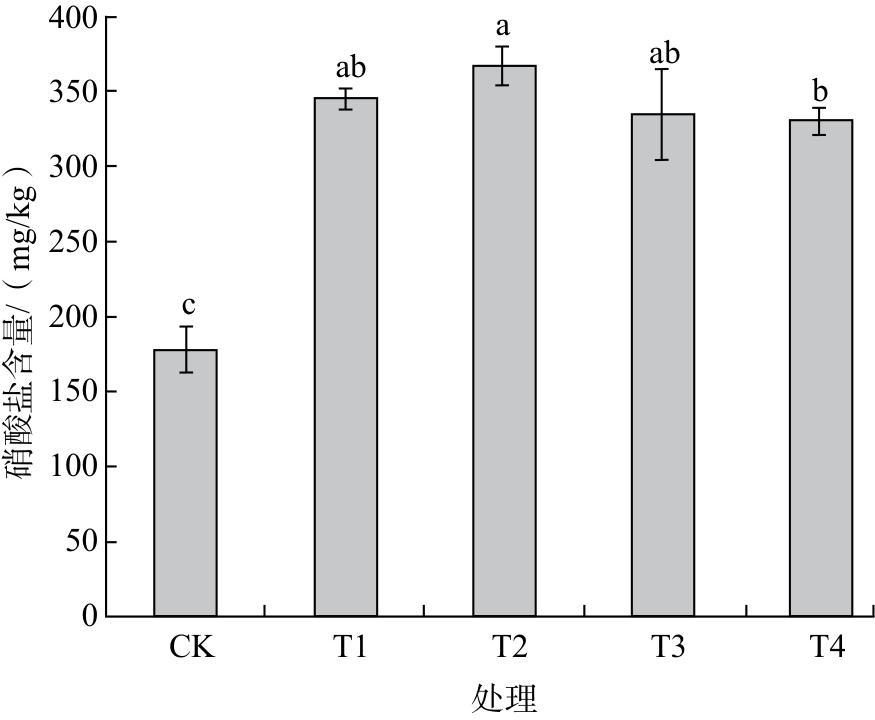
从果实品质指标来看,本研究发现有机肥替代化肥能明显改善辣椒的部分品质,相较于常规施肥处理(T1),有机肥替代化肥后辣椒的维生素C、可溶性糖含量均显著提高,硝酸盐含量有所降低;可溶性蛋白含量呈先上升后降低的趋势。其他相关研究也得出类似结果,例如,袁奇等[13]研究发现,有机肥替代化肥后,蔬菜品质得到有效改善,茄子和包菜的维生素C和可溶性糖含量增加,硝酸盐含量降低。有机肥替代化肥后辣椒果实硝酸盐含量降低,主要原因是有机肥属于缓效氮肥,施用到土壤后需经过微生物的作用逐步转化为速效营养物质,再被作物吸收和利用。因此,化肥和有机肥配合施用能有效降低蔬菜中的硝酸盐含量,改善蔬菜的品质。
综上,有机肥替代化肥可有效提高辣椒的生长发育水平和产量,同时对辣椒的维生素C、可溶性糖含量均有显著提升作用,对硝酸盐含量也有一定降低作用。有机肥替代化肥还能有效增加土壤有机质含量,提高肥料利用率,减少土壤养分的流失。