

马铃薯是茄科茄属块茎类草本植物,是一种粮菜饲兼用作物,具有抗旱、耐寒、耐贫瘠、适应广泛、营养全面、加工用途多和产业链长等优势,对于保障粮食安全具有重要意义[1]。近年来,马铃薯产量受病毒病影响较大。该作物属于无性繁殖,长期种植过程中可能受到病毒感染,其在植株体内繁殖、传递并累积,会引起种薯退化,造成产量降低和品质下降[2]。目前已报道的马铃薯侵染病毒和类病毒有40多种,其中发生率较高、危害较大的有马铃薯X病毒(PVX)、马铃薯Y病毒(PVY)、马铃薯A病毒(PVA)、马铃薯S病毒(PVS)、马铃薯M病毒(PVM)和马铃薯卷叶病毒(PLRV)6种。不同地区病毒病发生情况存在差异,南方地区以PVX发生较重,北方地区以PVY发生较重[3]。马铃薯病毒感染后主要表现症状为植株矮小、簇生,茎秆纤细,长势衰弱,叶片卷曲缩皱、叶色斑驳失绿、叶脉坏死,薯块变小、畸形开裂、内部呈褐色网纹状坏死等[4]。当前,采用茎尖剥离组织培养技术进行脱毒处理是解决种薯退化的有效途径之一。该技术利用了植株体内病毒分布不均衡的特点,即茎尖组织不带病毒或病毒含量极低。原因是茎尖分生组织的细胞分裂活动旺盛,消耗了大量营养物质,导致其营养物质不足以支持病毒的复制活动。同时,病毒在植株体内主要通过维管束移动,而分生组织内不存在维管束,只能通过胞间连丝移动,速度缓慢[5]。因此,利用植物组织培养技术进行马铃薯茎尖脱毒和快繁,可使马铃薯种性得到恢复,产量和品质进一步提高。实际生产中,由于组培技术无菌操作要求高、技术环节复杂,可能会遇到各种问题。本文系统阐述了马铃薯茎尖脱毒组织培养技术全流程,并总结了其常见问题及应对策略,为脱毒种薯生产提供参考。
1 茎尖脱毒组织培养技术流程
马铃薯茎尖脱毒组织培养技术流程如图1所示。首先需确定脱毒的品种,在田间选择具有该品种特性的健康植株留种,待块茎发芽后经过外植体预处理、茎尖剥离和初代试管苗培养。培养的初代苗经病毒检测合格后进入试管苗增殖扩繁。
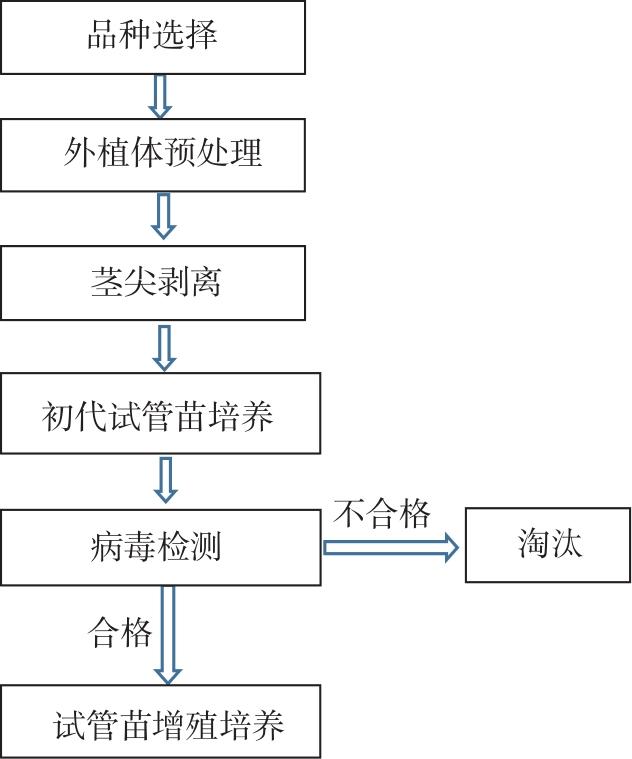


1.1 初代试管苗培养
1.1.1 外植体预处理
从发芽的健康马铃薯块茎上切取2 cm长的顶芽或侧芽,在75%乙醇溶液中浸泡15 s,用无菌水冲洗2次;然后在0.1%氯化汞溶液中浸泡8~10 min(或5%次氯酸钠溶液中浸泡20 min),用无菌水冲洗3~5次,每次冲洗5 min,之后置于无菌培养基中培养[6]。为提高脱毒效果,可对发芽的块茎进行热疗法、电疗法或冷冻疗法预处理,一般采用热疗法(将发芽块茎置于37 ℃条件下处理28 d)。
1.1.2 培养基制备
为诱导茎尖分生组织分化形成完整植株,通常以MS培养基为基础培养基,添加各种植物生长调节剂。马铃薯茎尖组织培养常用生长素包括萘乙酸(NAA)、吲哚乙酸(IAA)、2,4-二氯苯氧乙酸(2,4-D)、赤霉素(GA3)等,细胞分裂素包括6-苄氨基嘌呤(6-BA)、6-糠氨基嘌呤(KT)、玉米素(ZT)等。杨凉花[7]研究表明,MS培养基添加0.5 mg/L NAA+0.5 mg/L 6-BA+30 g/L蔗糖+7 mg/L琼脂,马铃薯茎尖分化及成活率较高。黄萍等[8] 研究指出,MS+0.5 mg/L NAA+0.5 mg/L 6-BA+0.1 mg/L GA3+30 g/L蔗糖+6~9 g/L琼脂是适宜的马铃薯茎尖诱导培养基。调节培养基溶液pH至5.8,使用高压高温灭菌锅(0.101 MPa、120 ℃)灭菌20 min。
1.1.3 茎尖剥离
在40倍双目立体显微镜下,用灭菌解剖针层层剥离幼叶,切取0.2~0.3 mm带有1~2个叶原基的茎尖,接种于准备好的培养基上。茎尖一般切取0.2~0.3 mm,茎尖过长,成活率高但脱毒率降低;茎尖过短,脱毒率较高但成活率较低。
1.1.4 培养条件
将接种有茎尖分生组织的试管置于培养室,设置温度20~25 ℃,光暗周期16 L:8 D,光照强度2 000~3 000 lx。诱导培养3~6个月,其间在同样的培养基上转接1~2次,最终形成完整的小植株为初代试管苗[9]。
1.2 病毒检测
将初代苗扩繁到一定数量后需进行病毒检测。检测方法包括生物学鉴定、电子显微镜鉴定、血清学鉴定和分子生物学鉴定。
1.2.1 生物学鉴定
根据寄主植物被病毒侵染后产生的特异性症状鉴定病毒病的一种简单方法。通常选用的指示植物包括千日红、白花刺果曼陀罗、花曼陀罗、洋酸浆等。该方法耗时长、灵敏度较低,可作为血清学和分子生物学鉴定的初步鉴定[10]。
1.2.2 形态学鉴定
将待检测样品制片,通过电子显微镜直接观察,根据病毒粒子的形态、大小、内含体组成、亚结构等判断病毒种类[10]。
1.2.3 血清学鉴定
利用抗原与抗体发生的特异性反应,以及酶对底物的催化作用进行鉴定。血清学方法主要有琼脂双扩散法、酶联免疫吸附法(ELISA)等,其中ELISA具有灵敏度高、检测速度快、操作简单等优势,被广泛应用[10]。
1.2.4 分子生物学鉴定
该方法是通过检测样品中病毒的核酸来判断病毒种类,较其他方法更加可靠。常用的检测技术有核酸杂交(NASH)、聚合酶链式反应(PCR)等。其中PCR技术特异性强、重复性好、简单、敏感等优点,是当前病毒检测的主要方式之一[10]。
1.3 试管苗增殖培养
2 常见问题及对策
在马铃薯茎尖脱毒组织培养过程中,由于外植体材料特性、环境条件等多种因素的影响,常出现组培苗污染、玻璃化和褐化等现象,这些问题的发生不仅影响脱毒效率,也对种苗质量和后续生产造成威胁,因此需系统分析其成因并采取相应防控策略。
2.1 污染
组培污染病原菌主要分为细菌、真菌和内生菌3类。细菌性污染出现较早,一般在接种后1~2 d出现,培养基或材料表面有黄色或乳白色黏液;引起细菌污染的原因包括接种材料和培养基灭菌不彻底、接种人员操作不规范、工具消毒不到位等。真菌性污染通常在接种后5~10 d出现,初期为针状雾斑,之后产生菌丝,形成黑、白、黄、绿各色孢子;引起真菌污染的主要原因是瓶口封口不严或培养室空气中病原孢子浓度过大。内生菌污染主要由于外植体表面灭菌不彻底导致,通常在繁殖初期不易发现,随着繁殖代数增加,内生菌污染显现,进而造成大部分瓶苗被污染[14]。
污染防治措施主要为严格执行无菌操作规程,确保培养基、接种室、培养室、工作人员衣物及操作器具消毒彻底。培养基灭菌时注意灭菌锅内冷空气排放,灭菌后无菌环境放置3 d,检查灭菌效果。接种室内采用紫外灯照射和75%乙醇表面消毒。培养室采用50 mL甲醛+15 g高锰酸钾熏蒸法密闭12 h进行消毒,每7 d熏蒸1次。培养室污染瓶苗灭菌后统一销毁[14]。
2.2 玻璃化
2.3 褐化
试管苗褐化是指外植体在离体培养过程中,培养物伤口处分泌的褐色物质影响其自身正常生长或导致死亡的现象。关于褐化发生机理通常有两种观点。一是酚类物质的酶促反应,由多酚氧化酶与天然底物酚类物质作用而形成醌类物质。在自然条件下,植物细胞内的酚类物质和多酚氧化酶在不同区域独立分布,酚类物质位于液泡中,多酚氧化酶位于质体和细胞质中,通常与膜相结合呈潜伏状态;当植物体受到机械损伤时,膜结构被破坏,多酚氧化酶被活化并与酚类物质接触,从而在培养物伤口处发生氧化反应形成醌类物质。二是在组织培养过程中,外植体被切割,切口处的组织或细胞接触培养基产生了应激防御反应,进而形成醌类物质。同时,也有研究发现,不利的培养条件或环境胁迫会导致外植体褐化现象的发生[20-22]。龚晓洁[23]研究表明,在培养基中添加防褐剂有助于抑制组织培养外植体褐化现象发生,其中硫代硫酸钠和柠檬酸可将褐化率降至15%以下。
3 结语
综上,本文阐述了马铃薯茎尖脱毒组织培养技术流程,总结了其常见问题和应对策略。马铃薯茎尖脱毒组织培养技术流程包括外植体预处理、茎尖剥离、初代试管苗培养、病毒检测、试管苗增殖培养等。茎尖生长点的诱导培养基及增殖培养基均以MS培养基为基础培养基,灭菌及培养环境条件基本一致,其中添加的植物生长调节剂种类和数量需根据品种特性确定;试管苗病毒检测常采用酶联免疫吸附法和PCR技术等;病毒检测合格后可进入增殖培养阶段。组织培养过程中,可能因无菌操作不规范、培养光温不适宜、外植体酶促反应等造成组培苗污染、玻璃化和褐化;可通过规范无菌操作流程、调节昼夜温差、添加柠檬酸等防褐剂,减少组培苗污染、玻璃化和褐化概率。未来研究可探索开放式培养模式,以简化组织培养操作程序。本文为马铃薯茎尖脱毒组织培养提供参考。