

近年来,随着全球变暖趋势持续加剧,地区极端天气频繁发生。尽管养殖设施不断改进,但高温仍是家禽养殖行业面临的严峻挑战。尤其在当前集约化规模养殖模式下,热应激已成为影响家禽养殖产业发展的重要因素。当环境温度超过家禽的热舒适区时,其机体会出现热应激反应,导致采食量下降、生长性能、肠道免疫能力和繁殖能力等降低[1]。Awad等[2]研究表明,热应激能够降低肉鸡的日增重和饲料转化率。邓谭杰等[3]研究表明,高温会使家禽免疫细胞受损。Abd等[4]研究表明,持续1 d的30 ℃高温会明显改变家禽肠道的形态与微生物群落,增加致病菌附着的机会。此外,热应激会导致母鸡性成熟期及开产日龄推迟[5];对于公鸡,除了延迟性成熟日龄,还会影响精子发生与形成[6]。尽管这些不利影响可以通过环境调控和营养补充来缓解,但在节能减排、减抗趋势下,天然有效的植物来源活性产物在家禽热应激防治药物研发中显示出了较大的应用潜力[7-9]。
迷迭香酸是一种天然酚酸类化合物,存在于多种植物中,如紫草科、唇形科植物等,具有潜在的抗炎、抗氧化和抗菌等特性[10-11]。该化合物在动物生产中应用较为广泛。例如,饲料中加入迷迭香酸可以提高肉鸡的抗氧化活性[12];能有效减缓大肠杆菌感染仔猪引起的腹泻和炎症反应[13];增加了肉鸡血清中的免疫球蛋白,降低了促炎因子,增强了肉鸡的免疫机能[14]。结合迷迭香酸抗氧化、抗炎等特性,表明其可能对家禽的热应激有一定的缓解作用。基于此,本研究通过建立“迷迭香酸—热应激—靶点”的网络关系,利用分子对接技术分析迷迭香酸和靶点间的结合力,预测迷迭香酸缓解家禽热应激的靶点,为其进一步在家禽生产中的应用提供理论基础。
1 材料与方法
1.1 迷迭香酸潜在作用靶点的获取
在PubChem数据库中输入“rosmarinic acid”,得到迷迭香酸的SMILES号与结构式,将2D结构式导入SwissTargetPrediction数据库,剔除概率值为0的靶点后获得潜在作用靶点。
1.2 热应激相关靶点的获取
在Genecards数据库中分别输入“heat shock”和“heat stress”,获得热应激相关靶点,剔除Relevance score小于中位数的靶点后,再去除重复靶点,最后与1.1中迷迭香酸潜在作用靶点一起输入Venny 2.1.0软件中制作韦恩图并获得交集靶点。
1.3 构建PPI网络
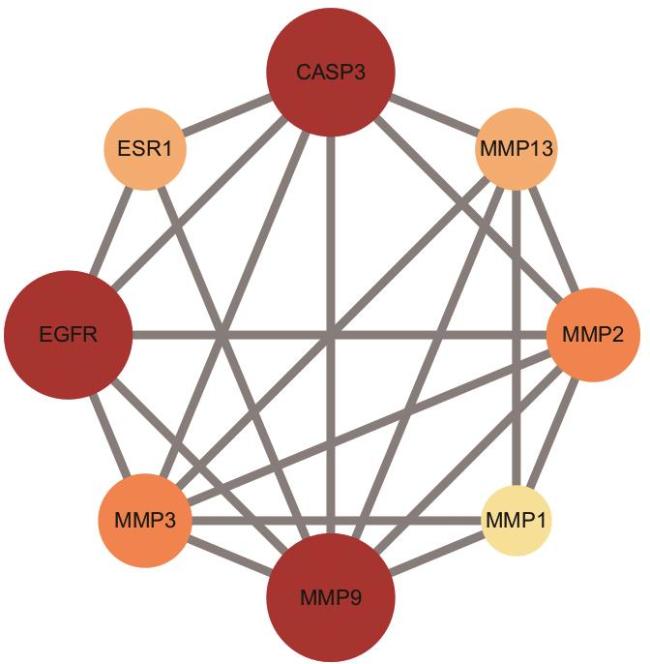
将交集靶点导入STRING数据库,研究物种选择“Gallus gallus”,minimum required interaction score设置为0.4,构建PPI网络,并利用Cytoscape 3.10.3软件筛选出核心靶点。
1.4 GO富集分析和KEGG通路分析
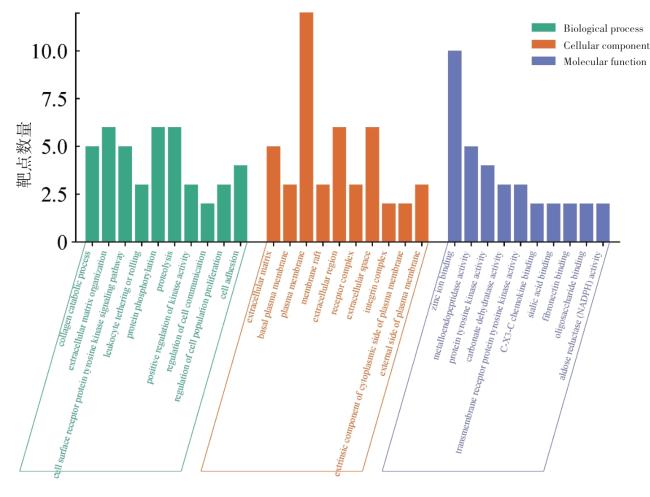
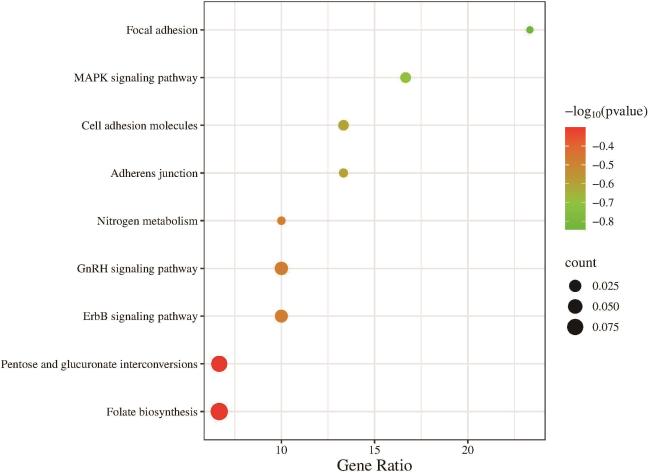
将获得的交集靶点导入David数据库,进行GO富集分析和KEGG通路分析,物种设置为“Gallus gallus”。GO富集分析包含生物学过程、分子功能和细胞组分。分析后的结果利用微生信在线平台(https://www.bioinformatics.com.cn/)制作三合一柱状图和KEGG富集气泡图。
1.5 分子对接
在PubChem数据库导出迷迭香酸的2D结构,经Chem 3D软件处理,使物质结构能量最小化。在RCSB PDB数据库中下载核心靶点PDB格式文件,用PyMOL软件打开后,分别对每个蛋白进行去水、去配体、加氢等处理。将处理后的pdbqt格式文件用AutoDockTools-1.5.7软件以大分子形式打开,调节Grid Box参数,使长方体正好包住大分子。最后由AutoDock Vina 1.1.2软件进行分子对接,选择结合能最低的分子。
2 结果与分析
2.1 迷迭香酸缓解热应激的关键靶点
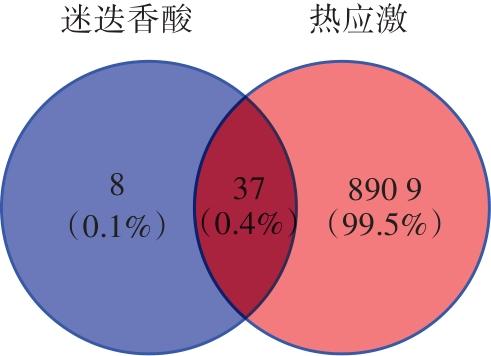
2.2 核心靶点筛选
如图2所示,PPI网络包含8个节点和21条边。8个核心靶点分别是表皮生长因子受体(EGFR)、半胱氨酸天冬氨酸蛋白酶3(CASP3)、雌激素受体α(ESR1)和基质金属蛋白酶(MMP1、MMP2、MMP3、MMP9和MMP13),主要与细胞增殖、凋亡及炎症反应等有关。
2.3 GO富集分析
将37个交集靶点进行GO富集分析,如图3所示,涉及24个生物学过程(Biological process),包括细胞外基质组织(Extracellular matrix organization)、蛋白质磷酸化(Protein phosphorylation)、蛋白质水解(Proteolysis)等;12个细胞成分(Cellular component)包括细胞质膜(Plasma membrane)、胞外区(Extracellular region)、细胞外间隙(Extracellular space)等;15个分子功能(Molecular function)包括锌离子结合(Zinc ion binding)、金属内肽酶活性(Metalloendopeptidase activity)等。
2.4 KEGG通路分析
将37个交集靶点进行KEGG通路分析,如图4所示,共涉及9条KEGG通路,主要包括黏着斑(Focal adhesion)、丝裂原活化蛋白激酶信号通路(MAPK signaling pathway)、细胞黏附分子(Cell adhesion molecules)和黏着连接(Adherens junction)等。


2.5 分子对接
将上述8个核心靶点分别与迷迭香酸进行分子对接。分析表明,与迷迭香酸结合最好的是MMP2,结合能为-6.66 kJ/mol,其余依次为MMP13(-6.54 kJ/mol)、EGFR(-6.45 kJ/mol)、MMP9(-5.89 kJ/mol)、CASP3(-5.59 kJ/mol)、MMP3(-5.56 kJ/mol)、ESR1(-5.04 kJ/mol)和MMP1(-4.63 kJ/mol)。前7个靶点的结合能均<-5 kJ/mol,表明迷迭香酸与这7个靶点可能具有良好的结合能力。
3 结论与讨论
高温环境是家禽生产中主要的应激来源,氧化应激、细胞凋亡、细胞因子失衡等与热应激息息相关[15]。炎症性先天免疫反应对于宿主抵抗病原体是不可或缺的,通过相关途径和反应避免宿主受到病原微生物的感染,但过度炎症反应可能会造成细胞和组织的损伤[16]。丝裂原活化蛋白激酶(MAPK)是介导细胞多种生理反应的重要信号通路,包括增殖、分化和凋亡等。激活蛋白-1(AP-1)是一种通过影响基因表达而激活胞外信号的转录因子。激活MAPK信号通路可诱导AP-1的产生,AP-1在细胞核中转录加剧了炎症反应[17]。细胞凋亡是一种细胞程序性死亡方式,具有维持内环境稳态的作用[18]。应激状态下,自噬是细胞通过吞噬蛋白和受损的细胞器来适应环境变化的一种保护机制,通过降解炎症因子和调节因子参与炎症反应的负反馈调控。细胞凋亡与自噬均有助于维持细胞的稳态[19]。
分子对接结果显示,EGFR和CASP3可能是迷迭香酸应对热应激的潜在作用靶点。EGFR位于细胞膜表面,被炎症因子激活后,形成二聚体,诱导自身及下游PI3K磷酸化。磷酸化的PI3K再次磷酸化AKT,从而激活信号通路,抑制下游蛋白表达,抑制自噬[20]。Sari等[21]研究显示,迷迭香酸可以抑制EGFR的表达。CASP3是一种半胱氨酸蛋白酶,属于Caspase家族,作为凋亡执行因子参与细胞凋亡。研究显示,迷迭香酸可以通过提高Caspase-3蛋白的表达,降低Bcl-2蛋白表达,促进多种肿瘤细胞发生、凋亡[22-23]。GO和KEGG富集分析结果显示,迷迭香酸可能通过作用于细胞膜参与蛋白质磷酸化、蛋白质水解,且涉及MAPK信号通路。以上结果说明,迷迭香酸可能通过调控细胞凋亡与自噬的平衡,减轻热应激诱导的过度炎症反应,从而实现对热应激的调节作用。
家禽遭受热应激时,为增加散热,体内大量血液会流向体表和四肢,导致肠道血流量减少。这会引发肠道代谢降低,进而导致有毒物质积聚和活性氧增多,活性氧会攻击肠道细胞膜,最终造成肠组织损伤[24]。热应激会损伤家禽肠道黏膜屏障,降低免疫细胞数量与产生的免疫介质量,还可以通过MAPK途径激活炎症反应,增加肠道通透性[25]。此时过多的病原体会透过肠上皮细胞,进一步加剧炎症反应[2]。基质金属蛋白酶(MMPs)是机体中通过细胞外基质发挥作用的一类重要酶。研究显示,MMPs是炎症性肠病患者肠道黏膜中主要表达的蛋白酶,大部分的MMPs,如MMP2、MMP3、MMP7、MMP9、MMP10、MMP12和MMP13在结肠炎中表达较高,降低这些MMPs的表达水平可有效预防炎症的发展[26]。研究表明,迷迭香酸可以降低MMP2和MMP9的表达[11]。分子对接显示MMP2、MMP3、MMP9和MMP13均是迷迭香酸应对热应激的潜在作用靶点。结合GO和KEGG富集分析结果显示,迷迭香酸可能通过白细胞黏附、细胞黏附、MAPK和ErbB信号通路等缓解热应激引起的肠道功能损伤。
热应激除了对家禽自身造成伤害,还会引起家禽下丘脑-垂体-性腺轴上组织结构相应的损伤,进而造成家禽繁殖功能受损[27]。例如,当蛋鸡遭受热应激时,体内的内分泌失调会导致下丘脑分泌的促性腺激素释放激素(GnRH)减少,进而导致垂体前叶合成与分泌的卵泡刺激素减少,最终降低雌激素的分泌[28]。雌激素受体(ESR)是甾体激素受体家族的重要成员之一,有ESR1和ESR2两种亚型,均可与雌激素结合发挥相应作用。研究显示,ESR基因在调控雌性家禽繁殖性能上具有重要作用,能提高家禽的产蛋性能[29]。分子对接显示ESR1可能是迷迭香酸应对热应激的潜在作用靶点。结合GO和KEGG富集分析结果显示,迷迭香酸可能通过GnRH信号通路等保护家禽的繁殖功能。
综上所述,通过网络药理学分析方法与分子对接工具分析迷迭香酸缓解家禽热应激的潜在作用机制,结果表明,迷迭香酸可能围绕MMP2、MMP13、EGFR、MMP9、CASP3、MMP3和ESR1共7个核心靶点,从调控细胞凋亡与自噬、降低肠道损伤和保护繁殖功能等方面缓解热应激给家禽带来的损伤。本研究为迷迭香酸缓解热应激提供了理论依据,但局限于数据库的选择和资料有限,需进一步试验加以验证。同时,本研究还为开发植物饲料添加剂和富含迷迭香酸的农副产品提供了参考。