

入侵植物一旦在新的滋生地摆脱了人为控制和天敌制约,就会蔓延并排挤本土植物形成优势种群,最终导致侵入地物种或遗传多样性发生改变[1]。近年来,各地积极宣传和普查入侵植物,有效提高了对入侵植物的认识,其中,以菊科植物加拿大一枝黄花(Solidago canadensis)分布较广泛,其造成的经济、生态与社会损失较大[2]。
加拿大一枝黄花原产北美,为多年生草本植物,茎直立,高 0.3~2.5 m,叶披针形或线状披针形、长5~12 cm,头状花序小,多数聚集形成开展的圆锥状花序;以种子和根状茎繁殖,其瘦果(含种子)多而小,根状茎长而发达,繁殖力极强;其传播速度快,生长迅速,生态适应性广,在山坡林地、田园地带和沿海湿地均可生长。相关研究显示,加拿大一枝黄花最早作为观赏植物引入我国,在上海、浙江一带作庭院植物栽培,后来蔓延成为杂草,并对长三角地区造成严重危害[3-4]。
该植物常入侵农业用地、城镇庭院、交通沿线、郊野荒地、河岸湿地等处,会消耗土壤肥力,在侵入地与周围植物争夺阳光和肥料等资源,甚至导致其他植物死亡,从而对农业、林业及牧业造成经济损失[5]。近年来,其在江苏沿海地区有蔓延趋势,并逐渐向内陆扩展[5-6]。江苏省自然资源厅组织的专项调查结果显示,2024年11月底全省共排查出加拿大一枝黄花发生面积约5 300 hm2,除治面积约2 900 hm2,其中江苏省盐城市发生面积较大,约2 300 hm2;以盐城东台市为例,其农田生态系统区域发生面积约667 hm2,林地发生面积约800 hm2。从发生面积上看,加拿大一枝黄花入侵蔓延的态势暂未得到有效遏制。现有研究主要集中于其蔓延为害的生物学特征与机制[7-11]、治理或管理策略[12-17]、资源综合利用[18-25]等方面。本文基于相关研究成果,系统阐述了有关加拿大一枝黄花入侵蔓延的生物学机制、治理策略及综合利用方法与进展,为更好地促进其治理与资源化利用提供参考。
1 加拿大一枝黄花入侵蔓延的生物学机制
1.1 多倍化复合群体
1.2 有性生殖与无性繁殖
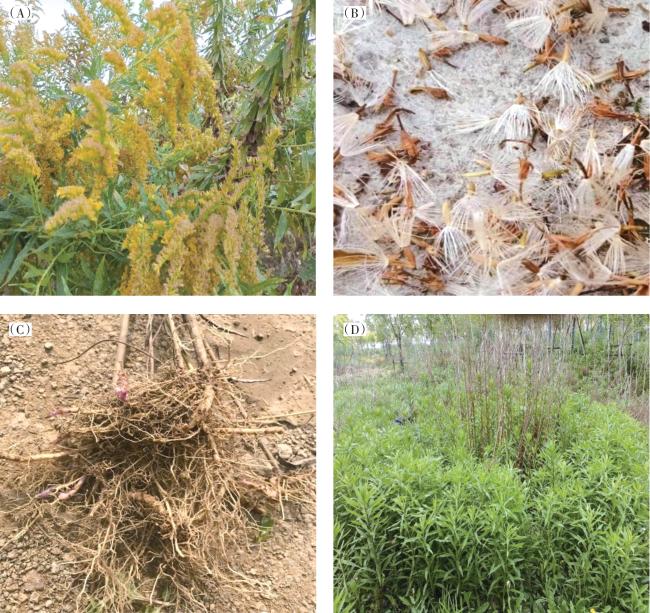
入侵植物定殖与种群建立过程中,植物本身强大的繁殖性能是其入侵的重要原因。入侵植物中有性生殖占72.62%,有性、无性繁殖兼有占25.00%,只有无性繁殖的仅占2.38%,而加拿大一枝黄花的繁殖方式为有性与无性兼有[1]。该植物的有性生殖为绝对的自交不亲和,虫媒传粉,通过有性生殖产生种子,种子生成量大,每棵植株可形成2万粒左右的种子,且瘦果(含种子)上附有冠毛,可随风传播(图1A、B),种子的成活率可达80%,有性生殖形成实生苗,对其入侵、长距离传播与定殖具有重要作用。其无性繁殖以地下根状茎横走传播,根状茎发达,繁殖力极强(图1C),无性繁殖会形成大量克隆苗,能在入侵地迅速形成物种群。一株春季移栽的幼苗可在2年内形成50余株独立的植株(图1D),此外根茎可随土壤的翻动运转而传播蔓延。作为根茎型克隆植物,其地下根茎具有较强的生理整合能力,通过地上地下、不同分枝间的资源分配,使其能利用异质生境并克服不同逆境的影响,从而扩大生存空间,增加种群数量。加拿大一枝黄花有性生殖与无性繁殖相结合所形成的高繁殖能力是其蔓延为害的根源。


1.3 化感物质
1.4 微生物—植物协同
加拿大一枝黄花被认为是一种菌根营养植物,植株与菌根真菌形成共生体,可以促进植物的营养生长等生理过程,提高其生物量,提升光合能力,增强对环境的耐受性,从而在一定程度上增强了其生存竞争能力。此外,该植物可以吸引产生生长素的细菌,并在其根系表面定殖,这些根表细菌可通过分泌吲哚乙酸来促进植物根部发育与植株生长,有利于其入侵早期的快速定殖[11]。
2 加拿大一枝黄花的综合治理策略
对加拿大一枝黄花的治理需针对其发育时期(生活史)及入侵蔓延的生物学特征来进行,常用防除方式包括农业防治、生物生态防治、物理清除、化学灭杀等。其中,定植当年3—10月(苗期—初花期)是防治适期,苗期植株幼嫩矮小,通过农业、生物、物理、化学等措施综合处理的灭杀效果较好;初花期呈现特征性花形花色时,易于识别,可采用物理清除方式有效清除。11—12月是其生殖生长时期,可采用物理清除为主,化学灭杀为辅的方式,此时期防治效果较有限;次年1—2月是其枯萎休眠期,此时期可采用物理清除方式进行防除。
2.1 农业治理
2.2 生物或生态治理
生态治理策略中较典型的是植物替代控制[17]。如在河滩和堤坝两侧的豚草、紫茎泽兰发生重灾区,种植具有经济价值的杂交象草来进行替代控制,可促进生物多样性恢复。在江苏沿海地区,可在堤岸处、田埂边、林地里种植一些根系发达、生长旺盛或具有攀缘缠绕能力的本土或草本植物,如芦竹、葎草等,以压缩加拿大一枝黄花的生存与扩展空间。生态治理策略注重从整体生态系统的角度出发,加强生态系统的稳定性和多样性。通过合理规划土地利用,避免过度开发和破坏生态平衡;加强湿地、森林等生态系统的保护和修复,为本土生物提供良好的生存环境。此外,建立生态监测体系,持续监测加拿大一枝黄花的生长状况、分布范围以及生态系统变化,及时调整治理策略,以确保治理效果的持久性和稳定性。
2.3 物理清除
物理清除主要包括人工拔除和机械铲除,即采用机械或人工物理割除、拔除入侵植株的地上部分,挖出晒干或就地焚烧地下部分。该方法在入侵植物各时期均可进行,但生长后期的工作量与难度较大,若管理不到位,还可能人为促进种子与根茎传播。此外,可创新物理清除方法,如定向喷火焚烧等。由于加拿大一枝黄花入侵地的生态类型较为复杂,且存在根茎繁殖与种子生发同时存在的情况,其进入花期的时间并不完全一致。伍仕林等[12]研究表明,在加拿大一枝黄花营养生长中期割除地上部分对控制其根茎扩散较有效,而在初花期刈割则能消除其种子产生,从而控制其大规模远距离扩散。该植物的花期较长(9月中旬至12月底),在开花后割除地上部分,其地下部分的根与根茎生长可能不受影响。基于应激繁殖策略,其会在根系损伤后产生更多的分株与地下根茎,产生“秋发”效应,形成二茬植株,因此10月之后,部分加拿大一枝黄花由根茎形成的幼苗继续生长,甚至进入花期,对于二茬植株,应在11月前刈割其地上部分,此后直至开春前进行根茎清除或破碎,使其残根长度低于2 cm,以遏制其蔓延[13]。实际操作中,具体割除时间可根据植株生长发育情况进行调整。
2.4 化学灭杀
2.4.1 农田
每年3—5月,加拿大一枝黄花处于营养生长阶段时,可用氯氟吡氧乙酸异辛酯乳油180~210 g/hm2、41%草甘膦异丙胺盐水剂1 200 g/hm2、30%草甘膦·氟氯氨草酯2 200~3 000 g/hm2、21%氨氯吡啶酸1 500~2 000 g/hm2、40 g/L氟草啶900 g/hm2、25%环嗪酮1 500 g/hm2+200 g/L草铵膦600 g/hm2、75%甲嘧磺隆600~700 g/hm2、50% 2,4-滴异辛酯5 400 g/hm2、56% 2甲4氯钠盐6 000 g/hm2、20%双氟·氯氟酯120 g/hm2、20%双氟·氯氟吡820 g/hm2、10%双唑草酮200~250 g/hm2、70%苯嘧磺草胺80 g/hm2等定向喷雾防治。
2.4.2 果蔬园
在加拿大一枝黄花苗期,可用咪唑乙烟酸水剂750 g/hm2、草甘膦异丙胺盐水剂1 200~1 500 g/hm2、75%甲嘧磺隆600~700 g/hm2、氯氟吡氧乙酸异辛酯乳油180~210 g/hm2、50% 2,4-滴异辛酯5 400 g/hm2、56% 2甲4氯钠盐6 000 g/hm2、20%双氟·氯氟酯120 g/hm2、20%双氟·氯氟吡820 g/hm2、10%双唑草酮200~250 g/hm2等定向喷雾防治。
2.4.3 堤坡荒地
在大型机械翻耕灭除基础上,在该入侵植物营养生长阶段,选择30%草甘膦·氟氯氨草酯2 200~3 000 g/hm2、咪唑乙烟酸水剂750~1 125 g/hm2、草甘膦异丙胺盐水剂1 500~1 800 g/hm2、甲嘧磺隆可溶粉剂375~450 g/hm2、667 g/L 三氯吡氧乙酸·丁氧基乙酯6 000 g/hm2、25%环嗪酮1 500 g/hm2+200 g/L草铵膦600 g/hm2、21%氨氯吡啶酸1 500~2 000 g/hm2、40 g/L氟草啶900 g/hm2等定向喷雾防除。
2.4.4 绿带林地
在该入侵植物苗期,选择30%草甘膦·氟氯氨草酯2 200~3 000 g/hm2、草甘膦异丙胺盐水剂1 200~1 500 g/hm2、咪唑乙烟酸水剂750 g/hm2、啶嘧磺隆水分散粒剂93.75~112.5 g/hm2、甲嘧磺隆可溶粉剂375 g/hm2、667 g/L 三氯吡氧乙酸·丁氧基乙酯6 000 g/hm2、25%环嗪酮1 500 g/hm2+200 g/L草铵膦600 g/hm2、21%氨氯吡啶酸1 500~2 000 g/hm2、40 g/L氟草啶900 g/hm2等定向喷雾防除。
2.4.5 交通沿线
在该入侵植物营养生长阶段,选择30%草甘膦·氟氯氨草酯2 200~3 000 g/hm2、草甘膦异丙胺盐水剂1 500~1 800 g/hm2、甲嘧磺隆可溶粉剂450~600 g/hm2、咪唑乙烟酸水剂750~1 125 g/hm2、667 g/L 三氯吡氧乙酸·丁氧基乙酯6 000 g/hm2、25%环嗪酮1 500 g/hm2+200 g/L草铵膦600 g/hm2、21%氨氯吡啶酸1 500~2 000 g/hm2、40 g/L氟草啶900 g/hm2等均匀喷雾防除。
2.4.6 河滩湿地
在该入侵植物处于营养生长阶段时,选择667 g/L 三氯吡氧乙酸·丁氧基乙酯6 000 g/hm2、草甘膦异丙胺盐水剂1 200 g/hm2、56% 2甲4氯钠盐6 000 g/hm2、50% 2,4-滴异辛酯5 400 g/hm2、20%双氟·氯氟酯120 g/hm2、20%双氟·氯氟吡820 g/hm2、10%双唑草酮200~250 g/hm2等均匀喷雾防除。
长期施用单一除草剂可能导致加拿大一枝黄花产生抗药性,因此需定期更换除草剂品种或采用多种除草剂混合施用的方式。在该入侵植物清除实践中,常将除草剂草甘膦异丙胺盐水剂与氯氟吡氧乙酸乳油、甲嘧磺隆可溶粉剂、2,4-滴·草铵膦混用,氯氟吡氧乙酸乳油与草甘膦异丙胺盐水剂、2,4-滴丁酯混用,甲嘧磺隆可溶粉剂与草甘膦异丙胺盐水剂混用。曹晶晶等[14]研究表明,25%环嗪酮1 500 g/hm2+200 g/L草铵膦600 g/hm2、40 g/L氟草啶900 g/hm2等药剂见效较快,可用于非耕地加拿大一枝黄花的应急控害。各地在进行入侵植物化学灭杀时,可对候选药剂种类与用量进行预试验,同时明确对非靶标生物与周边环境的影响,取得明显成效后加以应用推广。在实际应用上,物理清除和化学灭杀往往结合使用,在大面积蔓延的区域先采用机械铲除,然后针对残留的植株和根茎施用除草剂进行灭杀。
3 加拿大一枝黄花的综合利用途径
4 结语与展望
4.1 传播方面
人类活动在一定程度上影响加拿大一枝黄花的传播。该物种最初作为观赏植物被引入,而城市化进程中的工程建设、物流运输等活动进一步加速了其扩散。该植物瘦果具冠毛,易附着于交通工具上实现远距离传播,这一特征在各交通干线沿线表现得尤为明显。此外,城市绿化工程中苗木与土壤的跨区域调运过程中,也可能携带其根状茎或种子等繁殖体,导致该入侵植物在城市绿带中出现。相关人类活动为加拿大一枝黄花等入侵物种的定殖和扩散创造了有利条件。因此,下一步研究应针对加拿大一枝黄花传播受人为活动影响的特性展开,从源头预防其入侵。
4.2 治理技术方面
在防控加拿大一枝黄花的过程中,目前虽已形成生物生态治理、物理清除与化学防治等多重手段并用的治理体系,在一定程度上遏制了其蔓延态势,但整体防控效能有待进一步提升与优化。现有治理方式暂存在一定局限性,具体包括:生物与生态治理需要较长的时间才能见到显著效果;物理清除需耗费大量的人力物力,成本较高;化学灭杀可能会带来环境风险,过度依赖化学方法不仅会导致杂草产生抗药性,而且可能会导致环境受到二次伤害。因此,未来应致力于构建更加高效、低耗、环境友好的综合治理技术体系,推动形成科学长效的生态治理机制。
4.3 综合利用技术方面
目前,关于加拿大一枝黄花潜在利用途径的相关研究较多,但从实验室成果到产业化应用的转化率还有待提高。首先,该植物资源化利用需要成熟高效的加工技术,而现有工艺暂不完善,处理成本偏高,制约了其规模化应用;其次,在市场方面,新产品的推广和市场接受度存在不确定性,消费者的消费意愿不明,需通过系统调研和科学宣传逐步引导;最后,在开发利用过程中需高度警惕其生态风险,任何采集、运输和加工环节均须严格管理,避免因资源化利用不当导致的二次扩散。因此,推动加拿大一枝黄花的可持续利用,必须同步建立完善的技术标准、市场规范和监管体系,确保在控制入侵危害的前提下实现其资源价值。
加拿大一枝黄花作为一种入侵性强、危害严重的植物,本文总结了其入侵蔓延的生物学机制、综合治理策略和资源化利用等方面内容。该植物具有多倍化复合群体、有性生殖与无性繁殖结合、化感作用以及微生物协同等特性,使其能在新生境中迅速占据生态位。针对其生物学特性与发生规律,提出物理清除、化学灭杀、农业防治及生物生态治理等综合策略。实践证明,单一方法难以取得长效,必须依据其生活史,在不同生境和发育阶段采取综合措施,并注重防治时机。与此同时,该植物的资源化利用为治理提供了新思路。其在药用、饲用、纤维原料和生物能源等方面的潜在价值,展示了将环境威胁转化为经济收益的可能性,是实现可持续治理的重要方向。
展望未来,对加拿大一枝黄花的治理与综合利用还须进一步整合资源与技术,以发展环境友好、经济可行的治理与利用路径。同时,应持续发挥科技创新的支撑作用,研发更加环保、高效的防控技术和高值化利用工艺。此外,应积极构建政策支持与激励措施,引导鼓励社会力量参与,形成各阶层共同关注和参与治理的良好氛围。持续完善治理体系,将逐步实现入侵物种有效防控、生态系统健康维护与资源可持续利用的多元目标。