Welcome to visit Anhui Agricultural Science Bulletin!

Bibliometric analysis of the research trends on maize drought stress based on Web of Science database

  • HUANG Feifei 1 ,
  • YANG Jiwei 2, 3 ,
  • JIANG Shangming 2, 3 ,
  • YUAN Hongwei 2, 3 ,
  • LI Xiaoliang 1
Expand
  • 1. College of Resource and Environment, Anhui Science and Technology University, Fengyang 233100, China
  • 2. Anhui & Huaihe River Institute of Hydraulic Research, Hefei 230088, China
  • 3. Anhui Provincial Key Laboratory of Water Science and Intelligent Water Conservancy, Bengbu 233000, China

Received date: 2025-03-02

  Online published: 2025-12-25

Abstract

To understand the research hotspots and trends in the field of maize drought stress studies, this paper used 1 842 articles published between 1994 and 2023 from the Web of Science database as samples, and conducted a visual analysis of the publication output and keywords using CiteSpace software. The results showed that: (1) The development trend of this field from 1994 to 2023 can be divided into three stages: the embryonic period (1994-2007), the slow development period (2008-2015), and the explosive growth period (2016-2023), with the number of publications showing an exponential growth trend. (2) Keyword clustering analysis revealed that the keywords in this field formed 9 clusters, generating 6 research hotspots covering 3 aspects: biological phenotypes (yield characteristics, growth and development), physiological responses (oxidative stress, gene transcription, and water use efficiency), and mitigation measures (drought resistance). (3) Keyword burst analysis indicated that the research themes in the embryonic period focused on abscisic acid regulatory mechanisms, genetic traits, and yield characteristics; those in the slow development period centered on the improvement of maize drought tolerance under climate change; and the research themes in the explosive growth period were water use, gene expression, and the drought-resistant mechanism of salicylic acid. Overall, water use, gene expression, and the drought-resistant mechanism of salicylic acid in maize under drought stress may remain frontier research directions in the future. This study provides a reference for maize drought resistance research.

Cite this article

HUANG Feifei , YANG Jiwei , JIANG Shangming , YUAN Hongwei , LI Xiaoliang . Bibliometric analysis of the research trends on maize drought stress based on Web of Science database[J]. Anhui Agricultural Science Bulletin, 2025 , 31(24) : 114 -119 . DOI: 10.16377/j.cnki.issn1007-7731.2025.24.023

干旱在一定程度上可能会造成土地荒漠化、生态系统被破坏以及水资源短缺,对农业生产区的粮食安全构成了重大威胁[1-3]。作为非生物胁迫之一,干旱通过影响植物幼苗形成、光合作用等生长过程造成产量损失[4-5]。玉米作为重要的粮食作物之一,其种植面积较广。然而,干旱胁迫明显增加了玉米产量损失风险[6-7]。基于此,相关研究人员积极探索玉米的干旱胁迫响应机制。例如,Qin等[8]研究指出,根系作为作物吸收养分和水分的主要器官,在干旱胁迫响应中发挥关键作用,其抗逆适应性多通过调控特定基因实现。Jiao等[9]研究指出,Zmhdz9基因通过调控高脱落酸和木质素的合成代谢,对玉米抗旱胁迫响应具有关键作用。文献计量学通过量化分析文献的数量特征、分布规律揭示学科发展动态、研究热点与趋势[10]。为厘清玉米干旱胁迫领域的研究热点及发展趋势,本文基于Web of Science数据库文献数据,对1994—2023年玉米干旱胁迫研究领域进行了文献计量学研究,为玉米抗旱研究提供参考。

1 材料与方法

1.1 数据来源

本文以Web of Science数据库为文献数据来源,设置TI=“maize” or “corn” or “mealie” or “zea mays*” and TI=“drought” or “arid” or “dryness” or “water deficit” or “water shortage”or“water stress”),日期设为1994年1月1日至2023年12月31日,文献类型设定为“article”,语言种类设定为“English”,同时剔除书籍章节、议案文件等。通过人工阅读标题和摘要的方式对所选文献进行逐一甄别,共筛选出1 842篇文献。

1.2 研究方法

CiteSpace是一款基于Java运行环境的文献计量分析软件,可直观地分析领域研究热点和发展模式[11-12]。在图谱中,研究对象(作者、关键词、被引文献等)被描述为节点,节点大小与节点的发文量、共现或引用频次呈正相关[13],节点之间连线表征节点的合作、共现或引用关系[14],节点的色谱表示研究对象出现的时间顺序[15]。此外,节点的紫色外圈则表示中介中心性(BC),BC>0.1表明节点具有关键性和影响力[16]。本文采用CiteSpace软件(v.6.3.R1版本)对玉米干旱胁迫领域的相关文献数据进行发文量和关键词的可视化分析。关键词是对文章研究内容高度凝练的信息标签,对关键词进行聚类分析可突出领域内的研究热点[17];关键词的突现分析可体现研究领域的发展趋势[18]

2 结果与分析

2.1 发文量

图1所示,1994—2023年玉米干旱胁迫研究领域的发文量呈逐年递增态势,这与指数函数y=4.420 3e0.129 9 x (相关性系数R 2=0.977 8)的拟合结果高度吻合,表明相关学者对干旱影响玉米产量形成与抗逆机理的研究关注度不断提高。总体来看,1994—2023年玉米干旱胁迫研究领域的发展趋势可划分为3个阶段。(1)萌芽时期(1994—2007年),该阶段整体呈现出低水平、慢增速发展趋势,每年出版物数量基本稳定在20篇以下,合计发文量占总发文量的9.01%;(2)缓慢发展时期(2008—2015年),该阶段发文量呈现出较为明显的增势,每年发文量在30~85篇,合计发文量占总发文量的24.27%;(3)激增时期(2016—2023年)。该阶段发文量呈现出明显递增状态,每年发文量均超过100篇,合计发文量占总发文量的66.72%。
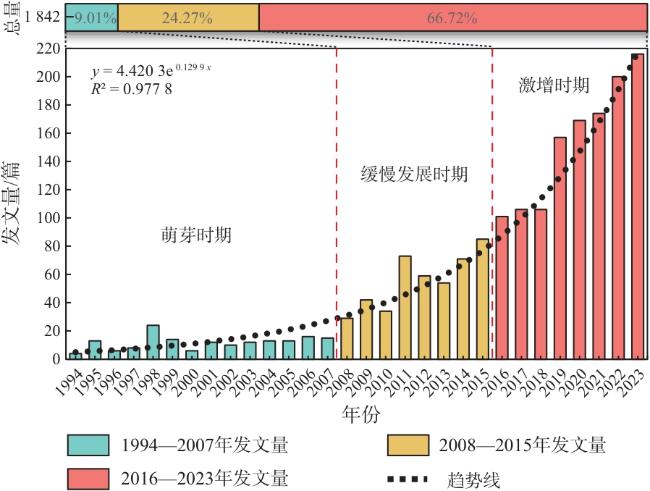
图1 1994—2023年玉米干旱胁迫研究发文量特征

2.2 研究热点

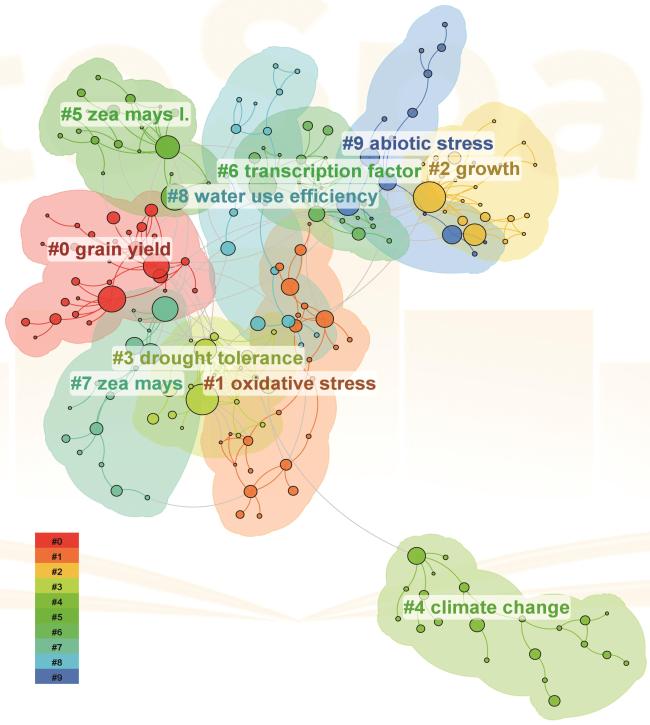
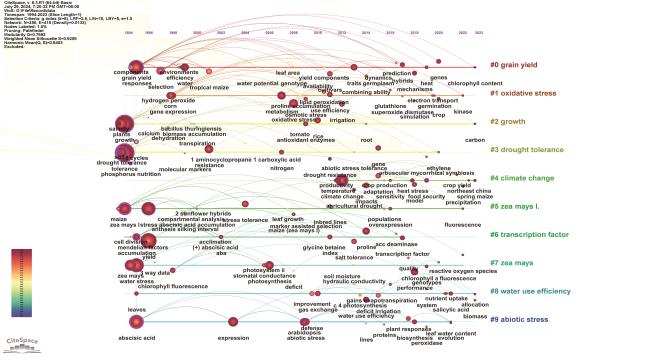
对玉米干旱胁迫领域的关键词进行聚类,合计形成9个显著聚类集群,每个集群内部包含多个具有高度同质性的成员关键词(以同颜色节点表示)。聚类图谱(图2)的模块值Q=0.769 2(>0.3)、平均轮廓值S=0.925 9(>0.5),这表明本次聚类结构结果可靠[17]。采用时间轴的方式对聚类集群所含的关键词进行可视化表达(图3)。综合来看,1994—2023年该领域的研究人员主要从3个方面开展玉米干旱胁迫研究,即生物表型、生理响应和缓解措施。
图2 关键词研究热点聚类图谱
图3 关键词聚类时间轴图谱
(1)生物表型方面,形成了产量特征(#0籽粒产量grain yield,#4气候变化climate change)和生长发育(#2 生长growth)2个研究热点,其热度一直从1994年持续到2023年,研究方向具体如下。一是产量特征方面。随着气候变化对农业生产的影响加剧,自2011年起研究人员加大了对干旱和高温双因素胁迫下玉米产量的研究力度。研究表明,胁迫若发生在玉米开花期或灌浆期,其产量会大幅度下降[19-20]。考虑到穗高、百粒重等性状表现为过度显性遗传[21],研究人员通过选育耐旱自交系品种降低玉米产量损失[22]。同时,为减轻干旱气候对粮食安全产生的影响,研究人员围绕玉米产量预测展开了多项研究,主要包括基因组选择[23]、热成像技术[24]、作物生长模型[25]等方面研究,有利于农户及时调整种植策略。二是生长发育方面。研究人员加强了玉米干旱过程中伴有的盐度、高温等非生物胁迫因素的共同作用研究,并针对根系长度、根导水率、叶面积、叶绿素含量等指标进行表型分析,探索干旱胁迫对玉米生长发育造成的影响[26]。例如,玉米在面临干旱导致的缺水状态时,最初反应是在土壤中形成长而细的根系[27],但土壤性质的不同会迫使玉米根系性状(直径)表现出高度的可塑性[28]。最终,根系性状通过调节土壤水分以支持籽粒灌浆,进而提高干旱胁迫时的收获产量[29]
(2)生理响应方面,形成了氧化应激(#1氧化应激oxidative stress)、基因转录(#5玉米zea mays L.、#6转录因子transcription factor、#9非生物胁迫 abiotic stress)以及水分利用效率(#7玉米zea mays L.、#8水分利用效率water use efficiency)3个研究热点,仅水分利用效率的关注热度持续至2023年,具体如下。一是氧化应激方面。当面临干旱胁迫时,玉米新陈代谢过程会出现自发性紊乱,导致其细胞内的活性氧(ROS)积累与膜脂质过氧化[30],进而影响其生长发育和产量[31]。为提升逆境状态下的适应能力,玉米植株激活了体内的抗氧化防御系统[32],超氧化物歧化酶(SOD)、过氧化氢酶(CAT)以及过氧化物酶(POD)等抗氧化物质的含量迅速增加[33],以减轻ROS对玉米细胞的损伤。针对玉米氧化应激的生理机制,研究人员在外源性添加剂[34]、基因选择[35]等方面开展大量研究,以期提升玉米干旱胁迫时的抗氧化能力。二是基因转录方面。聚类集群#5、#6、#9中均多次出现与“脱落酸abscisic acid”和“表达expression”相关的关键词,提示脱落酸等植物激素在玉米干旱响应的基因转录调控中发挥核心作用[36]。具体而言,其调控机制主要包括通过调节脱落酸(ABA)信号通路调控胁迫相关基因提高干旱耐受性[37],通过基因编码的方式增强ABA在信号转导中的作用[38],从而减弱蒸腾作用并保持植株水分平衡,达成提升玉米干旱环境适应性的目标,相关转录因子包括ZmEREBP60、ZmPMP3以及ZmPYL13等,上述基因转录过程也为培育抗旱玉米品种提供了潜在分子标记。三是水分利用效率方面。干旱导致的缺水是限制农作物可持续生产的重要因素,故水分利用效率直接关系玉米的生物质积累及产量[39]。Liu等[40]研究发现,干旱会迫使玉米通过调节气孔密度减少蒸腾作用,进而提高水分利用效率和抗旱性。此外,适当的干旱胁迫不仅可以提高玉米的水分利用效率,还能够节省灌溉用水[41]。因此,农业干旱过程中常对玉米进行赤字灌溉,在节省水资源的同时也有利于保障粮食产量。
(3)在缓解措施方面,形成的研究热点为抗旱性能(#3抗旱性能drought tolerance),其热度从1994年持续到2020年,具体如下。为提升植株在干旱胁迫条件下的适应能力,研究人员主要围绕农艺管理(外源措施)和基因选择(内源措施)展开研究。其中,农艺管理包括植物激素、营养物质、根际细菌及农技措施4个方面。例如,外源喷施的植物激素包括ABA、水杨酸、抗坏血酸等;外源喷施的营养物质包括硅、尿素、钾等;接种的根际细菌包括克罗诺杆菌属(Cronobacter)、放线菌(Actinobacterium)、球囊霉属Glomus)等;农技措施包括土壤改良、农业灌溉、秸秆覆盖等。而基因选择则是通过杂交育种、基因编辑等手段,改变玉米对干旱环境的适应性,进而达到保障其生长发育和稳产增产的目标。

2.3 研究趋势

对玉米干旱胁迫领域关键词进行突现性分析,提取突现强度(Strength)排名前22位的关键词。如图4所示,红色线条表征关键词的爆发持续时间(分别以Begin和End代表起始时间点),表明该时期内相应研究主题的关注度快速增长,进而从特定领域的研究趋势中分析前沿方向。本文以关键词突现的起始年份为依据,从3个阶段分析玉米干旱胁迫研究领域的发展趋势,具体如下。
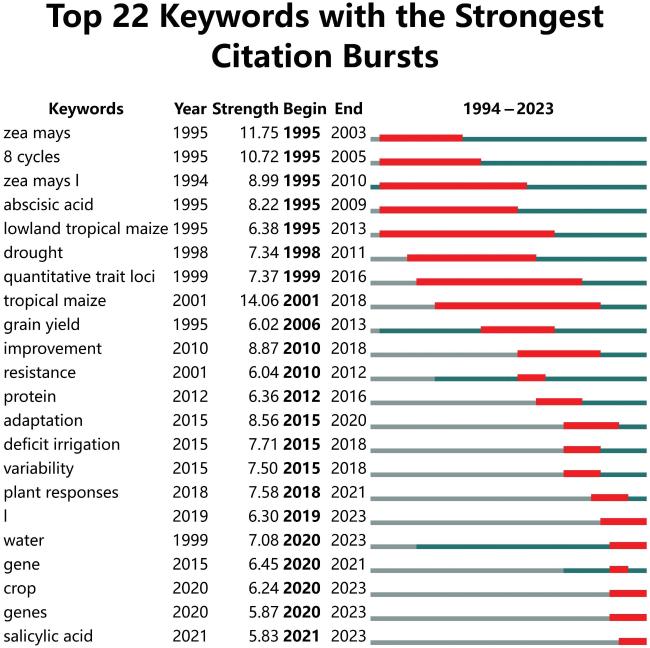
图4 关键词突现图谱
(1)萌芽时期(1994—2007年),重点突现关键词(突现强度和持续时间)为“脱落酸abscisic acid”(8.22,14年)、“数量性状基因座quantitative trait loci”(7.37,17年)、“籽粒产量grain yield”(6.02,7年),表明该阶段兴起的研究主题为脱落酸调节机制、遗传性状及产量特征,整体热度较高且持续时间长。其主要受人口增长与极端气候的叠加影响,分子生物技术及保障粮食安全成为研究热点。
(2)缓慢发展时期(2008—2015年),重点突现关键词为“抗性resistance”(6.04,2年)、“蛋白质protein”(6.36,4年)、“适应性adaptation”(8.56,5年)、“亏缺灌溉deficit irrigation”(7.71,3年)“变异性variability”(7.5,3年),表明该阶段兴起的研究主题为气候变化条件下玉米干旱耐受性提升,整体热度较高但持续时间较短。
(3)激增时期(2016—2023年),重点突现关键词为“水分water”(7.08,3年)、“基因genes”(5.87,3年)和“水杨酸salicylic acid”(5.83,2年)且爆发时间均持续到2023年,表明该阶段兴起的研究主题为水分利用、基因表达及水杨酸抗旱机制,整体热度较高且极有可能成为未来的前沿方向。

3 结论

本文以Web of Science数据库文献为数据来源,采用CiteSpace对1994—2023年玉米干旱胁迫研究领域的文献进行可视化分析,得出以下结论。(1)近30年发文量整体呈指数级递增态势,经历了萌芽时期(1994—2007年)、缓慢发展时期(2008—2015年)及激增时期(2016—2023年)3个阶段,其中第三阶段的发文量较高,占总发文量的66.72%。(2)通过关键词聚类分析发现,近30年该领域从生物表型、生理响应和缓解措施3个方面产生产量特征、生长发育、氧化应激、基因转录、水分利用效率和抗旱性能6个研究热点。(3)关键词的突现性分析结果显示,随着全球性气候变化对玉米作物的影响加剧,水分利用、基因表达及水杨酸抗旱机制将成为前沿研究方向。
[1]
WU C L WANG T J. Evaluating cumulative drought effect on global vegetation photosynthesis using numerous GPP products[J]. Frontiers in environmental science202210:908875.

[2]
ZHOU Z L ZHANG L P CHEN J,et al. Projecting global drought risk under various SSP-RCP scenarios[J]. Earth’s future202311(5):e2022EF003420.

[3]
LI Q Q YE A Z WADA Y,et al. Climate change leads to an expansion of global drought-sensitive area[J]. Journal of hydrology2024632:130874.

[4]
MAHTO S S MISHRA V. Increasing risk of simultaneous occurrence of flash drought in major global croplands[J]. Environmental research letters202318(4):044044.

[5]
YIN X M LENG G Y HUANG S Z,et al. Aggravation of global maize yield loss risk under various hot and dry scenarios using multiple types of prediction approaches[J]. International journal of climatology202444(4):1058-1073.

[6]
HENDRAWAN V S A KOMORI D KIM W. Possible factors determining global-scale patterns of crop yield sensitivity to drought[J]. PLoS one202318(2):e0281287.

[7]
KIM K H LEE B M. Effects of climate change and drought tolerance on maize growth[J]. Plants202312(20):3548.

[8]
QIN T Y KAZIM A WANG Y H,et al. Root-related genes in crops and their application under drought stress resistance:a review[J]. International journal of molecular sciences202223(19):11477.

[9]
JIAO P JIANG Z Z MIAO M,et al. Zmhdz9,an HD-Zip transcription factor,promotes drought stress resistance in maize by modulating ABA and lignin accumulation[J]. International journal of biological macromolecules2024258:128849.

[10]
赵文赛. 基于文献计量学的玉米抗旱基因领域全景分析[J].中国发明与专利202421(2):39-46.

[11]
XU Y X,LYU J, LIU H B,et al. A bibliometric and visualized analysis of the global literature on black soil conservation from 1983–2022 based on CiteSpace and VOSviewer[J]. Agronomy202212(10):2432.

[12]
HU Y M YANG S Q QIAN X,et al. Bibliometric network analysis of crop yield gap research over the past three decades[J]. Agriculture202313(11):2105.

[13]
HUANG S Y LI S E WU M S,et al. A scientometric analysis of research trends and knowledge structure on the climate effects of irrigation between 1993 and 2022[J]. Agronomy202313(10):2482.

[14]
ZHANG F T LIU Y D ZHANG Y L. Bibliometric analysis of research trends in agricultural soil organic carbon mineralization from 2000 to 2022[J]. Agriculture202313(6):1248.

[15]
LIU D YAO Z K YANG X X,et al. Research progress and trend of agricultural non-point source pollution from non-irrigated farming based on bibliometrics[J]. Water202315(8):1610.

[16]
XIAO J F WEI J WU M Y,et al. Bibliometric and visual analysis of crop water footprint:a widely used agricultural water resources evaluation method[J]. Water202214(18):2866.

[17]
WU L J MIAO H Y LIU T Z. Development in agricultural ecosystems’ carbon emissions research:a visual analysis using CiteSpace[J]. Agronomy202414(6):1288.

[18]
WEI Q WEI Q XU J Z,et al. Nitrogen losses from soil as affected by water and fertilizer management under drip irrigation:development,hotspots and future perspectives[J]. Agricultural water management2024296:108791.

[19]
PATIL N L SHANTHAKUMAR G BIRADAR B D,et al. Role of genetic diversity and combining ability and heterosis in maize (Zea mays L.) Hybrids under drought stress[J]. Bangladesh journal of botany202452(4):915-923.

[20]
ZHANG N N LIU B B YE F,et al. Molecular mechanisms of drought resistance using genome-wide association mapping in maize (Zea mays L.)[J]. BMC plant biology202323(1):468.

[21]
HUSSAIN M SHAH K N GHAFOOR A,et al. Genetic analysis for grain yield and various morphological traits in maize (Zea mays L.) under normal and water stress environments [J]. Journal of animal and plant sciences201424(4):1230-1240.

[22]
KHODARAHMPOUR Z. Evaluation of drought tolerance in different growth stages of maize (Zea mays L.) inbred lines using tolerance indices[J]. African journal of biotechnology201110(62):13482-13490.

[23]
ANANDA KUMAR B V VENKATACHALAM S R RAVIKESAVAN R,et al. Genomic prediction in doubled haploid maize (Zea mays) populations under water stress at flowering and well-watered conditions using high-density single-nucleotide polymorphisms[J]. Plant breeding2022141(4):566-573.

[24]
PRADAWET C KHONGDEE N PANSAK W,et al. Thermal imaging for assessment of maize water stress and yield prediction under drought conditions[J]. Journal of agronomy and crop science2023209(1):56-70.

[25]
YAN S Y WENG B S JING L S,et al. Effects of drought stress on water content and biomass distribution in summer maize (Zea mays L.)[J]. Frontiers in plant science202314:1118131.

[26]
ZHANG L YAN M F REN Y Y,et al. Zinc regulates the hydraulic response of maize root under water stress conditions[J]. Plant physiology and biochemistry2021159:123-134.

[27]
SHI R L SEILER C KNOCH D,et al. Integrated phenotyping of root and shoot growth dynamics in maize reveals specific interaction patterns in inbreds and hybrids and in response to drought[J]. Frontiers in plant science202314:1233553.

[28]
VETTERLEIN D PHALEMPIN M LIPPOLD E,et al. Root hairs matter at field scale for maize shoot growth and nutrient uptake,but root trait plasticity is primarily triggered by texture and drought[J]. Plant and soil2022478(1):119-141.

[29]
VAN OOSTEROM E J YANG Z J ZHANG F L,et al. Hybrid variation for root system efficiency in maize:potential links to drought adaptation[J]. Functional plant biology201643(6):502-511.

[30]
ZENG W J PENG Y L ZHAO X Q,et al. Comparative proteomics analysis of the seedling root response of drought-sensitive and drought-tolerant maize varieties to drought stress[J]. International journal of molecular sciences201920(11):2793.

[31]
SOMTRAKOON K CHOUYCHAI W. Effect of salicylic acid and calcium chloride on growth of corn under water stress condition[J]. Journal of agricultural sciences–Sri Lanka202217(2):350-359.

[32]
CHUGH V KAUR N GREWAL M S,et al. Differential antioxidative response of tolerant and sensitive maize (Zea mays L.) genotypes to drought stress at reproductive stage [J]. Indian journal of biochemistry & biophysics201350(2):150-158.

[33]
AHANGIR A GHOTBI-RAVANDI A A REZADOOST H,et al. Drought tolerant maize cultivar accumulates putrescine in roots[J]. Rhizosphere202016:100260.

[34]
SUN S A YAO X F LIU X,et al. Brassinolide can improve drought tolerance of maize seedlings under drought stress:by inducing the photosynthetic performance,antioxidant capacity and ZmMYB gene expression of maize seedlings[J]. Journal of soil science and plant nutrition202222(2):2092-2104.

[35]
LI Y H CUI J Y ZHAO Q,et al. Physiology and proteomics of two maize genotypes with different drought resistance[J]. Biologia plantarum2019(64):519-528.

[36]
WANG C R YANG A F YIN H Y,et al. Influence of water stress on endogenous hormone contents and cell damage of maize seedlings[J]. Journal of integrative plant biology200850(4):427-434.

[37]
WANG C T RU J N LIU Y W,et al. Maize WRKY transcription factor ZmWRKY106 confers drought and heat tolerance in transgenic plants[J]. International journal of molecular sciences201819(10):3046.

[38]
HE Z H ZHONG J W SUN X P,et al. The maize ABA receptors ZmPYL8,9,and 12 facilitate plant drought resistance[J]. Frontiers in plant science20189:422.

[39]
STONE P J WILSON D R REID J B,et al. Water deficit effects on sweet corn. I. Water use,radiation use efficiency,growth,and yield[J]. Australian journal of agricultural research200152(1):103-113.

[40]
LIU Y B QIN L J HAN L Z,et al. Overexpression of maize SDD1 (ZmSDD1) improves drought resistance in Zea mays L. by reducing stomatal density[J]. Plant cell,tissue and organ culture (PCTOC)2015122(1):147-159.

[41]
LI Y B WANG X ZHU Y N,et al. Effects of stage drought and re-watering on photosynthesis,root shoot ratio and water use efficiency of summer maize (Zea mays L.)[J]. Applied ecology and environmental research202018(6):7643-7653.

Outlines

/