

宠物是人类重要的生活伴侣和精神寄托。随着生活水平的不断提高,越来越多的宠物融入居民的日常生活,且健康化、精细化养宠理念正逐渐成为众多家庭的共识[1]。然而,猫饲养数量激增带来的疾病高发,特别是肠道疾病的流行威胁着宠物的健康,造成了一定的经济损失[2]。同时,猫与人频繁而紧密地接触,也为人畜共患病的流行与传播提供了条件。因此,在禁抗背景下实现宠物饲养数量与生活质量的双提升是当前亟需解决的行业问题。
肠道疾病是猫高发病类型之一,应激[3]、细菌与病毒[3]感染均会诱导其发生。疾病发生后,动物体内活性氧含量会明显增加并不断积累,导致机体出现脂质过氧化、DNA损伤、蛋白质错误折叠、线粒体突变等问题[4],进而加重疾病的症状。因此,在治疗宠物肠道疾病时,一方面应采取对症治疗的策略,另一方面则要注重活性氧和自由基的清除,在缓解氧化应激的同时促进疾病的缓解与消除。
益生菌能通过重塑和调节肠道菌群及其代谢产物的结构,改善机体表型和功能[5-6];同时能够通过抗氧化信号通路发挥抗氧化功能并抑制病原的复制与增殖[7],进而实现安全、快速治疗肠道疾病的目标。因此,兼具肠道功能调节和抗氧化功能的抗氧化益生菌成为治疗宠物肠道疾病的优选目标。然而,当前应用于宠物的益生菌大多来源于人或畜禽[8],而作为肉食性动物的猫具有独特的饮食和肠道结构,非猫源益生菌在其肠道内的定植能力有限,难以充分发挥功效[1]。因此,鉴定获取具有较强抗氧化能力的猫本源益生菌成为治疗猫肠道疾病的重要途径之一。基于此,本研究从猫粪便中分离具有较强抗氧化能力的益生菌,并对其益生特性进行体外评价,为猫用抗氧化益生菌产品的开发提供候选菌株,并为安全高效饲料添加剂和替抗产品的研发提供参考。
1 材料与方法
1.1 样品来源与指示菌株
健康成年猫购自临清狮猫保种繁育基地,常规饲养,采集健康猫粪便内芯进行乳酸杆菌的分离。大肠杆菌(Escherichia coli)ATCC25922、金黄色葡萄球菌(Staphylococcus aureus)ATCC29213、沙门氏菌(Salmonella)由农业农村部畜禽生物组学重点实验室保存。
1.2 主要仪器和试剂
高速离心机(5425,eppendorf 公司);浊度仪(BSS9700,贝尔分析仪器(大连)有限公司);电热恒温培养箱(DPH-9082,上海一恒科学仪器有限公司)。
MRS肉汤/琼脂培养基、LB肉汤/琼脂培养基购自青岛海博生物技术有限公司;生理生化鉴定试剂购自杭州微生物试剂有限公司;无菌脱纤维绵羊血、2,2-二苯基-1-苦基肼(2,2-diphenyl-1-picrylhydrazyl,DPPH)、牛胆盐购自北京索莱宝科技有限公司;抗生素药敏纸片购自常德比克曼生物科技有限公司。
1.3 试验方法
1.3.1 粪便微生物悬液的制备
无菌采集猫粪便内芯,加入装有30 mL MRS液体培养基中,37 ℃培养24 h后取10 μL菌液接种于1 mL MRS液体培养基中,再次培养24 h后制成微生物悬液并将悬液进行10倍系列稀释。
1.3.2 菌株的分离纯化
取不同梯度的菌悬液100 μL涂布于MRS平板,37 ℃培养48 h后挑取不同形态的单菌落,每个单菌落划线培养3代后得到纯化菌株,编号并贮存于4 ℃冰箱,备用。
1.3.3 菌株抗氧化能力的测定
1.3.4 抗氧化菌株形态及16S rDNA的测定
将菌株接种至MRS固体培养基,挑取单菌落进行稀释和革兰氏染色,使用电子显微镜观察形态。取100 μL菌液于10 mL MRS液体培养基中过夜培养,提取细菌基因组DNA并扩增16S rDNA[11],产物测序后进行序列比对和系统进化树构建。
1.3.5 益生特性的体外鉴定
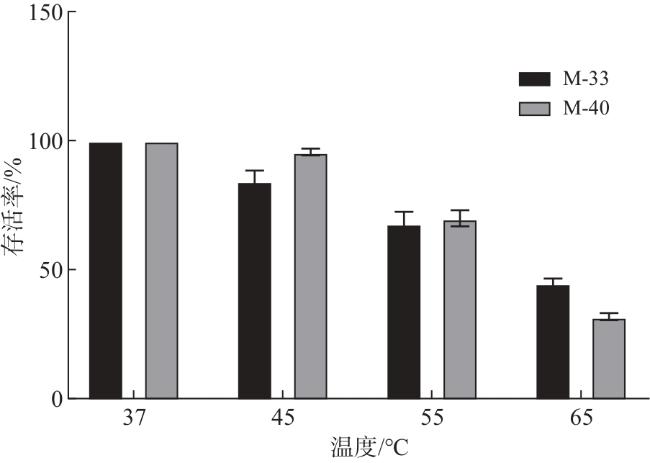
分别对菌株的生长特性、碳源利用能力、溶血性、耐热/耐酸/耐胆盐能力、抑菌能力和抗生素耐药性进行测定。(1)将菌株接种于MRS液体培养基中,37 ℃静置培养24 h,每2 h取样后在600 nm波长处测定吸光度(OD600),并根据结果绘制菌株的生长曲线。(2)在碳源利用特性的测定中,分别记录菌株对纤维二糖、麦芽糖、七叶苷、水杨素、山梨醇、蔗糖、菊糖、棉子糖、甘露醇和乳糖的利用情况。(3)将菌株划线于含5%羊血的哥伦比亚血琼脂平板,37 ℃培养24 h后观察并记录菌株的溶血情况。(4)参照孙丽萍等[10]的方法,对菌株的抑菌能力和抗生素敏感性进行测定。(5)将菌液接种至MRS肉汤培养基,分装后分别放在37、45、55、65、75 ℃的恒温水浴锅中处理10 min,各取50 μL菌液进行涂板并计数,以37 ℃条件下培养的菌落数为对照组计算存活率。(5)将待测菌株分别接种到pH为2和含0.2%牛胆盐的MRS液体培养基中,置于37 ℃条件下培养,分别在0 (对照组)和4 h(试验组)时取菌液涂板进行平板计数,计算存活率,计算如式(1) 。
存活率(%)=(实验组平板菌落平均数/对照组平板菌落平均数)×100
1.4 数据统计
每个试验均设3个重复,使用GraphPad Prism 9.0软件对数据进行统计学分析,并以平均值±标准差形式表示。
2 结果与分析
2.1 菌株的分离及抗氧化能力
通过乳酸杆菌的特异性培养,共获得10株菌,分别命名为M-01、M-06、M-16、M-18、M-24、M-27、M-30、M-33、M-34和M-40。如表1所示,10株分离菌的发酵上清液、菌悬液和无菌体破碎物均有一定的DPPH自由基清除能力,其中M-40和M-33的清除能力较强,在3组组分中的清除率均高于100%。羟自由基清除率方面,不同菌株的3种组分均具有一定的清除能力,以M-18最强,其次为M-33和M-40,而M-24和M-34较弱。还原能力方面,大部分菌株的发酵上清液不具备还原能力,M-33和M-40是仅有的阳性菌株,同时其菌悬液和无菌体破碎物也具备一定的还原能力,尤其是M-33,菌悬液的还原能力为60.6%,明显高于M-06外的其他菌株(P<0.05)。因此,M-33和M-40是具有较强抗氧化能力的菌株,可作为候选菌株进行后续研究。
表1 分离菌株的抗氧化能力测定 单位:% |
| 菌株 | DPPH自由基清除率 | 羟自由基清除率 | 还原能力 | ||||||
|---|---|---|---|---|---|---|---|---|---|
| 发酵上清液 | 菌悬液 | 无菌体破碎物 | 发酵上清液 | 菌悬液 | 无菌体破碎物 | 发酵上清液 | 菌悬液 | 无菌体破碎物 | |
| M-01 | 95.5±0.6 c | 104.2±0.8 ab | 107.1±1.65 a | 78.3±0.8 c | 65.4±0 cd | 58.1±0.8 e | / | 3.9±3.9 de | 36.3±1.1 b |
| M-06 | 91.9±0.8 cd | 91.4±1.1 c | 92.6±0.6 b | 85.5±1.1 a | 68.4±0.3 c | 66.0±0.9 d | / | 58.0±0.6 a | / |
| M-16 | 101.7±0.5 b | 102.8±0.4 b | 92.6±0.5 b | 77.2±0.3 c | 67.3±0.3 c | 70.6±0.4 bc | / | 24.1±0.2 b | 56.8±0.4 a |
| M-18 | 92.7±2.6 cd | 104.2±1.6 ab | 101.2±1.8 a | 84.2±1.7 a | 79.0±0.9 a | 75.8±0.5 a | / | / | 38.7±1.9 b |
| M-24 | 93.5±3.8 cd | 80.7±1.2 e | 83.7±5.2 c | 41.0±2.2 e | 62.2±1.8 d | 57.8±1.6 e | / | 13.8±4.0 cd | / |
| M-27 | 91.4±1.0 d | 86.4±0.9 d | 92.0±1.5 b | 83.0±2.3 ab | 62.6±2.5 d | 72.7±1.6 ab | / | 13.0±2.4 cd | 51.3±0.9 ab |
| M-30 | 85.7±0.8 e | 84.3±3.2 d | 41.2±1.0 c | 84.4±2.2 a | 68.1±0.2 c | 68.0±0.7 cd | / | 8.3±1.0 cd | 4.9±6.8 cd |
| M-33 | 107.4±1.00 a | 102.1±1.4 b | 107.1±2.0 a | 84.5±1.2 a | 72.9±2.3 b | 74.3±4.7 ab | 7.8±2.3 a | 60.6±0.5 a | 20.1±1.3 c |
| M-34 | 103.2±2.5 b | 103.7±1.3 ab | 74.2±1.0 d | 72.5±1.9 d | 63.2±2.7 d | 57.0±1.7 e | / | 6.4±4.7 de | 5.6±3.1 cd |
| M-40 | 106.9±3.3 a | 105.6±1.1 a | 102.4±1.0 a | 79.7±5.2 bc | 74.8±3.0 b | 73.3±3.3 ab | 0.8±0.3 b | 16.9±5.3 bc | 5.8±2.1 cd |
|
2.2 菌落形态及16S rDNA鉴定
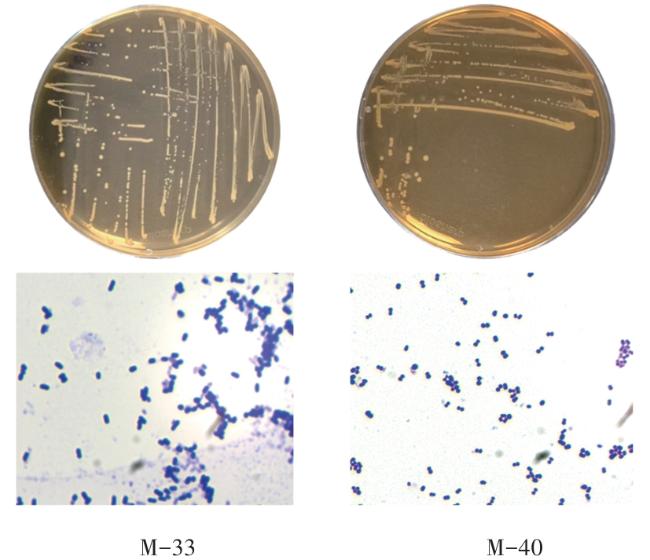
M-33和M-40的菌落形态和革兰氏染色镜检结果如图1所示,两个菌株呈白色或乳白色,菌落表面光滑圆润,边缘整齐;革兰氏染色均呈阳性,呈单个或成对排列,M-33为短杆状,而M-40为球状。
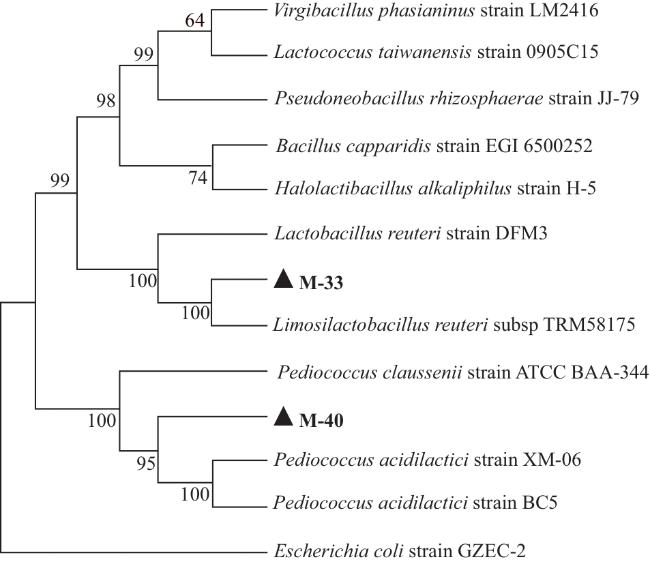
将两株菌的16S rDNA扩增序列进行系统发育树的构建,结果如图2所示,M-33与罗伊氏乳杆菌(Limosilactobacillus reuteri)TRM58175处于同一进化分支,亲缘关系较近,M-40则与乳酸片球菌(Pediococcus acidilactici)XM-06处于同一进化分支。表明两菌株分别为罗伊氏乳杆菌和乳酸片球菌。
2.3 生长曲线
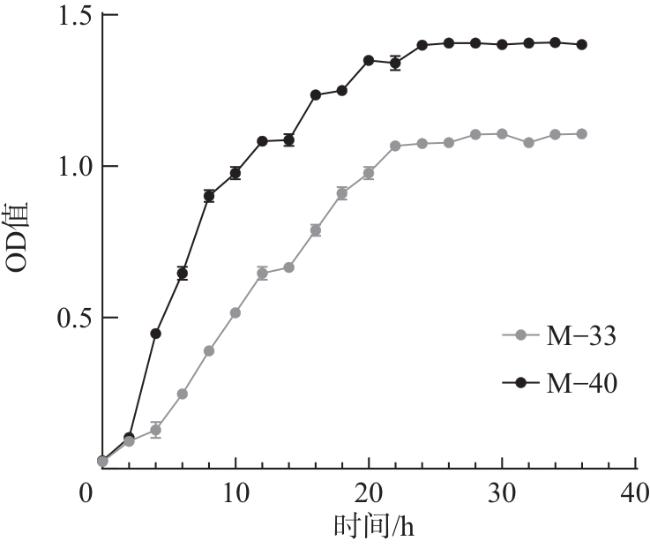
生长特性的测定结果如图3所示,M-40在2 h进入对数生长期,18 h进入平台期;而M-33生长相对缓慢,2~22 h为对数生长期,24 h后进入平台期。
2.4 碳源利用能力
如表2所示,M-33和M-40对纤维二糖、麦芽糖、七叶苷、水杨素、山梨醇、蔗糖、菊糖、棉子糖、甘露醇和乳糖的反应均呈阳性,表明菌株可利用上述碳源进行发酵,其碳源利用度较广。
表2 M-33和M-40对碳源的利用情况 |
| 生化项目 | M-33 | M-40 |
|---|---|---|
| 纤维二糖 | + | + |
| 麦芽糖 | + | + |
| 七叶苷 | + | + |
| 水杨素 | + | + |
| 山梨醇 | + | + |
| 蔗糖 | + | + |
| 菊糖 | + | + |
| 棉子糖 | + | + |
| 甘露醇 | + | + |
| 乳糖 | + | + |
|
2.5 抑菌能力
2.6 抗生素耐药性的测定
如表4所示,M-33对环丙沙星和红霉素均具有一定的耐药性,而M-40仅对环丙沙星表现出耐药性。
表4 抗生素敏感性抑菌圈直径 |
| 抗生素 | 每片含量/μg | 抑菌圈直径/mm | 敏感类型 | ||
|---|---|---|---|---|---|
| M-33 | M-40 | M-33 | M-40 | ||
| 万古霉素 | 30 | 14.76±0.58 | 17.39±3.61 | S | S |
| 环丙沙星 | 5 | R | R | ||
| 庆大霉素 | 10 | 14.91±0.32 | 14.24±0.56 | I | I |
| 氯霉素 | 30 | 28.55±2.65 | 30.12±1.53 | S | S |
| 氨苄西林 | 10 | 32.60±5.03 | 24.37±4.16 | S | S |
| 利福霉素 | 5 | 28.13±5.03 | 24.82±5.03 | S | S |
| 四环素 | 30 | 20.90±1.00 | 19.90±1.53 | S | S |
| 红霉素 | 15 | 1.62±2.63 | 27.32±0.68 | R | S |
|
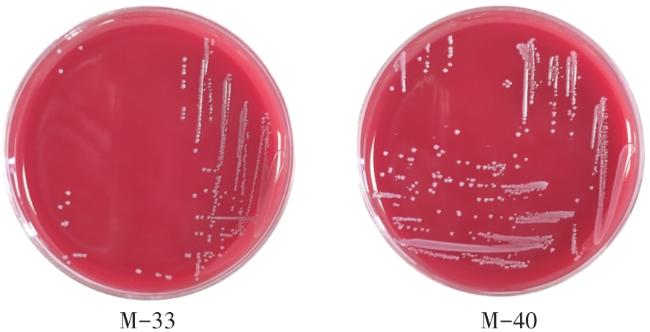
2.7 溶血性的测定
2.8 耐热、耐酸和耐胆盐能力的测定
如图6所示,两菌株的存活率随温度的升高而逐渐降低,55 ℃处理后的存活率仍在50%以上,65 ℃处理后分别降至44.86%(M-33)和31.82%(M-40)。说明M-33和M-40具有较强的耐高温能力。


如表5所示,M-33和M-40在pH 2的条件下培养4 h的存活率分别为54.92%和27.82%,差异具有统计学意义(P<0.05);而在0.2%牛胆盐条件下培养4 h的存活率分别为71.87%和70.77%,差异无统计学意义(P<0.05)。表明M-33的耐酸和耐胆盐能力均较强,M-40的耐胆盐能力较强,但耐酸能力较弱,但仍能保证其在正常生物体肠道环境中生存。
表5 菌株M-33和M-40的酸耐受性和胆盐耐受性 |
| 项目 | 存活率/% | |
|---|---|---|
| M-33 | M-40 | |
| 酸耐受性(pH 2,4 h) | 54.92±2.57 a | 27.82±3.16 b |
| 胆盐耐受性(0.2%牛胆盐,4 h) | 71.87±3.03 a | 70.77±5.35 a |
3 结论与讨论
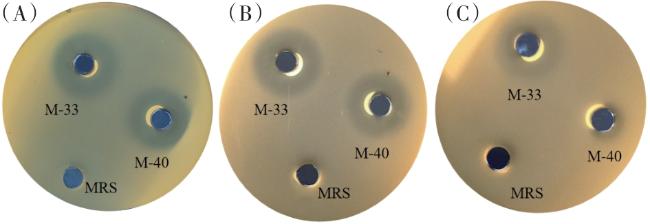
抑菌和抵抗极端环境的能力是衡量益生菌抑制病原微生物增殖与保护肠道的重要指标。仇聪蕊等[18]研究表明,乳酸菌能够通过促进β防御素的表达与分泌,抑制病原微生物的生长和繁殖,同时利用代谢产生的有机酸、细菌素、抗菌肽等物质发挥抑制和杀灭病原菌的作用。本研究分离的M-33和M-40对大肠杆菌、沙门氏菌和金色葡萄球菌均具有较好的抑菌作用,较张杨等[19]分离的枯草芽孢杆菌的抑菌能力更强,这可能得益于两种乳酸菌能够产生更多具有抑菌作用的代谢产物,如乳酸、乙醇、乙酸、罗伊氏菌素等[1]。无论是在机体胃肠道还是微生态制剂加工过程中,菌株难免会暴露于高温、低pH和高胆盐等环境中,所以优质益生菌还需具备耐受高温、强酸和高胆盐的能力。M-33在pH 2条件下培养4 h的存活率仍在50%以上,而M-40存活率也能达到27.82%;在0.20%牛胆盐条件下的两个菌株的存活率在70%以上,表明其对强酸和高胆盐环境均具有一定的耐受性。其中,M-33和M-40在低pH环境下的存活率差异较大,反映出两株菌对低pH耐受性的种间差异,这可能与菌株代谢的酸类物质有关[1]。
宠物疾病治疗中抗生素滥用导致的细菌耐药性值得关注,因此替抗益生菌是否具有耐药性是筛选过程的关键,无毒无害、无溶血性且对大多数抗生素无耐药性是必备条件。本研究的结果显示,M-33和M-40对氯霉素、四环素等5种常见抗生素无耐药性。此外,M-33和M-40不具有溶血性,具有较高的安全性。
综上,本研究分离鉴定获得的2株具有较强抗氧化能力的猫源益生菌M-33和M-40不仅对胆盐、强酸和高温条件具有一定的耐受性,且对常见致病菌具有较好的抑制作用,此外,药敏和溶血等指标也符合常见益生菌的特性。因此,M-33和M-40具备开发成为猫源益生菌制剂的潜力。