

化肥是小麦生产体系中的关键农业投入品,然而,长期过量施肥不利于农业的可持续发展[1]。推广施用新型环保肥料是解决该问题的重要手段[2]。Li等[3]研究表明,在化肥中添加有机肥可提高土壤有机碳含量,增强土壤酶活性。
微生物复合菌剂由2种以上无拮抗作用的微生物制成,其不仅可改变土壤微生物群落结构,减少病原菌数量,同时具有增加土壤速效养分含量,增强土壤酶活性,最终提升作物产量[4-6]。吕黎等[7]研究表明,木霉复合菌剂对病原菌具有拮抗作用,能够有效抑制植物病害的发生发展。
植物免疫诱抗剂是一种外源植物激素,主要通过苯丙氨酸解氨酶(PAL)基因的表达,诱导水杨酸的生物合成、促进RNA沉默来抵抗病毒侵染[8]。此外,其还可提高氮素代谢相关酶活性,提高氮肥利用率,促进作物生长发育并增加作物产量[9-10]。
新型绿色投入品在小麦生产中起着关键作用,关于新型农业投入品单一作用的研究较多,然而对配施的交互效应研究较少。基于此,本试验开展了含有机质复合肥、木霉复合菌剂和免疫诱抗剂3种绿色投入品单一施用和组合配施比较试验,探究其对土壤及小麦产量的影响,以期为小麦高产高效生产提供参考。
1 材料与方法
1.1 试验地基本情况
试验在山东省莱阳市团旺镇东后寨村(36°46′ N,120°38′ E)进行,该地属温带季风气候,年平均降水量约650 mm,年平均气温13.4 ℃,年平均日照时数2 933.1 h,平均无霜期173 d。光照充足、四季分明,月降水量差异较大且多集中在6—8月,主栽作物为小麦、玉米、花生和大豆等,供试土壤为砂质棕壤土。
1.2 试验材料
供试小麦品种为胜麦711(鲁审麦20206024)。含有机质复合肥由山东农业大学肥业公司提供;木霉复合菌剂由山东省科学院生物研究所提供;免疫诱抗剂由山东蓬勃生物科技有限公司提供,是从野生沙棘植株中分离、纯化的内生真菌菌丝体中提取的高活性植物生长促进物质,母液浓度为5 mg/mL。
1.3 试验设计
采用三因素随机区组设计,分别是复合肥、菌剂和免疫诱抗剂。其中复合肥设2个水平,分别为施用含有机质复合肥750 kg/hm2(N∶P∶K为15∶15∶15)(D)和施用当地农户常用复合肥(N∶P∶K为17∶17∶4)750 kg/hm2对照,播前均匀撒施;菌剂2个水平,分别为木霉复合菌剂30 kg/hm2(J)和不施用菌剂对照,播前均匀撒施;免疫诱抗剂2个水平,分别为5 mg/mL免疫诱抗剂(施用时稀释至50 ng/mL)450 L/hm2(Z)和清水对照,在苗期与拔节期各喷施1次。以施用当地农户常用复合肥、不撒施菌剂和喷施清水处理为对照(CK),设置CK、D、J、Z、DZ(含有机质复合肥与免疫诱抗剂配施)、DJ(含有机质复合肥与木霉复合菌剂配施)、JZ(木霉复合菌剂与免疫诱抗剂配施)、DJZ(含有机质复合肥、木霉复合菌剂和免疫诱抗剂配施)共8个处理,设置3个重复小区,共24个小区,各小区面积为222 m2。
1.4 测定项目与方法
在小麦拔节期、开花期和收获期采用“S”形取样法用土钻取0~10、10~20、20~30、30~40、40~50 cm土层土样,取部分样品放入4 ℃冰箱保存备用,另一部分自然风干过60目筛。采用半微量凯氏定氮法,利用全自动定氮仪(k9840,海能未来技术集团股份有限公司)测定土壤全氮含量;总有机碳分析仪(vario TOC cube,Elementar Analysensysteme GmbH)测定土壤有机碳含量;采用苯酚—次氯酸钠比色法,使用紫外可见分光光度计[UV-2450,岛津仪器(苏州)有限公司]测定土壤脲酶活性;取冷冻鲜土,使用流动分析仪[AA3,水尔分析仪器(上海)有限公司]测定其铵态氮、硝态氮含量。在小麦收获期选取具有代表性的1 m2小区人工收获,每个处理3次重复,进行室内考种以及测产工作。
1.5 数据处理
采用SPSS 26.0软件的单因素方差法进行数据统计学分析,利用Origin 2021软件绘图。
2 结果与分析
2.1 对土壤全氮含量的影响
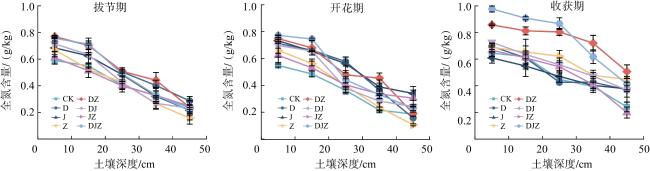
由图1可知,小麦拔节期,D处理下土壤全氮含量最高;DJZ处理下0~10、10~20、20~30 cm土层全氮含量较CK分别增加28.26%、30.03%和21.15%;J、Z和JZ处理下0~10 cm土层全氮含量高于CK,但低于其他处理。开花期,DJZ处理下0~10 cm、10~20 cm土层全氮含量较高,较CK分别增加40.78%、50.03%;D处理下20~30 cm土层全氮含量最高,较CK增加58.07%;DZ处理下30~40 cm土层全氮含量最高,较CK增加109.02%;收获期,DJZ处理(除40~50 cm土层外)与DZ处理土壤全氮含量均高于其他处理,DJZ处理下0~10、10~20、20~30 cm土层全氮含量较高,较CK分别增加51.42%、46.85%和93.41%,DZ处理下30~40、40~50 cm土层全氮含量最高,较CK分别增加82.4%、110.32%。综合来看,与CK相比,3种投入品均可增加各土层全氮含量,有机质复合肥与免疫诱抗剂(DZ)效果较好。
2.2 对土壤有机碳含量的影响
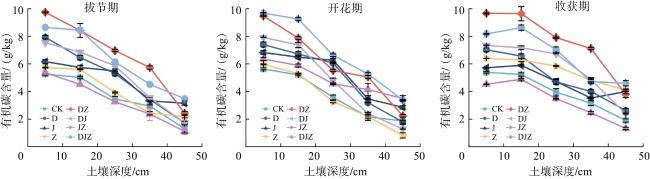
由图2可知,小麦拔节期,DZ处理下0~10、10~20、20~30、30~40 cm土层有机碳含量较高,较CK分别增加70.41%、55.57%、77.22%和68.99%;DJZ处理下40~50 cm土层有机碳含量较CK增加91.17%,JZ处理下10~50 cm各土层有机碳含量均低于CK,其他处理(除Z处理30~40 cm土层外)在各土层均高于CK。开花期,DJZ处理下土壤有机碳含量最高。CK处理下40~50 cm土层有机碳含量高于Z、DJ和D处理,分别高56.5%、32%和4.2%,其处理的20~30 cm土层有机碳含量高于Z处理,除此之外,其他处理各土层有机碳含量均高于CK。收获期,JZ处理下土壤有机碳含量最低;DJ处理下40~50 cm土层有机碳含量相对较低,30~40 cm土层有机碳含量较20~30 cm土层降低23.9%;DZ处理下各土层有机碳含量均高于CK,且在0~40 cm土层有机碳含量均高于其他处理,40~50 cm土层有机碳含量较DJZ、J和Z分别降低14.1%、3.9%和5.8%。综合来看,与CK相比,3种投入品均可增加土壤有机碳含量,但菌剂与免疫诱抗剂组合(JZ)施用在小麦拔节期与收获期会降低土壤有机碳含量。
2.3 对土壤脲酶活性的影响
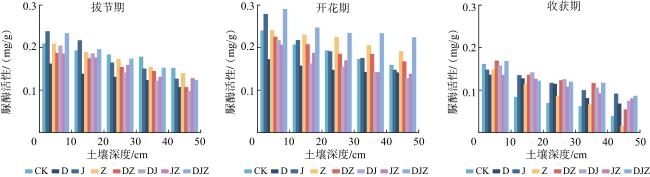
由图3可知,土壤脲酶活性表现为开花期最高,收获期最低。小麦拔节期,D处理下0~10、10~20 cm土层土壤脲酶活性较CK分别提升11.7%和10.9%,其余处理下(除DJZ处理下0~10、10~20 cm土层外)各土层脲酶活性均低于CK。开花期,DJZ处理下0~10、10~20、20~30、30~40、40~50 cm土层土壤脲酶含量明显高于其他处理,较CK分别增加21.2%、19.6%、21.7%、35.6%和41.6%,J、DJ和JZ处理下各土层土壤脲酶活性均低于CK。收获期,DJZ处理下0~10 cm土层脲酶活性最高,较CK提升了4.2%;各处理下10~50 cm土层脲酶活性均高于CK。综合来看,含有机质复合肥与免疫诱抗剂主要在开花期增强土壤脲酶活性,单一施用木霉菌剂在拔节期和开花期会降低土壤脲酶活性,与其他投入品配合施用则增强土壤脲酶活性。


2.4 对土壤氨态氮含量的影响
2.4.1 小麦拔节期
由表1可知,DZ处理下0~10 cm土层NH4-N含量较CK提高48.3%,DJ处理较CK降低24.5%。10~20 cm土层,DZ处理下NH4-N含量最高,较CK处理提高19.5%,J、DJ和JZ处理均低于CK,较CK分别降低4.7%、13.6%和11.8%;20~30、30~40 cm土层,各处理NH4-N含量均明显低于CK(P<0.05);40~50 cm土层,与CK相比,DZ处理下NH4-N含量降低58.6%,DJZ处理下NH4-N含量提高29.5%。
表1 对拔节期土壤NH4-N含量的影响 (mg/kg) |
| 处理 | 土壤深度 | ||||
|---|---|---|---|---|---|
| 0~10 cm | 10~20 cm | 20~30 cm | 30~40 cm | 40~50 cm | |
| CK | 28.641 bc | 23.853 b | 27.967 a | 79.168 a | 54.054 ab |
| D | 26.353 c | 24.168 ab | 20.837 b | 14.125 d | 32.984 c |
| J | 29.533 b | 22.739 ab | 21.777 b | 43.250 b | 31.864 c |
| Z | 29.467 b | 24.940 ab | 25.609 a | 42.826 b | 68.603 a |
| DZ | 42.484 a | 28.505 a | 20.783 b | 21.201 c | 22.391 c |
| DJ | 21.614 d | 20.620 c | 20.902 b | 14.125 d | 41.696 b |
| JZ | 26.582 c | 21.038 c | 20.364 b | 33.125 bc | 31.332 c |
| DJZ | 23.571 c | 23.810 b | 20.174 b | 64.239 a | 69.995 a |
|
2.4.2 小麦开花期
由表2可知,0~10 cm土层与CK相比,J处理下NH4-N含量提高58.6%,DJ和DJZ处理下NH4-N含量分别降低12.9%和7.2%。10~20 cm土层,与CK处理相比,J处理下NH4-N含量提高48.1%,而D、Z、DZ、DJ和DJZ处理下NH4-N含量分别降低8.6%、3.7%、12.1%、11.0%和8.0%。20~30 cm土层,与CK处理相比,J处理下NH4-N含量提高55.9%,DZ、DJ和DJZ处理下NH4-N含量分别降低2.3%、8.2%和2.6%。30~40 cm土层,与CK处理相比,J处理下NH4-N含量提高21.9%,而DJZ处理下NH4-N含量降低0.6%。在40~50 cm土层,JZ处理下NH4-N含量较CK提高13.8%,而DJ和DJZ处理下NH4-N含量分别降低2.0%和2.5%。
表2 对开花期土壤NH4-N含量的影响 (mg/kg) |
| 处理 | 土壤深度 | ||||
|---|---|---|---|---|---|
| 0~10 cm | 10~20 cm | 20~30 cm | 30~40 cm | 40~50 cm | |
| CK | 30.511 c | 26.913 b | 22.728 c | 20.489 c | 20.804 d |
| D | 31.478 c | 24.609 c | 24.978 b | 20.902 c | 21.217 cd |
| J | 48.380 a | 39.870 a | 35.435 a | 24.967 a | 21.750 c |
| Z | 30.924 c | 25.924 bc | 23.413 bc | 22.467 b | 20.924 d |
| DZ | 44.598 b | 23.663 c | 22.207 c | 21.380 bc | 21.141 cd |
| DJ | 26.587 d | 23.946 c | 20.859 d | 20.707 c | 20.391 d |
| JZ | 38.163 b | 33.011 a | 24.870 b | 20.902 c | 23.674 b |
| DJZ | 28.304 d | 24.750 c | 22.130 c | 20.359 c | 20.293 d |
2.4.3 小麦收获期
由表3可知,0~10 cm土层,与CK相比,J处理下NH₄-N含量降低38.7%;10~20 cm土层,DJZ处理下NH₄-N含量较CK提高0.8%(P>0.05),而D、Z处理下NH₄-N含量明显高于CK(P<0.05);20~30 cm土层,与CK相比,DJZ处理下NH₄-N含量提高15.5%,而DJ处理下NH₄-N含量降低13.2%。30~40 cm土层,与CK相比,Z处理下NH₄-N含量降低32.5%,而JZ、DJZ处理下NH₄-N含量分别提高470.9%、383.2%,且明显高于其他处理(P<0.05)。40~50 cm土层,D、J和Z处理下NH₄-N含量与CK差异无统计学意义(P>0.05),而DZ、DJ、JZ和DJZ处理下NH₄-N含量较CK分别明显提高297.4%、411.1%、384.7%和541.4%。
表 3 对收获期土壤NH4-N含量的影响 (mg/kg) |
| 处理 | 土壤深度 | ||||
|---|---|---|---|---|---|
| 0~10 cm | 10~20 cm | 20~30 cm | 30~40 cm | 40~50 cm | |
| CK | 8.239 c | 10.761 b | 5.185 c | 6.315 c | 4.196 c |
| D | 21.935 a | 16.217 a | 7.663 a | 5.576 c | 4.424 c |
| J | 5.054 c | 7.696 c | 6.652 b | 5.620 c | 5.141 c |
| Z | 6.772 c | 16.728 a | 7.587 a | 4.261 c | 5.935 c |
| DZ | 11.707 b | 9.826 b | 5.946 bc | 10.696 b | 16.674 b |
| DJ | 11.565 b | 4.652 c | 4.500 c | 10.283 b | 21.446 b |
| JZ | 11.424 b | 7.826 c | 6.152 b | 36.054 a | 20.337 b |
| DJZ | 14.250 b | 10.848 b | 5.989 bc | 30.511 a | 26.913 a |
2.5 对土壤硝态氮含量的影响
2.5.1 小麦拔节期
由表4可知,0~10 cm土层,DJ处理下NO₃-N含量较CK明显提高103.9%,且明显高于其他处理(P<0.05);10~20 cm土层,与CK相比,DJ、D和DZ处理下NO₃-N含量分别提高97.1%、51.7%和59.4%;20~30 cm土层,与CK相比,DJ处理提高169.6%,且明显高于其他处理(P<0.05);30~40 cm土层,DJZ处理下NO₃-N含量较CK提高 862.2%,且明显高于其他处理(P<0.05);40~50 cm土层,DJZ处理较CK提高472.0%,且明显高于其他处理(P<0.05)。
表 4 对拔节期土壤NO3-N含量的影响 (mg/kg) |
| 处理 | 土壤深度 | ||||
|---|---|---|---|---|---|
| 0~10 cm | 10~20 cm | 20~30 cm | 30~40 cm | 40~50 cm | |
| CK | 8.587 c | 6.984 c | 7.538 c | 5.674 d | 8.277 c |
| D | 11.288 b | 10.592 ab | 8.533 bc | 30.435 b | 9.239 c |
| J | 9.826 c | 7.027 b | 7.005 c | 8.071 d | 7.962 c |
| Z | 7.978 c | 7.674 b | 7.196 c | 12.761 c | 14.049 bc |
| DZ | 9.609 c | 11.130 a | 11.826 b | 15.511 c | 21.332 b |
| DJ | 17.511 a | 13.766 a | 20.326 a | 30.435 b | 10.957 c |
| JZ | 8.853 c | 9.946 ab | 8.750 c | 13.908 c | 14.283 bc |
| DJZ | 11.750 b | 8.821 b | 9.679 bc | 54.598 a | 47.342 a |
2.5.2 小麦开花期
由表5可知,0~10 cm土层,与CK相比,D、J、DZ、DJ和JZ处理下NO₃-N含量均明显高于CK(P<0.05);10~20 cm土层,与CK相比,DJ和DZ处理下NO₃-N含量分别提高120.2%和261.7%,而DJZ处理下的NO₃-N含量较CK降低1.8%;20~30 cm土层,与CK处理相比,DJ处理下NO₃-N含量提高232.1%;30~40 cm土层,CK和J处理下NO₃-N含量明显低于D、Z和DZ处理,而DJZ和JZ处理下NO₃-N含量较CK分别降低38.7%和26.6%。40~50 cm土层,与CK处理相比,DZ处理下NO₃-N含量明显提高147.7%(P<0.05)。
表5 对开花期土壤NO3-N含量的影响 (mg/kg) |
| 处理 | 土壤深度 | ||||
|---|---|---|---|---|---|
| 0~10 cm | 10~20 cm | 20~30 cm | 30~40 cm | 40~50 cm | |
| CK | 8.033 c | 8.304 c | 6.174 c | 13.217 b | 13.033 b |
| D | 15.207 b | 13.337 b | 8.804 c | 23.630 a | 25.826 a |
| J | 21.304 a | 12.826 b | 8.946 c | 11.120 b | 13.022 b |
| Z | 8.087 c | 9.880 c | 6.902 c | 23.359 a | 12.076 b |
| DZ | 16.924 a | 30.033 a | 36.554 a | 24.837 a | 17.217 b |
| DJ | 15.826 b | 18.283 b | 14.163 b | 12.630 b | 9.598 c |
| JZ | 14.717 b | 15.815 b | 13.174 b | 9.707 c | 10.15 2 |
| DJZ | 11.359 c | 8.152 c | 8.804 c | 8.098 c | 8.511 c |
2.5.3 小麦收获期
由表6可知,0~10 cm土层,Z和JZ处理下NO₃-N含量明显低于其他处理,DJ、DJZ处理下NO₃-N含量明显高于其他处理(P<0.05);10~20 cm土层,DJ、DJZ处理下NO₃-N含量明显高于其他处理,其中DJZ处理较CK提高56.6%;20~30 cm土层,J、Z处理下NO₃-N含量明显低于其他处理(P<0.05),D、DJ处理与CK差异无统计学意义(P>0.05);30~40 cm土层,JZ、DJZ处理下NO₃-N含量明显高于CK(P<0.05),较CK分别提高了104.3%和104.4%;40~50 cm土层,JZ、DZ处理下NO₃-N含量较CK分别提高86.1%和147.7%,DZ处理下NO₃-N含量明显高于其他处理(P<0.05)。
表6 对收获期土壤NO3-N含量的影响 (mg/kg) |
| 处理 | 土壤深度 | ||||
|---|---|---|---|---|---|
| 0~10 cm | 10~20 cm | 20~30 cm | 30~40 cm | 40~50 cm | |
| CK | 11.163 b | 11.457 b | 11.239 a | 8.641 c | 7.674 c |
| D | 13.880 b | 8.500 bc | 11.340 a | 11.228 b | 8.478 c |
| J | 12.293 b | 9.826 b | 8.120 c | 7.609 c | 7.359 c |
| Z | 7.978 c | 7.696 c | 8.174 c | 9.859 c | 10.620 b |
| DZ | 13.511 b | 13.174 b | 9.239 b | 14.620 b | 19.011 a |
| DJ | 19.272 a | 15.870 a | 13.848 a | 9.793 c | 9.663 b |
| JZ | 9.043 c | 9.848 b | 8.902 bc | 17.652 a | 14.283 a |
| DJZ | 15.196 a | 17.946 a | 10.348 b | 17.663 a | 11.815 b |
2.6 对小麦产量的影响
由表7可知,DJZ处理单位面积穗数最高,明显高于其他处理,较CK增加37.52%;D、DZ和JZ处理小麦穗粒数较高,较CK分别增加8.58%、11.09%和11.30%;各处理千粒重差异无统计学意义(P>0.05);产量由高到低表现为DJZ>DJ>JZ>DZ>D>Z>J>CK,施用单一绿色投入品的处理中D处理产量最高,较CK增产8.30%,J、Z处理较CK分别增产6.36%、7.04%。施用绿色投入品组合处理中DJZ处理产量最高,较CK处理增产32.90%,DZ、DJ、JZ较CK分别增产9.78%、26.36%和11.41%。综上,与CK相比,DJ和DJZ处理增产效果最为明显。
表7 不同绿色投入品对小麦产量的影响 |
| 处理 | 单位面积穗数/ (万穗/hm2) | 穗粒数/粒 | 千粒重 | 产量/ (kg/hm2) |
|---|---|---|---|---|
| CK | 20.60 bc | 47.8 c | 46.31 a | 4 287.55 c |
| D | 20.87 bc | 51.9 ab | 42.87 a | 4 643.47 b |
| J | 21.67 b | 50.0 b | 42.35 a | 4 560.05 bc |
| Z | 19.40 c | 50.9 b | 43.42 a | 4 589.54 bc |
| DZ | 20.00 bc | 53.1 a | 44.32 a | 4 706.78 b |
| DJ | 22.93 b | 50.8 b | 46.51 a | 5 417.69 a |
| JZ | 20.20 bc | 53.2 a | 44.45 a | 4 776.78 b |
| DJZ | 28.33 a | 46.1 c | 43.63 a | 5 698.14 a |
3 结论与讨论
本研究中,开花期与收获期,与CK相比,施用DJZ处理可增加土壤全氮含量和土壤脲酶活性,同时增加土壤(尤其深层土壤)NH4-N含量;D处理可改变土壤氮素形态,增加NO₃-N比例。施用硝态氮肥能显著提高小麦干物质累积量,减少氮素损失,其与施用铵态氮肥相比具有更高的氮素利用率,作物产量更高[11]。施用有机复合肥可显著提高土壤NO3-N含量,进而提高作物产量。木霉复合菌剂除具有生物防治作用外,还可促进作物生长[12]。研究表明,有机肥配施微生物菌剂可有效改良土壤理化性质,增加土壤速效养分,提高土壤酶活性和作物产量[13-14]。免疫诱抗剂与控释肥配施具有协同效应,可提高小麦生育关键期的氮肥利用效率,实现小麦增产[15]。
施用单一绿色投入品或其组合均可明显增加小麦产量,配施较单一施用增产效果更为明显。含有机质复合肥可在小麦拔节期增加土壤全氮以及在开花期和收获期NH4-N含量;免疫诱抗剂与木霉复合菌剂可分别作用于土壤和植株,通过改变土壤环境与植株代谢对土壤氮素产生间接影响,单一施用木霉菌剂会直接影响土壤微生物群落结构,增加土壤有机碳含量,影响脲酶活性,但由于缺少有机质供应无法完全发挥作用。单一施用免疫诱抗剂通过作用于植株间接影响土壤脲酶活性,增加小麦开花期脲酶活性,免疫诱抗剂与木霉复合菌剂配施可在小麦收获期深层土壤提升脲酶活性。
本研究中含有机质复合肥与木霉复合菌剂配施可在开花期和收获期增加土壤全氮含量、氨态氮含量、有机碳含量及作物产量。与苏桢等[16]的研究结果一致。在此组合基础上增加免疫诱抗剂则有助于提高小麦开花期土壤脲酶活性,增加小麦生育前期的硝态氮含量,提高小麦产量。
综上,生产中配施有机复合肥、木霉复合菌剂和免疫诱抗剂可改善土壤理化性质,增加拔节期、开花期和收获期0~50 cm土层有机碳与全氮含量,增加收获期0~50 cm土层NH4-N含量,提升开花期和收获期0~50 cm土层脲酶活性,并提高小麦产量。