

了解地表产流与产沙特点,对制定有效的水土保持措施,保护生态环境具有重要意义[1-2]。砂姜黑土具有“漏水性”特征(孔隙度35%~40%),在强降雨条件下易发生较严重的土壤侵蚀[3]。研究表明,降雨强度和土壤坡度是影响地表产流与产沙的关键因子,低雨强时入渗主导产流,高雨强时以径流冲刷为主,而坡度通过改变水力梯度影响侵蚀动力,二者的耦合作用机制还有待进一步明确[4]。目前,相关研究多聚焦单一因素影响,对多变量协同作用的定量解析还有待深入。例如,祝怀春等[5]研究发现,降雨强度的变化对堆积体坡面产流具有显著影响。时宏[6]研究得出,坡面产流与产沙量随着坡度的增加而增大,坡度在20°~25°时的产流和产沙量最高。可见,地表产流和产沙与土壤结构、降雨历时等因素有关。人工模拟降雨作为水土流失防治领域的重要研究手段之一,其试验参数设置(雨强梯度、坡度组合等)对结果可比性存在显著影响。赵艳茹等[7]研究表明,土壤剥蚀率和水流含沙量与雨强的关系较为密切,随雨强的增加而增大;坡度对土壤剥蚀率有一定影响,在试验坡度和流量范围内剥蚀率、含沙量随坡度增加呈先增加后减小趋势[8]。本研究通过模拟降雨强度和坡度梯度试验,揭示砂姜黑土产流与产沙的响应规律,为平原坡面水土流失防治提供参考。
1 材料与方法
1.1 试验材料
试验在五道沟水文水资源实验站人工模拟降雨径流实验场进行。径流小区为固定坡长可调坡度的变坡钢槽(长×宽×高为8 m×4 m×2 m),回填的砂姜黑土取自五道沟实验站大田,取土后分层回填并自然密实,底部设置30 cm过滤层。实验区近30年实测最大降雨强度为78 mm/h,本次实验选定40、60、80 mm/h 3种降雨强度和2°、4°、6°、8° 4种坡度。试验在傍晚或夜晚无风的情况下进行。
1.2 试验过程
先标定泥沙测量传感器,配置0~50 g/L泥沙浓度,步长为5 g/L,每组至少测量3个数据,取平均值并拟合泥沙浓度与感光度曲线。降雨试验前用SL3-1型翻斗式雨量计测定雨强,测量钢槽内0~20 cm的土壤含水量,每次试验前保持土壤含水量基本一致。降雨开始时,用秒表计时,待坡面产流后,停止计时,此时秒表计时时间为初始产流时间;三角堰内泥沙径流测量传感器每隔1 min记录1次水位与泥沙含量,模拟降雨历时(t)60 min,模拟结束后,通过测量的水位和三角堰流量计算公式计算出产流量,由产流量和泥沙含量计算产沙率。
1.3 数据分析方法
运用WPS图表制作功能,绘制不同坡度和降雨强度下,产流时间、产流率和产沙率随降雨历时变化的折线图,初步分析各因素对产流、产沙的影响。采用SPSS 20软件中的曲线估计回归分析方法,分析初始产流时间、产流和产沙总量与雨强、坡度的关系,探索二者之间的函数关系,R 2越接近1,表明模型对数据的拟合效果越好,对变量之间的关系解释力越强,进而为研究结论提供统计学依据。
2 结果与分析
2.1 砂姜黑土坡面产流时间分析
不同降雨强度、坡度的初始产流时间如图1所示。当坡度一定时,初始产流时间与降雨强度呈负相关,降雨强度60 mm/h较40 mm/h的产流时间明显缩短,降雨强度80 mm/h较60 mm/h的初始产流时间缩短不明显。这表明相同坡度下,降雨强度的增大对产流时间的影响逐渐减弱。当坡度为2°时,降雨强度40 mm/h的初始产流时间较60 mm/h增加507 s,增长约58%;60 mm/h的初始产流时间较80 mm/h增加608 s,增长近234%。当坡度为4°时,40 mm/h的初始产流时间较60 mm/h增加216 s,增长约111%;60 mm/h的初始产流时间与80 mm/h基本一致。当坡度为6°时,40 mm/h的初始产流时间较60 mm/h增加91 s(约48%);60 mm/h的初始产流时间较80 mm/h增加50 s,增长约36%。当坡度为8°时,40 mm/h的初始产流时间较60 mm/h增加115 s(约100%);60 mm/h的初始产流时间较80 mm/h增加28 s(约32%)。产流时间增加主要是因为砂姜黑土土壤孔隙率大,入渗能力强,在降雨前期,降雨强度小于入渗强度;降雨前砂姜黑土前期影响雨量基本相同,当坡度不变时,径流小区有效雨量承受面积相同,随着降雨强度减小,有效减少了坡面单位面积所能承受的雨量,使产流时间大大增加[9]。
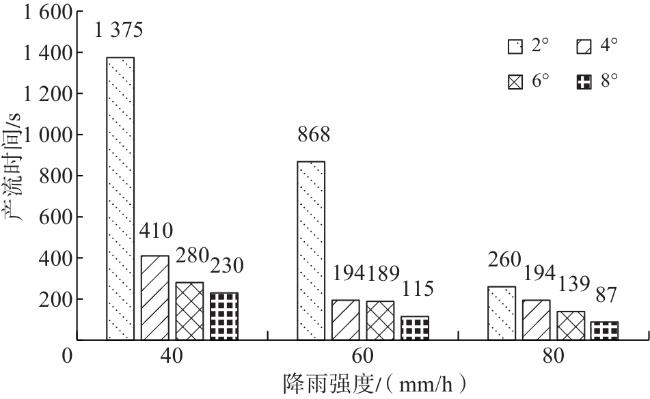
在相同降雨强度下,初始产流时间与坡度呈负相关,坡度减小,坡面初始产流时间增加。其中,4°坡较2°坡初始产流时间减少最为明显。当降雨强度为40 mm/h时,2°坡产流时间较4°坡增加965 s,4°坡产流时间较6°坡增加130 s,6°坡产流时间较8°坡增加50 s;当降雨强度为60 mm/h时,2°坡产流时间较4°坡增加674 s,4°坡产流时间较6°坡增加5 s,6°坡产流时间较8°坡增加74 s;当降雨强度为80 mm/h时,2°坡产流时间较4 °坡增加66 s,4°坡产流时间较6°坡增加55 s,6°坡产流时间较8°坡增加52 s。综上,初始产流时间随坡度减小而快速增加,这表明坡度越小对初始产流时间的影响程度越大。主要是因为降雨强度不变,随着坡度减小,土壤沿坡面方向的分力减少,径流汇流速度减小,削弱对坡面的冲刷效果,雨滴对坡面溅蚀能力增强,承雨量增加会与水流、土壤重力作用效果相互抵消部分,从而使初始产流时间增加。
对初始产流时间与降雨强度、坡度试验数据进行回归分析,得出初始产流时间与降雨强度、坡度回归方程,如式(1) 和式(2) 。
T0=-0.19σ2+8.18σ+782 R2=0.99
T0=2 647θ-0.965 R2=0.92
式中,T0为初始产流时间(s);σ为降雨强度(mm/h);θ为坡度(°)。
以上两个回归方程分析结果表明,初始产流时间与降雨强度、坡度呈负相关。
2.2 砂姜黑土坡面产流特征分析
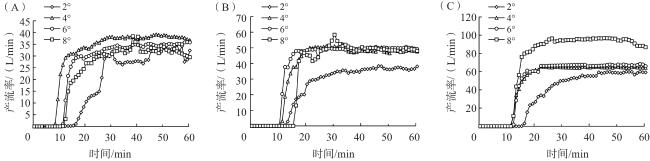
相同降雨强度、不同坡度的砂姜黑土裸坡产流情况如图2所示。砂姜黑土不同坡度产流率随降雨时间变化规律有所不同。当降雨强度为40 mm/h时,4°坡产流拐点出现最快,其次是6°、8°、2°;当降雨强度为60 mm/h时,6°坡产流拐点出现最快,其次是4°、2°、8°;当降雨强度为80 mm/h时,8°坡产流拐点出现最快,其次是6°、4°、2°。随着降雨历时增加,砂姜黑土中下层土壤含水量趋近饱和,表层土壤含水率迅速提高,土壤表层孔隙逐渐被水滴填满,产流率趋于稳定。3种降雨强度下,80 mm/h降雨强度的产流率随坡度变化最大,波动幅度约30 L/min;60 mm/h降雨强度的产流率变化幅度约22 L/min;降雨强度40 mm/h的产流率变化幅度最小,约15 L/min。这是因为当坡度和坡长不变时,径流小区承雨面积一致,降雨强度增大导致降雨量增加,相同时间内单位面积承接雨量增加,产流量与降雨强度呈正相关;与此同时,径流量增加导致土壤表面受到强烈的冲刷作用,发生细沟、塌陷现象,水流裹挟大量泥沙,产流率增加较大。
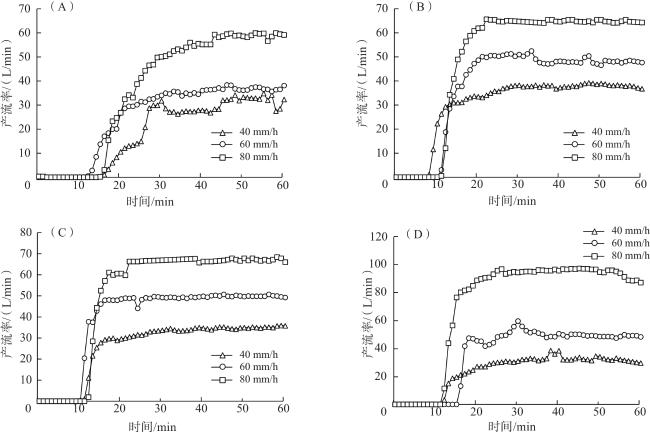
相同坡度下,产流率随降雨强度变化规律如图3所示。当坡度相同时,3种降雨强度下产流规律相似,即产流后降雨强度增加,产流率相应增大。当坡度为2°时,降雨强度80 mm/h的稳定产流率较60 mm/h增加25 L/min,较40 mm/h增加30 L/min;当坡度为4°时,降雨强度80 mm/h的稳定产流率较60 mm/h增加20 L/min,较40 mm/h增加30 L/min;当坡度为6°时,降雨强度80 mm/h的稳定产流率较60 mm/h增加20 L/min,较40 mm/h增加36 L/min;当坡度为8°时,降雨强度80 mm/h的稳定产流率较60 mm/h增加40 L/min,较40 mm/h增加65 L/min。当坡度和坡长不变时,径流小区有效承雨面积不变,随着降雨强度增大,小区承雨量增加;同时,降雨强度增加,雨滴能量相应增加,增强了对土壤的溅蚀能力,产沙量也会相应增加,两种因素共同作用下导致产流量增大。
2.3 砂姜黑土坡面产沙特征分析
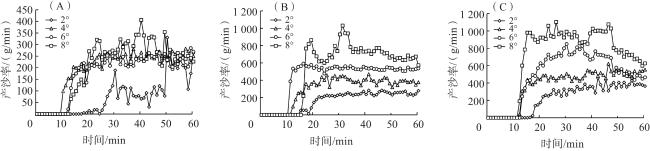
相同降雨强度、不同坡度坡面产沙率随降雨历时变化如图4所示。当降雨强度相同时,产流后,坡面产沙率随坡度增加而增加。产流后,产沙率表现为前期快速增大,后期振荡波动,坡度越大,振荡现象越明显。当降雨强度为40 mm/h时,产沙率拐点均出现在25 min后;2°和8°坡呈振荡增长,4°和6°坡在达到最大值后平稳波动,这表明在小降雨强度下,坡度在一定范围内产沙率达到平稳波动。当降雨强度为60 mm/h时,产沙率拐点出现在20 min。其中,2°坡在产流后15~22 min内快速增加,产沙率最大值为282 g/min,趋于稳定后,产沙率波动范围207~282 g/min;4°、6°和8°坡在产流后13~20 min内快速增加,随后振荡波动,产沙率最大值分别为470、592和1 031 g/min,在达到最大值后产沙率振荡减小。当降雨强度为80 mm/h时,2°坡产沙率拐点出现在25 min,4°、6°和8°产沙率拐点出现时间均为13 min;2°坡在产流后15~25 min内快速增加,随后振荡增加,产沙率最大值为458 g/min,趋于稳定后,产沙率波动范围260~458 g/min,4°、6°和8°坡在产流后13~20 min内快速增加,随后振荡波动,产沙率最大值分别为622、849和1 103 g/min,在达到最大值后产沙率振荡减小。
当坡度相同时,产沙率随着降雨强度的变化过程如图5所示,均表现为产流后随着降雨强度增加,产沙率增大。当坡度为2°时,降雨强度40 mm/h的产沙未达到稳定状态,波动范围79~268 g/min,降雨强度60 mm/h在20 min后趋于稳定产沙,产沙率在207~282 g/min,降雨强度80 mm/h在12~20 min内产沙率迅速增加,随后振荡上行,波动范围为242~458 g/min,均大于40和60 mm/h的产沙率波动范围。当坡度为4°时,降雨强度80 mm/h的稳定产沙率是60 mm/h的1.2倍、40 mm/h的2倍,40、60、80 mm/h在降雨历时内最大产沙率分别为297、470、622 g/min。当坡度为6°时,降雨强度80 mm/h的稳定产沙率是60 mm/h的1.16倍、40 mm/h的2.8倍,40、60、80 mm/h在降雨历时内最大产沙率分别为284、592、849 g/min。当坡度为8°时,降雨强度80 mm/h的稳定产沙率是60 mm/h的1.2倍、40 mm/h的3.2倍,40、80、60 mm/h在降雨历时内最大产沙率分别为406、1 031、1 103 g/min。
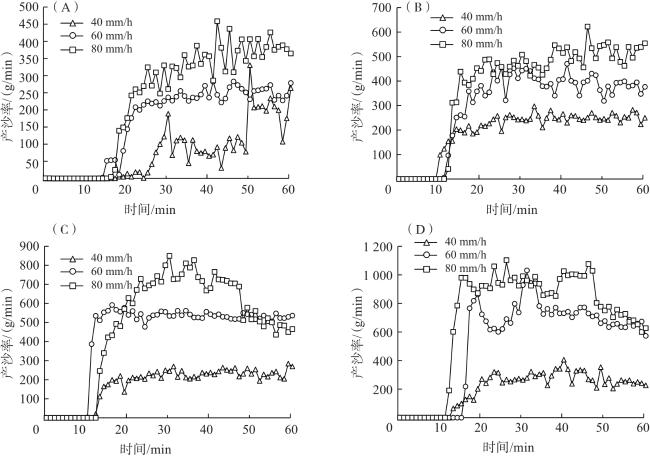


可以看出,相同坡度下,稳定产沙率随降雨强度增大变化明显。这是因为当降雨强度较小时,表层土壤含水率前期增长较慢,雨滴对土壤的作用以溅蚀为主,随着表层土壤含水量增加,坡面表层出现填洼直至形成径流,土壤受到的作用逐渐变成以冲刷为主。随着坡度的增加,水滴从顶部运动到汇水口的速度变快,水流动能增加,加剧对土壤的冲刷作用,导致产沙率随着坡度增加而增加;此外,随着降雨强度的增加,雨滴直径变大,导致落到坡面的动能增加[9],对土壤的溅蚀作用增强。随着坡度增加,在径流对土壤的冲刷作用以及土壤受到沿坡面向下作用力共同作用下,易发展细沟,甚至发生塌陷现象,细沟不断被冲刷,细沟之间相互连通,径流裹挟大量泥沙,导致产沙率波动范围较大,随着降雨时间的增加,细沟发育完全,产沙率在达到最大值后逐渐减少并趋于稳定[10]。
2.4 砂姜黑土坡面产流与产沙总量特征分析
对产流与产沙总量试验数据进行回归分析,得出产流总量、产沙总量与降雨强度、坡度的回归方程,如式(3) 和式(4) 。
V=3.133θ+0.436σ-22.162 R2=0.87
S=1.665σ1.026 θ0.287 9 R2=0.85
式中,V表示产流总量(m³);S表示产沙总量(kg)。
以上2个回归方程分析结果表明,坡度对于砂姜黑土产流量的影响程度大于降雨强度,降雨强度对于砂姜黑土产沙量的影响程度大于坡度。
3 结论
本研究通过人工模拟降雨试验,分析了砂姜黑土在不同降雨强度(40、60、80 mm/h)和坡度(2°、4°、6°、8°)条件下的产流与产沙规律,得出以下结论。
(1)初始产流时间(T0)与降雨强度(σ)、坡度(θ)均呈负相关关系;初始产流时间(T0)与降雨强度(σ)的函数关系为T0=-0.19σ2+8.18σ+782(R2=0.99),初始产流时间(T0)与坡度(θ)的函数关系为T0=2 647θ-0.965(R2=0.92);40 mm/h降雨强度下,2°坡T0=1 215 s,8°坡缩短至447 s(降幅63.3%),80 mm/h降雨强度下,2°坡T0=328 s,8°坡为221 s(降幅32.6%)。
(2)产流率随降雨历时(t)呈现不同时期的变化,初期(0<t<15 min)快速上升,拐点过渡期(15<t<30 min)坡度越大,拐点出现越早,8°坡提前至12 min,稳定波动期(t>30 min)产流率(Q)进入准稳态,振幅随降雨强度增大而扩大(80 mm/h时波动幅度达30 L/min)。
(3)产沙率随降雨历时(t)呈现不同时期的变化,其变化过程可分为3个时期:初期(0<t<15 min)快速上升,降雨强度越大,增速越显著;拐点过渡期(15<t<30 min)坡度越大,拐点出现越早(80 mm/h时8°坡拐点提前至13 min);稳定波动期(t>30 min)产沙率进入准稳态,降雨强度越大,振荡越剧烈,待细沟网络发育完全后,侵蚀进入平衡状态,产沙率趋于平缓。在8°坡、80 mm/h降雨强度时产沙峰值达1 103 g/min。
(4)根据产流与产沙总量回归方程得出,坡度对产流量的影响大于降雨强度,降雨强度对产沙量的影响大于坡度。