

滇杨(Populus yunnanensis)是杨柳科(Salicaceae)杨属(Populus)乔木,其在生长过程中易遭受盐胁迫侵害。盐胁迫通过诱导离子毒害、渗透胁迫及氧化损伤等方式抑制植物生长发育[1]。大量研究表明,植物通过多种生理及分子机制应对盐胁迫。例如,Sajid等[2]研究发现,聚乙二醇(PEG)处理可显著提高盐胁迫下萝卜种子的发芽率和生物量,并通过激活超氧化物歧化酶(SOD)、过氧化氢酶(CAT)等抗氧化酶系统降低丙二醛(MDA)含量,缓解氧化损伤。Shi等[3]研究表明,外源甲硫氨酸通过激活脱落酸(ABA)信号通路,调控植物生长发育与耐盐性的平衡关系,该结果为盐碱地作物的抗逆改良提供了新的策略。He等[4]研究表明,在杨树中,miR390/tasiRNA信号途径通过调控生长素通路增强植株的耐盐性,该研究进一步揭示了小RNA在植物盐胁迫响应过程中的关键调控作用,为解析杨树耐盐分子机制提供了重要理论依据。上述研究从渗透调节、激素信号、分子网络等多个维度,进一步拓展了植物耐盐机制研究,也为滇杨等木本植物的盐胁迫相关研究提供了理论支撑。
当前针对滇杨的研究多集中于种质资源调查、筛选及栽培技术优化等层面,对其盐胁迫响应过程中离子稳态重建、抗氧化防御系统调控等核心耐盐机制的系统解析有待深入研究。本研究通过对比土培与水培模式下滇杨的生理响应差异,旨在揭示其适应盐胁迫的特异性策略,为滇杨在盐碱化土地上的高效、可持续种植提供科学依据。
1 材料与方法
1.1 试验材料
1.2 试验设计
选取长势一致的滇杨无性系植株,采用不同浓度的NaCl模拟盐胁迫进行植株耐盐能力测试。参考史湘华等[8]针对其他杨树耐盐能力测试采用的盐浓度梯度试验,并结合前期预试验中水培滇杨在75 mmol/L NaCl浓度下致死的情况,本次试验确定盐胁迫处理浓度如下。土培设置0、50、100和150 mmol/L共4个NaCl浓度梯度进行处理,每个梯度处理3盆,重复3次。在处理期间根据土壤情况每隔3~4 d添加1次对应浓度的NaCl溶液500 mL。水培仅添加1/2 MS培养液,设置0、25、50和75 mmol/L共4个NaCl浓度进行处理,每个浓度处理3盆,重复3次。采集各处理植株叶片用于指标测定,每个指标采样约1 g,3个重复。采集的叶片用液氮速冻后,放于-80 ℃冰箱中备用。
1.3 试验方法
1.4 数据分析
采用GraphPad Prism 10.1.2软件对数据进行统计学分析与图表绘制。数据分析采用双因素方差分析(Two-way ANOVA),多重比较采用Tukey检验。
2 结果与分析
2.1 对滇杨叶片叶绿素含量的影响
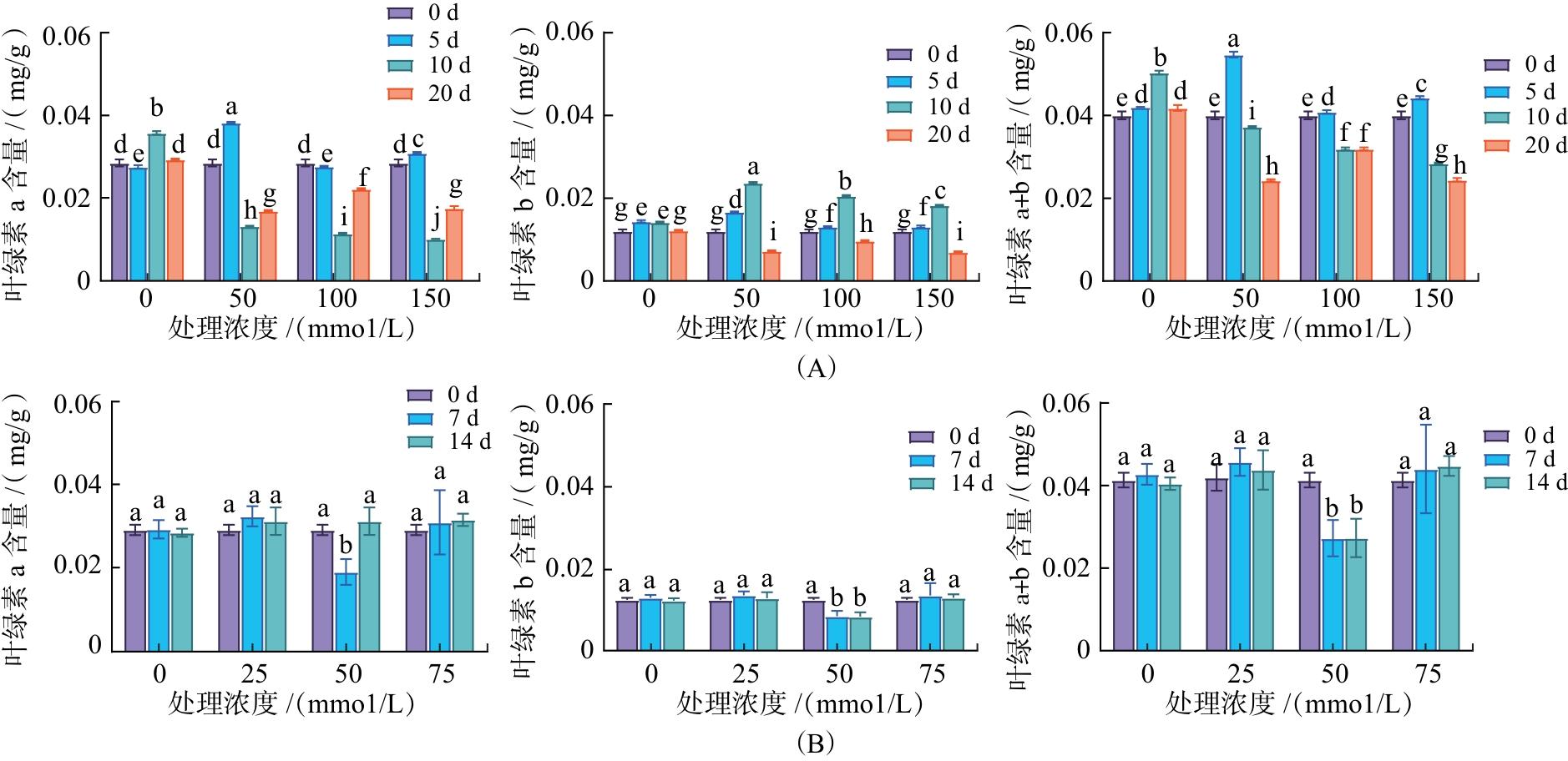
50 mmol/L NaCl 处理5 d后,土培滇杨叶绿素a和叶绿素a+b总含量较高,与其余处理组差异具有统计学意义(P<0.05);50 mmol/L NaCl 处理10 d后,土培滇杨叶绿素b含量较高,与其余处理组差异具有统计学意义(P<0.05)。随着盐胁迫浓度和处理时间的增加,水培滇杨的叶绿素含量变化趋势较为平稳。50 mmol/L NaCl处理下水培滇杨叶绿素a含量在处理7 d后显著降低(P<0.05),叶绿素b与a+b总含量在处理7和14 d后显著降低(P<0.05)(图1)。
2.2 对滇杨叶片可溶性糖含量的影响
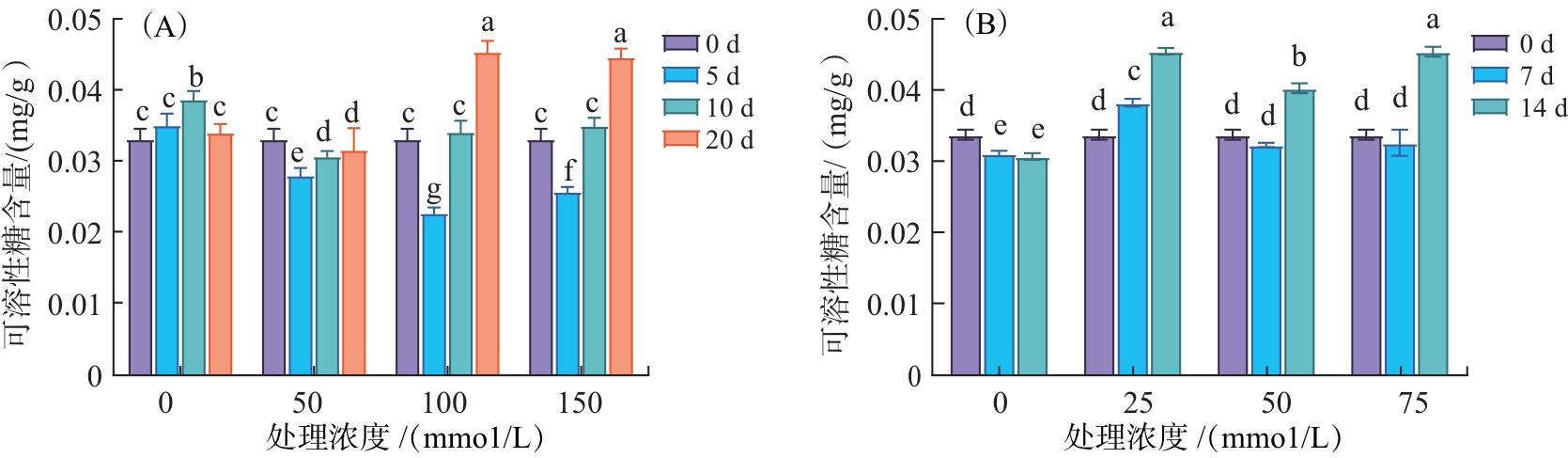
由图2A可知,土培滇杨在正常条件下可溶性糖含量呈先上升后下降趋势,其中培养10 d的叶片可溶性糖含量与其余处理差异具有统计学意义(P<0.05)。在50~150 mmol/L盐胁迫处理下,土培滇杨叶片可溶性糖含量随着处理时间的增加均呈先下降后上升趋势,以100 mmol/L NaCl处理的含量变化较明显。由图2B可知,在正常条件下,水培滇杨可溶性糖含量随着处理时间的增加呈下降趋势,其中培养7、14 d的可溶性糖含量与对照差异具有统计学意义(P<0.05)。在25~75 mmol/L盐胁迫处理中,水培滇杨可溶性糖含量变化趋势有所不同,25 mmol/L NaCl处理下各组间可溶性糖含量差异具有统计学意义(P<0.05);50和75 mmol/L NaCl处理下,处理14 d的可溶性糖含量较处理0和7 d明显增加(P<0.05)。
2.3 对滇杨叶片可溶性蛋白含量的影响
2.4 对滇杨叶片MDA含量的影响
2.5 对滇杨叶片脯氨酸含量的影响
2.6 对滇杨叶片SOD活性的影响
2.7 对滇杨叶片POD活性的影响


3 结论与讨论
植物遭受盐胁迫时会启动一系列生理响应,叶绿体是植物光合作用的核心场所,也是盐胁迫下最早发生损伤的细胞器之一。王小东等[18]研究发现,小叶杨(Populus simonii)中叶绿素a和b含量在盐胁迫初期呈上升趋势,但随着胁迫时间的延长和盐浓度的增加,叶绿素含量逐渐下降,表现出盐胁迫下的阶段性响应特征。本研究发现,滇杨在盐胁迫处理下叶绿素含量呈现相似的变化趋势,但在水培和土培中含量呈现明显差异,整体水平上水培滇杨的叶绿素含量低于土培组,且高盐胁迫下叶绿素含量变化更显著。这表明水培滇杨对盐胁迫的响应更为敏感,而土壤环境可延缓盐胁迫对叶绿素合成的抑制作用,进而提升土培滇杨光合能力的稳定性。
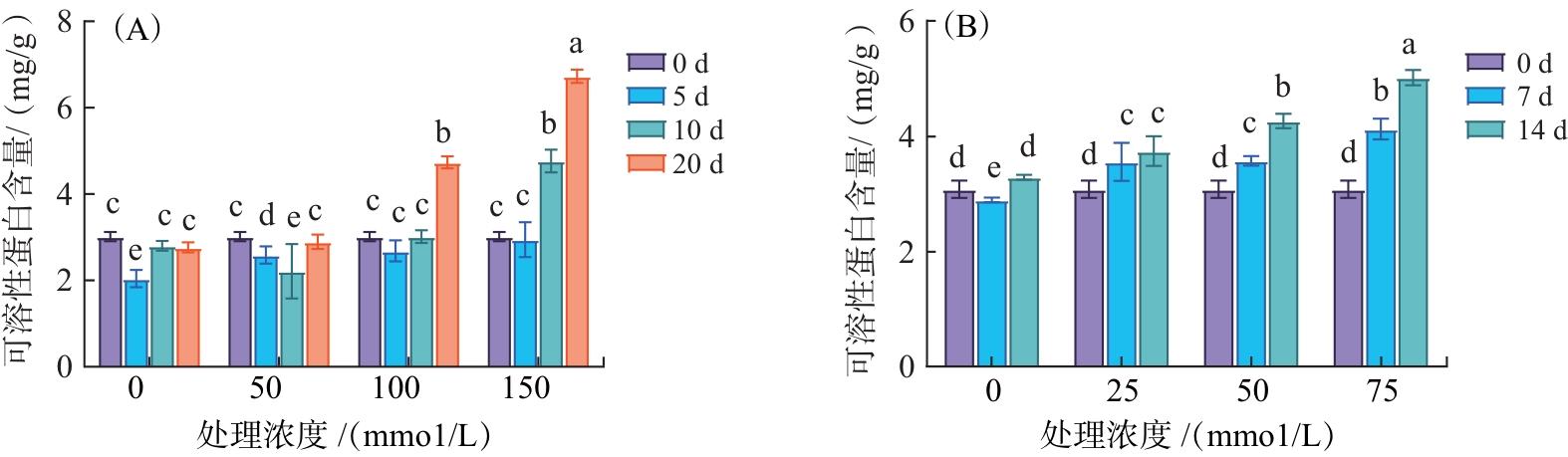
可溶性糖、可溶性蛋白、脯氨酸是重要的渗透调节物质,其含量随着盐胁迫处理时间的延长与盐浓度的增加呈现明显差异。林夏珍等[19]研究发现,青杨(Populus cathayana)在盐胁迫处理中可溶性糖含量明显降低。本研究发现,滇杨的可溶性糖含量受盐胁迫时间与培养方式的影响较大,短期盐胁迫会抑制其可溶性糖的积累,长期盐胁迫则表现为促进效应;且水培条件下滇杨可溶性糖含量的响应更迅速,土培条件下的变化趋势则相对平缓。在50~150 mmol/L盐胁迫处理下,土培滇杨的可溶性蛋白含量随盐胁迫处理时间的增加呈先下降后上升趋势,且高盐浓度下变化更显著;25~75 mmol/L盐胁迫处理下,水培滇杨的可溶性蛋白含量随盐胁迫处理时间的增加而增加。
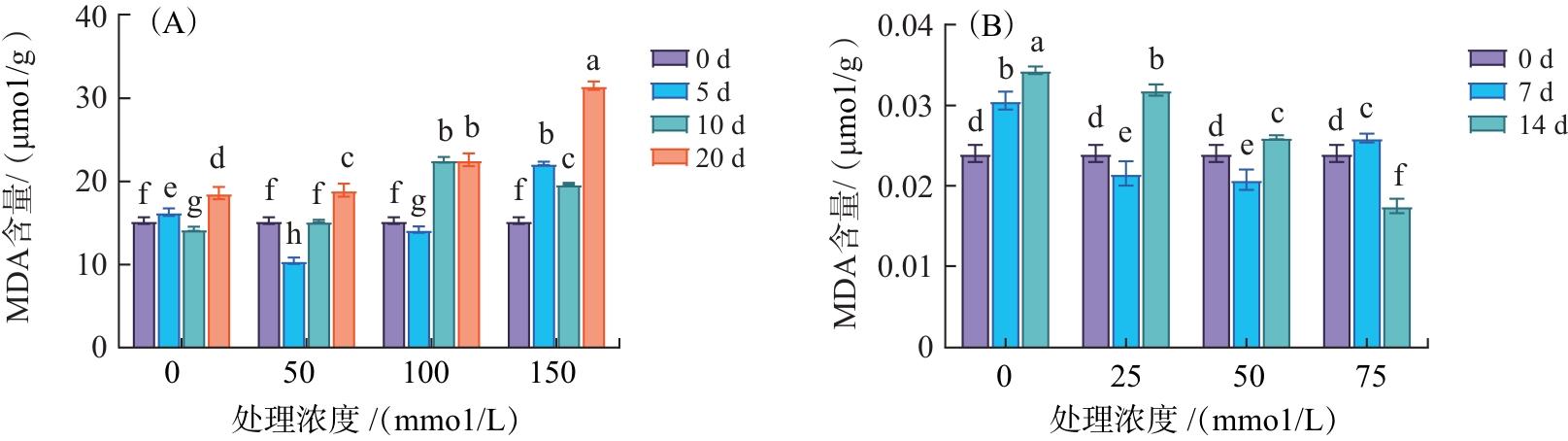
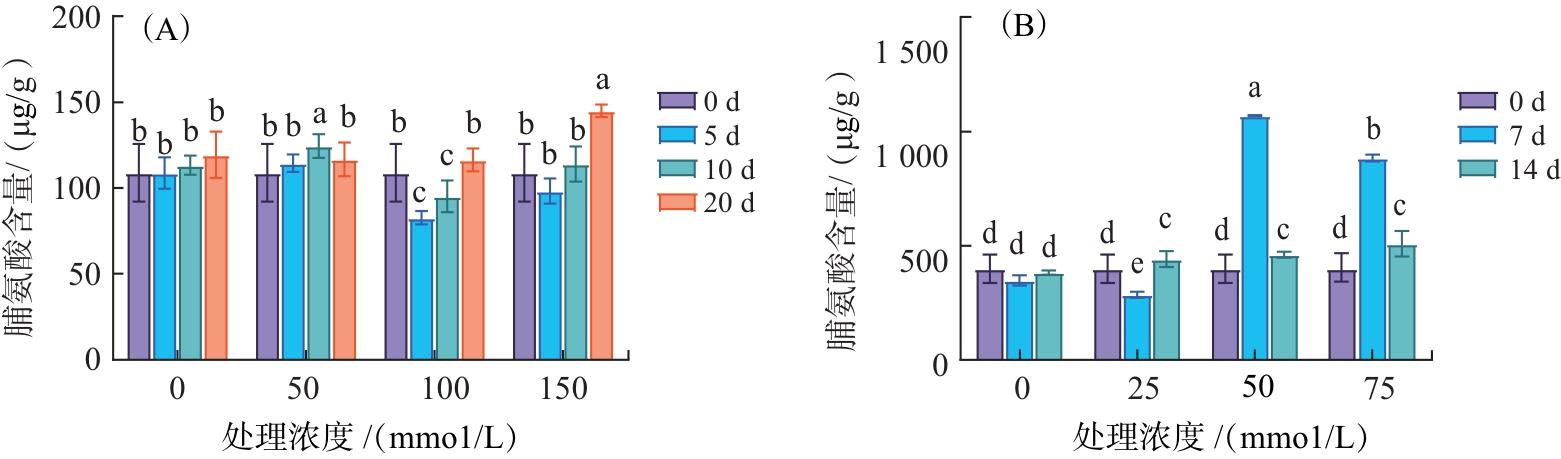
本研究发现,在50和100 mmol/L NaCl处理下,土培滇杨的MDA含量随着处理时间的增加呈先下降后上升的趋势;在25~50 mmol/L NaCl处理下,水培滇杨的MDA含量随着处理时间的增加呈先下降后上升的趋势,说明水培对盐胁迫造成的细胞膜损伤具有一定的缓冲作用,这与李永涛等[20]研究得出的柽柳扦插幼苗叶片MDA含量随盐胁迫强度的增强呈先升高后降低趋势的结果一致。脯氨酸是植物胁迫响应的信号物质。刘钰等[21]研究发现,经外源谷氨酸盐处理后,银腺杨84K(Populus alba×Populus glandulosa ‘84K’)脯氨酸出现大量累积现象。本研究中,在100~150 mmol/L NaCl处理下,土培滇杨的脯氨酸含量随处理时间的增加呈先下降再上升的趋势;在50~75 mmol/L NaCl处理下,水培滇杨的脯氨酸含量呈先上升后下降趋势,且含量显著高于土培组。说明水培条件下盐胁迫处理能更快促进脯氨酸积累。
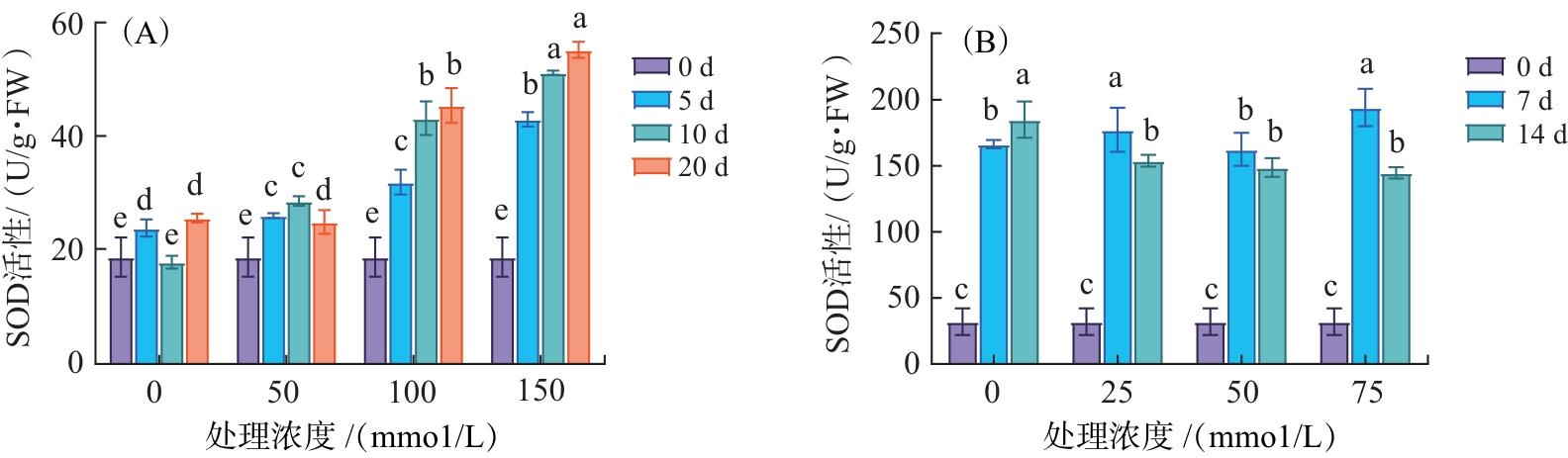
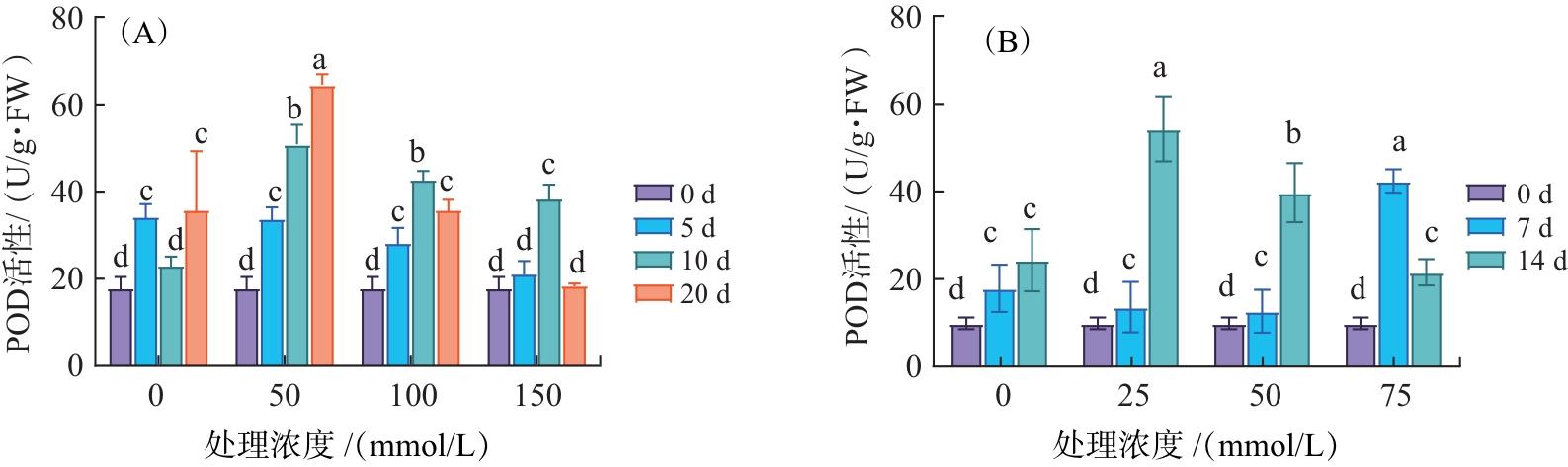
活性氧的清除能力是植物适应逆境胁迫的一个关键因素[20]。李端等[22]研究发现,盐胁迫处理下胡杨(Populus euphratica)的SOD、POD活性均呈现先上升后下降的趋势。本研究发现,随着处理时间的增加,土培滇杨SOD活性在高盐浓度(100~150 mmol/L)处理下持续上升,水培滇杨SOD活性在低盐胁迫(25~75 mmol/L NaCl)处理下呈先上升后下降的趋势;土培滇杨POD活性在高盐浓度(100~150 mmol/L NaCl)呈先上升后下降的趋势,水培滇杨POD活性在低盐浓度(0~50 mmol/L NaCl)呈上升趋势。水培组滇杨的SOD活性明显高于土培组,且其含量与MDA含量变化具有相关性,表明水培条件下滇杨的抗氧化系统被更早激活,有效缓解了植株体内氧化损伤,提升了植株对盐胁迫的整体耐受能力。
综上,土培与水培条件对滇杨耐盐能力的影响存在明显差异,水培条件下,滇杨对盐胁迫的响应更为迅速,生理调节能力更强,适用于滇杨耐盐相关的科学研究;而土培条件可通过缓冲外源盐胁迫,减缓盐胁迫对植株的损伤,适宜滇杨的实际栽培应用。