

土壤质量关系到农产品质量安全和粮食生产安全[1-2]。污染物进入土壤环境,一旦超过土壤自净能力,会导致污染物在土壤中累积。重金属污染是土壤环境污染的主要类型之一,其中镉为主要污染物[3-4]。土壤中镉以不同结合态的形式存在,其中可被植物直接吸收利用的弱酸可溶态和可还原态,经食物链富集后对人体的危害最大[5-7]。目前大部分的研究集中在降低植物可直接吸收利用形态镉含量等方面[8]。可见,镉污染土壤的钝化修复对保障农产品安全至关重要。
研究表明,生物炭可以吸附固定土壤中有机污染物和无机污染物,达到降低有毒物质迁移的目的[9]。张迪等[10]研究生物炭对城郊土壤镉有效性的影响,发现添加生物炭显著降低了低镉(镉含量为1.86 mg/kg)和高镉(镉含量为6.55 mg/kg)条件下土壤有效态镉的含量,最高降低幅度达6.82%。王丹丹等[11]研究发现,牛粪生物炭作为钝化剂能够使小白菜中的镉含量降低71.59%。水稻、玉米等秸秆制成的生物炭,具有原料丰富、可再生、低成本、减少CO2排放等优势,已被众多学者作为土壤改良剂用于农田重金属污染土壤的修复和土壤质量提升[12-14]。
生物炭具有一定的吸附污染物的能力,但其吸附去除能力有限。为此,相关学者对生物炭材料加以改良,以改进其材料特性,从而进一步增强其对污染物的吸附能力,拓展其在环保领域中的应用[15]。本文探究了高锰酸钾、酸和碱改性水稻秸秆生物炭和原样生物炭对不同梯度外源镉污染土壤的钝化效果,为镉污染土壤的安全利用提供数据支撑。
1 材料与方法
1.1 供试材料
自然晾干的水稻秸秆粉碎,马弗炉中550 ℃缺氧炭化2 h制造生物炭(BC),冷却至室温后研磨过筛,密封保存备用。选用NaOH、HCl和KMnO4制备改性生物炭材料。添加的外源镉为硝酸镉。供试作物为水稻,品种为吉粳113(吉审稻2014002)。本试验所用土壤采集于吉林农业科技学院校内旱田,自然晾干,去除杂物,过20目筛,备用。土壤理化性质为pH 5.15,有机质含量18.76 g/kg,速效磷含量130.47 mg/kg,速效氮含量90.82 mg/kg,速效钾含量165.33 mg/kg。
1.2 试验方法
2023年5—10月,在吉林农业科技学院温室大棚中进行盆栽试验。采用长54 cm、宽40.2 cm、高29.4 cm的整理箱种植水稻。每个整理箱装30 kg土壤,0.4 kg不同生物炭(按秸秆全量还田计算)。按照当地正常施肥水平施用尿素、过磷酸钙和硫酸钾。本试验设置0、10、20和40 mg/kg 4个水平的镉添加量,钝化材料为未改性、酸改性(HCl)、碱改性(NaOH)和高锰酸钾(KMnO4)改性生物质炭材料,分别记作BC、H-BC、OH-BC和Mn-BC,每个处理3次重复,随机排列。添加外源镉至整理箱土壤中,加水平衡2周后插秧。
生物炭和土壤、肥料混合均匀,于2023年4月29日插秧,每个整理箱4穴,每穴1株,水稻整个生育期正常进行田间管理,9月28日收获。在水稻不同生育期(分蘖期、孕穗期、抽穗期和成熟期,分别记作F1、F2、F3和F4)采集植物样品和土壤样品。植物样品分为根、茎、叶和穗,样品用自来水清洗3次,蒸馏水清洗3次,在105 ℃烘箱杀青30 min,70 ℃烘干至恒重。采集的水稻根系土壤样品,阴干、研磨后过20和100目筛,用于土壤理化性质和重金属含量测定。
1.3 测定项目与方法
水稻产量测定:水稻成熟期,采集每个处理剩余水稻穗,自然晾干,脱穗,去除杂物,称重,记为水稻产量。
参照《土壤农业化学分析方法》测定土壤pH,水土比例为2.5∶1,采用pH计测定。DTPA(pH=7.0)浸提土壤有效态镉,土壤样品中镉采用HNO3-HClO4-HF消煮;植物样品中镉含量采用HNO3-HClO4消煮,原子吸收分光光度计法测定样品中的镉含量。采用Origin 9.0软件处理数据,SPSS 21.0软件分析数据,并采用LSD法(P<0.05)进行显著性检验。
2 结果与分析
2.1 不同改性生物炭对水稻产量的影响
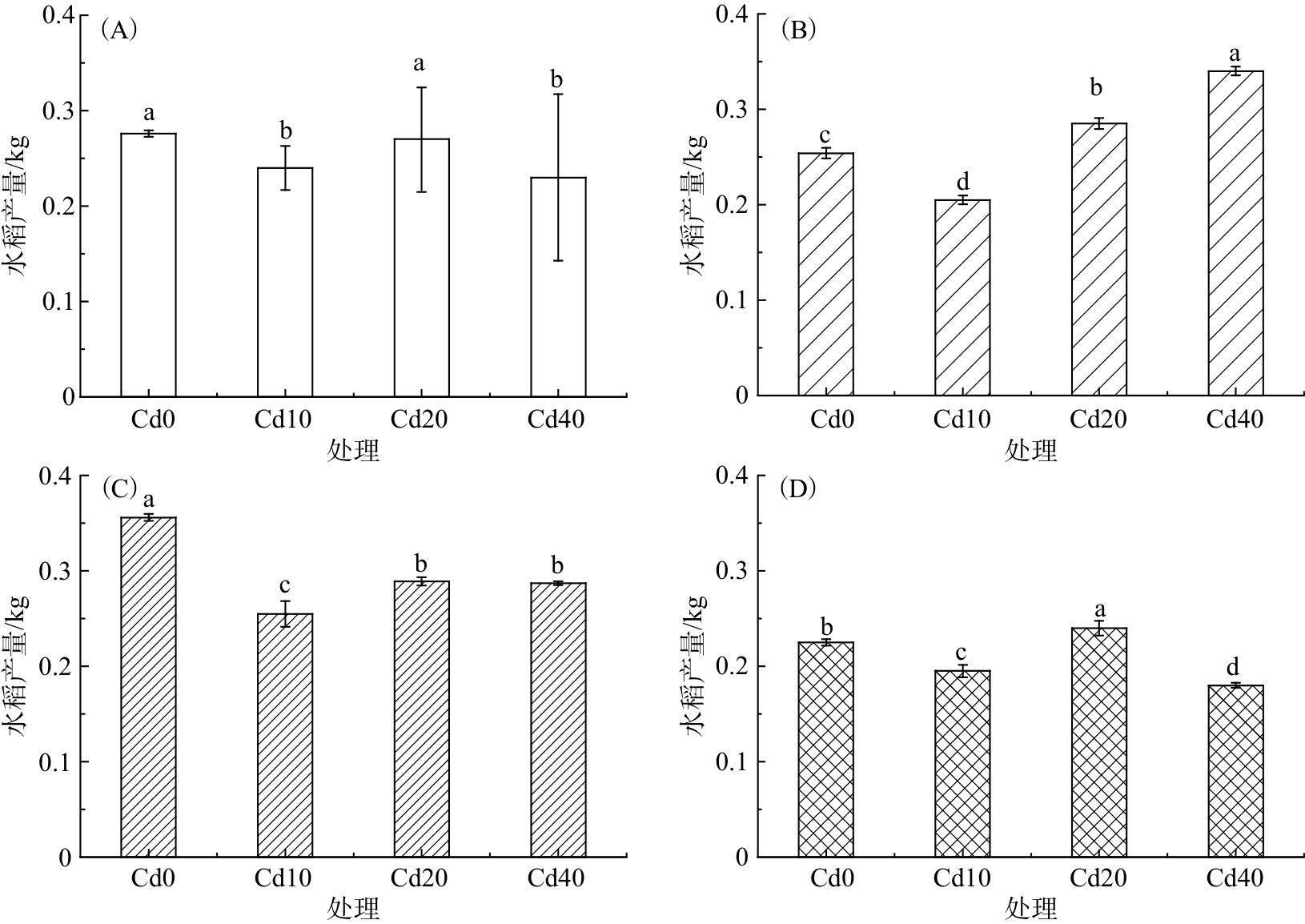
由图1可知,不同类型改性生物炭对水稻产量的影响存在差异。在BC条件下(图1A),未添加外源镉时,水稻产量最高,为0.276 kg,添加外源镉后,水稻产量降低了0.046~0.060 kg,Cd40和Cd10处理的水稻产量明显低于Cd0和Cd20(P<0.05)。在H-BC条件下(图1B),4个处理间差异具有统计学意义(P<0.05),Cd20和Cd40处理的水稻产量明显高于Cd0处理;在种植过程中,Cd0和Cd10处理受虫害影响,产量下降。在OH-BC(图1C)条件下,Cd0的产量最高,为0.356 kg,明显高于Cd10、Cd20和Cd40处理(P<0.05)。在Mn-BC条件下,4个镉处理的水稻产量存在明显差异(P<0.05)(图1D),Cd20处理的水稻产量最高,为0.240 kg,其次是Cd0处理(0.225 kg)。
2.2 不同改性生物炭对土壤pH的影响
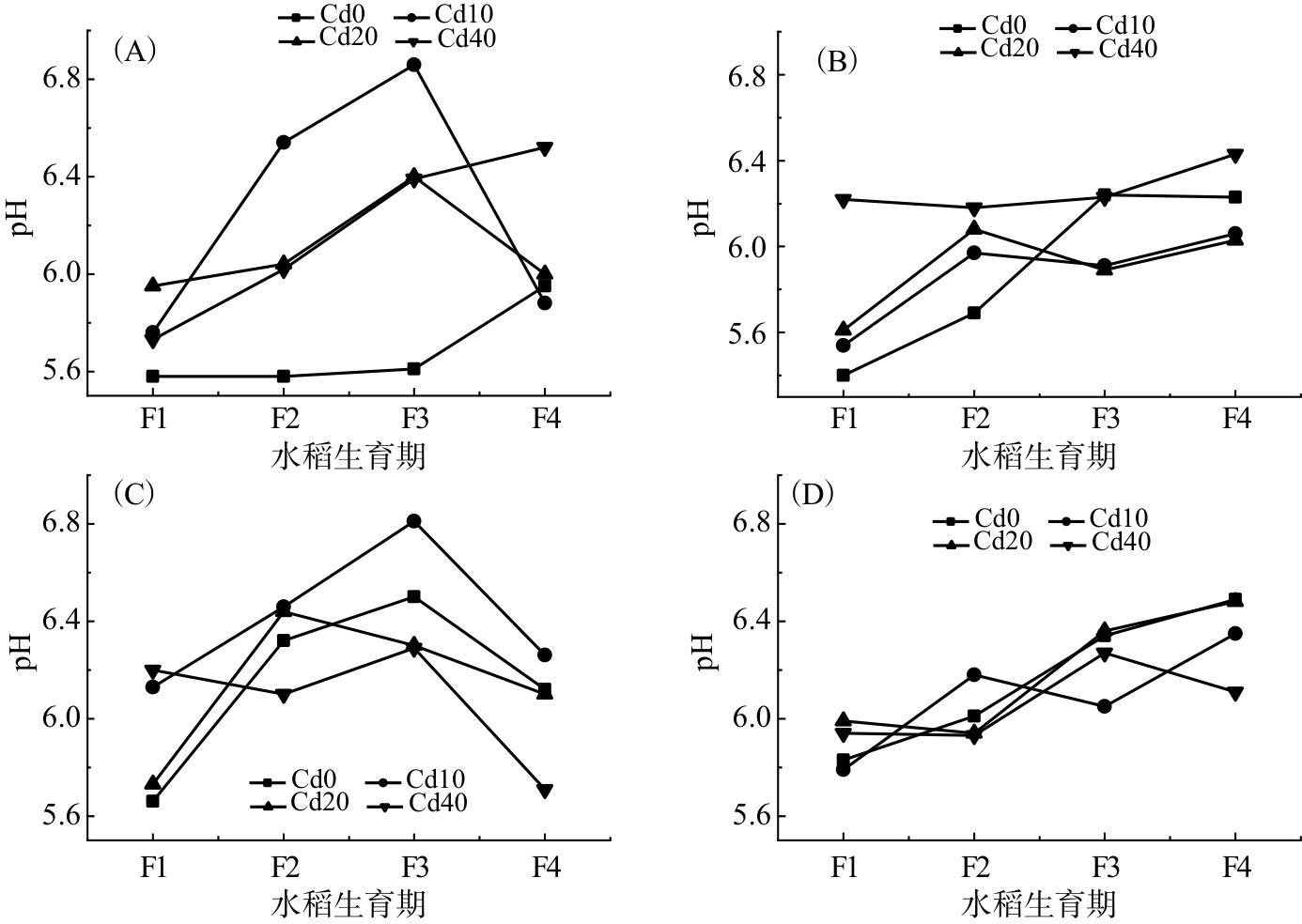
原土pH 5.15,偏酸性。如图2所示,加入生物炭后,水稻不同生育期土壤pH呈现差异变化。在添加BC(图2A)条件下,Cd0和Cd40处理的土壤pH随着水稻生育期逐渐升高,Cd10和Cd20处理的土壤pH在F1至F3上升,F3至F4下降。在Cd0处理下,从F1到F3时期,土壤pH保持相对稳定,从F3到F4时期快速增大,两个时期差值为1.25个单位。在F4时期,Cd0、Cd10和Cd20处理的土壤pH变化不明显。在添加H-BC(图2B)条件下,Cd40处理的土壤pH保持相对稳定,其余3个处理呈现先升高后平稳的趋势。添加OH-BC(图2C)条件下,除了Cd40处理,其余3个处理的土壤pH变化趋势一致,呈先升高后降低趋势;Cd40处理的土壤pH呈降低—升高—降低趋势;在水稻F4时期,Cd40处理的土壤pH低于其他3个处理。在添加Mn-BC(图2D)条件下,土壤pH变化幅度最小,整体呈上升趋势,F4时期Cd0和Cd20处理的pH基本一致,Cd40处理的pH最低。综合来看,不同生物炭添加对土壤pH的影响存在差异,其中H-BC和Mn-BC体系中土壤pH的变化波动较小,4种生物炭添加下水稻成熟期(F4)土壤pH均高于原土。
2.3 不同改性生物炭对土壤有效态镉含量的影响
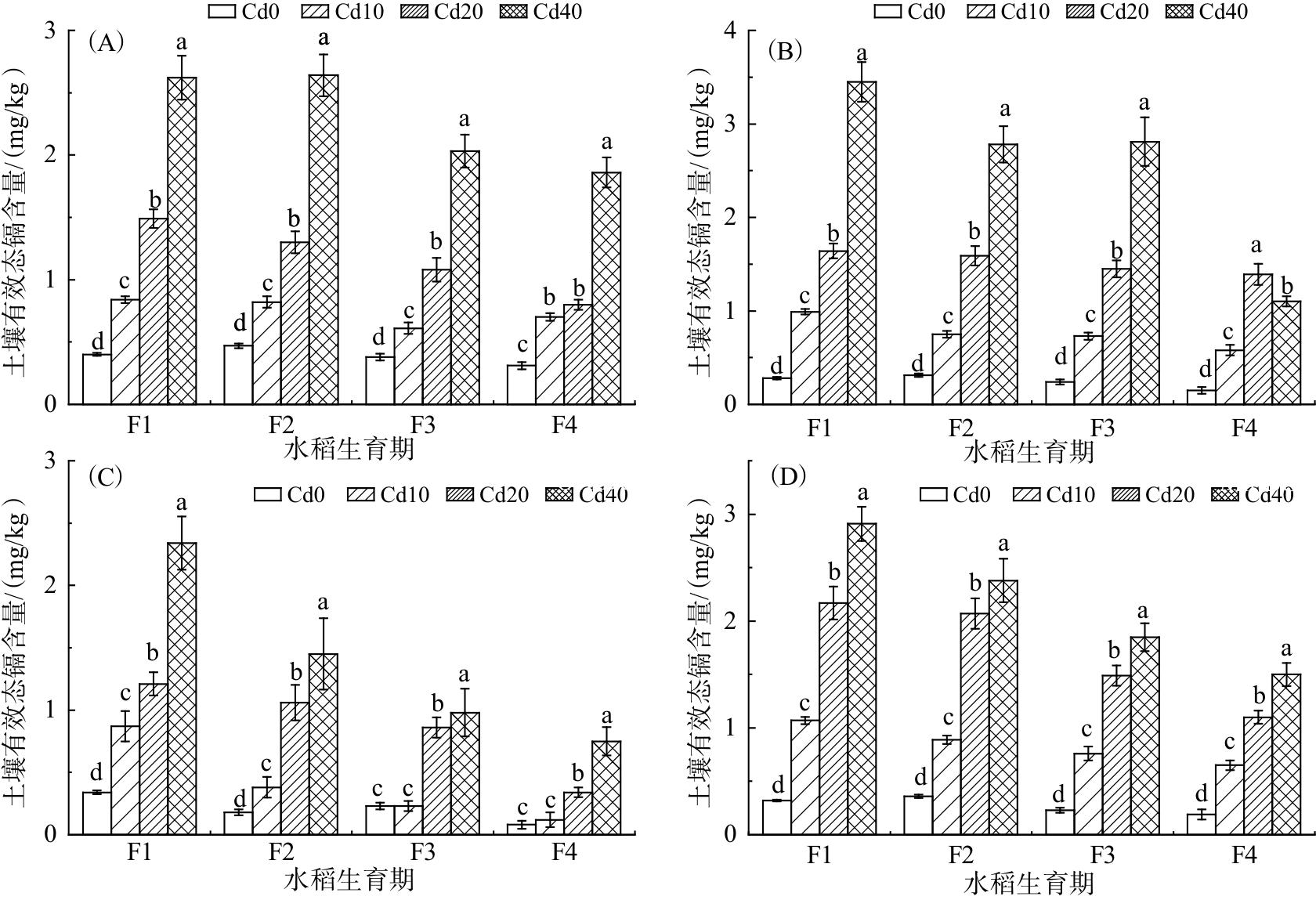
在酸改性生物炭体系(H-BC)中(图3B),水稻F1、F2和F3时期,随着外源镉浓度的增加,土壤有效态镉含量的变化趋势与BC体系变化趋势一致,随着外源镉添加量的增加而增加。在水稻F4时期,4个外源镉处理之间差异具有统计学意义(P<0.05),其中Cd20处理的土壤有效态镉含量最高,较Cd40处理高0.29 mg/kg。
在碱改性生物炭体系(OH-BC)中(图3C),未添加外源镉处理下,水稻F1至F3时期,土壤有效态镉含量呈现先降低后升高趋势,至F4时期,土壤有效态镉含量为0.08 mg/kg,较F1时期降低了76.5%。添加外源镉处理下,水稻不同时期土壤有效态镉含量随着外源镉浓度的增加而增加,且差异具有统计学意义(P<0.05)。总体上,水稻F1到F4时期,Cd10、Cd20和Cd40处理的土壤有效态镉含量呈下降趋势,与F1时期相比,F4时期分别降低了86.2%、71.9%和67.9%。
在高锰酸钾改性生物炭体系(Mn-BC)中(图3D),水稻各生育期,4个外源镉处理下土壤有效态镉含量差异具有统计学意义(P<0.05),且随着外源镉添加量的增加而增加。水稻F1至F4生育期,土壤有效态镉含量呈下降趋势。
综合来看,未添加外源镉时,从水稻生育期F1至F4,4种生物炭添加体系中根际土壤有效态镉含量大致呈升高—降低的趋势,成熟期(F4)含量最低;添加3种改性生物炭的土壤中有效态镉含量随生育期总体呈降低趋势;对比4种生物炭添加后土壤有效态镉含量,OH-BC体系土壤有效态镉含量最低,其次是Mn-BC、BC与H-BC。
2.4 不同改性生物炭对水稻糙米镉含量的影响


3 结论与讨论
本试验以不添加外源镉为对照组,研究了生物炭和酸、碱、高锰酸钾改性生物炭对水稻产量、土壤pH、土壤有效态镉含量和糙米中镉含量的影响。结果表明,添加外源镉对水稻产量有一定影响。不同生物炭添加对土壤pH的影响存在差异,其中H-BC和Mn-BC体系中土壤pH的变化波动较小,不同生物炭添加下土壤pH均高于原土。
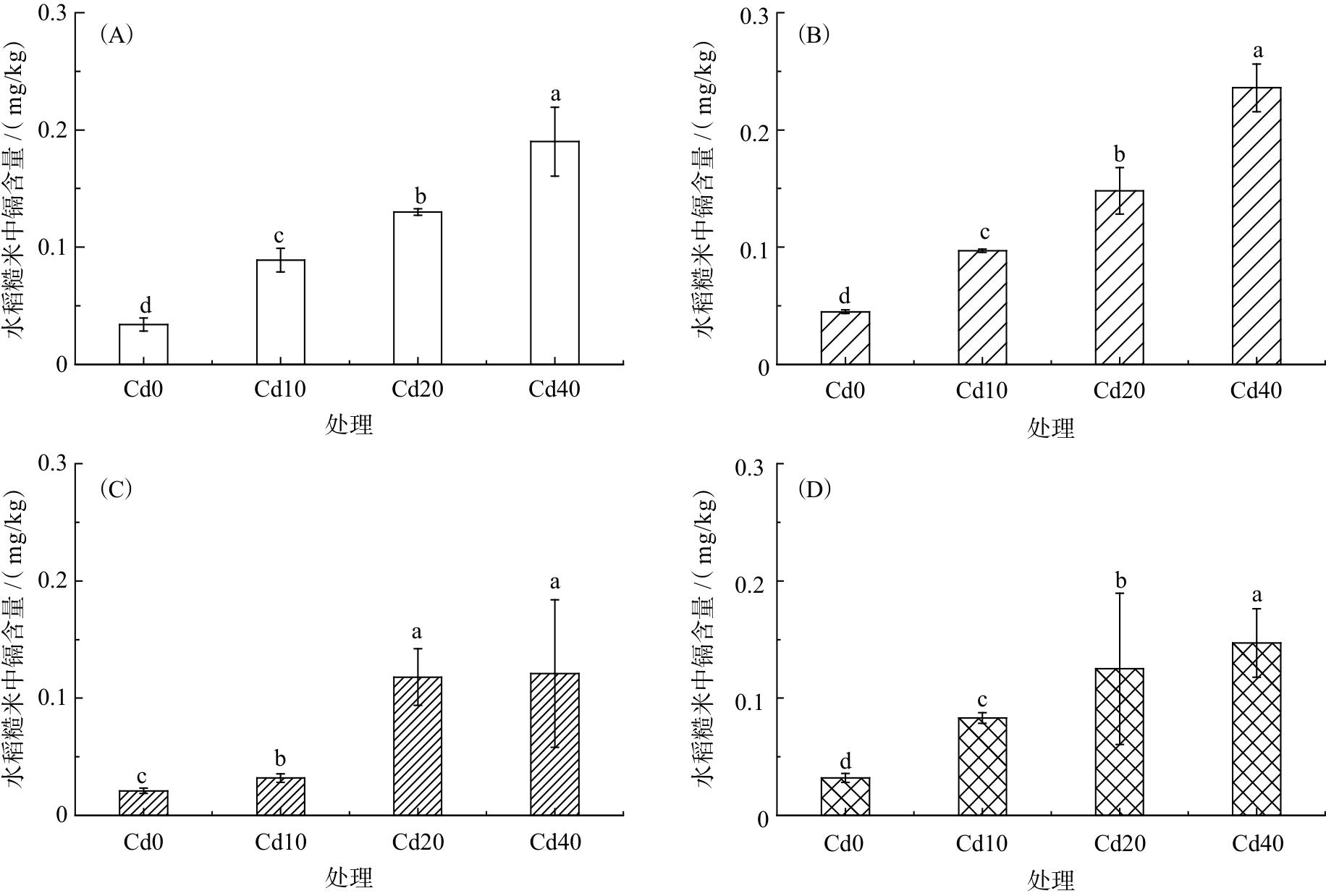
添加生物炭和改性生物炭后,随着水稻生育期从F1到F4,土壤有效态镉含量总体呈现降低的趋势。对比4种生物炭添加后土壤有效态镉及糙米中镉含量,发现OH-BC的钝化作用最优,其次是Mn-BC、BC与H-BC。杨兰等[20]研究表明,BC对土壤有效态镉含量的钝化作用不明显,本试验中发现BC处理下土壤有效态镉含量有增加的趋势,但总体上,从水稻F1到F4生育期,土壤有效态镉含量降低。H-BC改性生物炭材料能促进土壤中镉的解析,促进植物对镉的吸收,本研究也得出相同的结论,H-BC改性生物炭体系中,糙米中镉含量超过国家食品卫生安全标准(0.2 mg/kg)。