

太子参(Pseudostellaria heterophylla)为石竹科多年生草本植物孩儿参的干燥块根,具有补脾益肺、补气固表、益气生津等功效[1]。近年来,随着对其化学成分和药理活性的深入研究,为临床应用和产品研发提供了有力支持,使得太子参种植面积不断扩大[2]。福建和贵州两地为太子参主要种植区域,长期大规模种植,导致太子参叶斑病、根腐病、白绢病、紫纹羽病等病害频繁发生,其中叶斑病造成的经济损失较大[3]。研究表明,引起太子参叶斑病的主要致病菌为交链孢菌(Alternaria alternata)[4]。
研究表明,过氧化氢(H2O2)、超氧阴离子(O2-)、羟基自由基(·OH)作为活性氧(ROS)的主要形式,参与植物对生物胁迫和非生物胁迫的响应,ROS作为信号分子激活植物抗病相关基因的表达和抗病相关物质的合成,进而形成一定的防御能力[5]。因此,氧化迸发常被视作植物响应逆境胁迫的重要生理指示。许美秋[6]基于转录组和蛋白质组学分析,发现ROS作为信号分子之一参与梨果实对扩展青霉(Penicillium expansum)的响应;然而过量积累的ROS会加速蛋白质、脂质和核酸等大分子的氧化,对果实品质产生不利影响。植物已经进化出一套清除ROS的系统,包括以超氧化物歧化酶(SOD)、过氧化氢酶(CAT)、过氧化物酶(POD)、抗坏血酸过氧化物酶(APX)等为主的酶清除系统,以及还原型抗坏血酸、还原型谷胱甘肽、类黄酮、维生素C等非酶清除系统[5]。单春会[7]对接种青霉菌后的甜瓜果实抗氧化酶活性进行测定,结果发现,SOD、POD、CAT共同参与甜瓜果实对青霉菌的响应。
有关太子参抗叶斑病的研究大多集中在抗病品种选育,病原菌突变及致病性等方面,对其自身抗病生理指标的变化研究有待深入。为此,本研究以太子参为材料,接种交链孢菌,测定相关生理特性指标,探讨太子参在交链孢菌侵染胁迫下的防御性生理指标变化,为太子参叶斑病防治提供参考。
1 材料与方法
1.1 供试材料
太子参品种柘参1号来源于福建省宁德市柘荣县凤洋太子参基地(119.84° E,27.26° N,海拔991 m);病原菌为本课题组从凤洋基地太子参叶片中分离的交链孢菌(Alternaria alternata)。
1.2 试剂与仪器
供试试剂:0.9%生理盐水、蒸馏水、CAT试剂盒、POD试剂盒、APX试剂盒(南京建成生物工程研究所)。恒温水浴锅(HHW-600,绍兴市苏珀仪器有限公司),电子天平(YT1004,深圳市乐祺微电子科技有限公司),超净工作台(SW-CJ-2D,苏州净化设备有限公司),紫外分光光度计(T6-1650F,北京普析通用仪器有限责任公司),酶标仪(Feyond-A300,杭州奥盛仪器有限公司),高速冷冻离心机(5425R冷冻型,艾本德中国有限公司)。PDA培养基配方:200 g马铃薯块,葡萄糖20 g,琼脂粉20 g,蒸馏水1 L;121 ℃高压灭菌20 min。
1.3 试验方法
1.3.1 交链孢菌悬浮液制备
取5 mL无菌水添加至交链孢菌培养皿内,用无菌牙签将菌丝表层附着的孢子轻轻刮落。漏斗中放入灭菌滤纸,将混有孢子的无菌水过滤到无菌蓝色丝口瓶中,并用无菌水冲洗滤渣1~2次,即得到孢子悬浮液。取孢子悬浮液稀释至浓度为108个/mL。
1.3.2 病原菌侵染
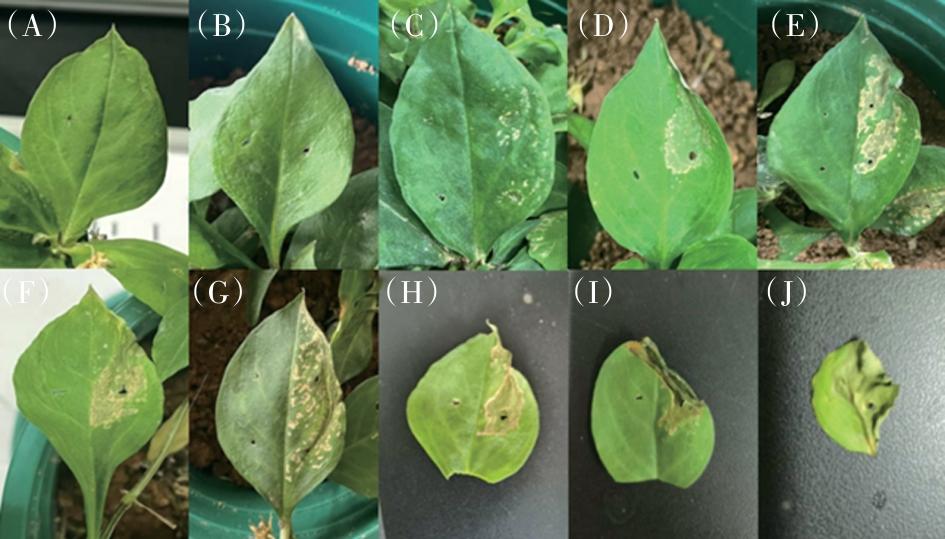
以4月下旬盛苗期的柘参1号为材料,交链孢菌孢子悬浮液为实验组,无菌水为对照组,在同一叶片两侧用无菌牙签打孔,对称滴加孢子悬浮液和无菌水,间隔0.5 d观察并采集叶片。
1.3.3 生理指标测定
分别于接种病原菌后0、0.5、1、2、3、3.5、4、4.5、5、5.5 d进行取样。称取各时间点的叶片样本0.1 g,放入离心管中,置于液氮速递,-80 ℃保存,用于测定植株生理指标。可溶性糖含量采用蒽酮硫酸比色法测定,可溶性蛋白含量采用考马斯亮蓝G-250法测定,H2O2含量采用钛盐显色法测定,几丁质酶活性采用3,5-二硝基水杨酸法测定,APX活性采用分光光度法测定,POD活性采用愈创木酚法测定,CAT活性采用紫外吸收法测定,MDA含量采用硫代巴比妥酸法测定,Pro含量采用茚三酮法测定[8]。
1.4 数据分析
使用Excel 2013和WPS软件整理数据及绘图,使用Origin软件进行数据分析。
2 结果与分析
2.1 病原菌侵染对太子参外观性状的影响
2.2 病原菌侵染对太子参生理指标的影响
2.2.1 渗透系统相关指标
2.2.2 抗逆性相关指标
2.2.3 抗氧化酶活性相关指标
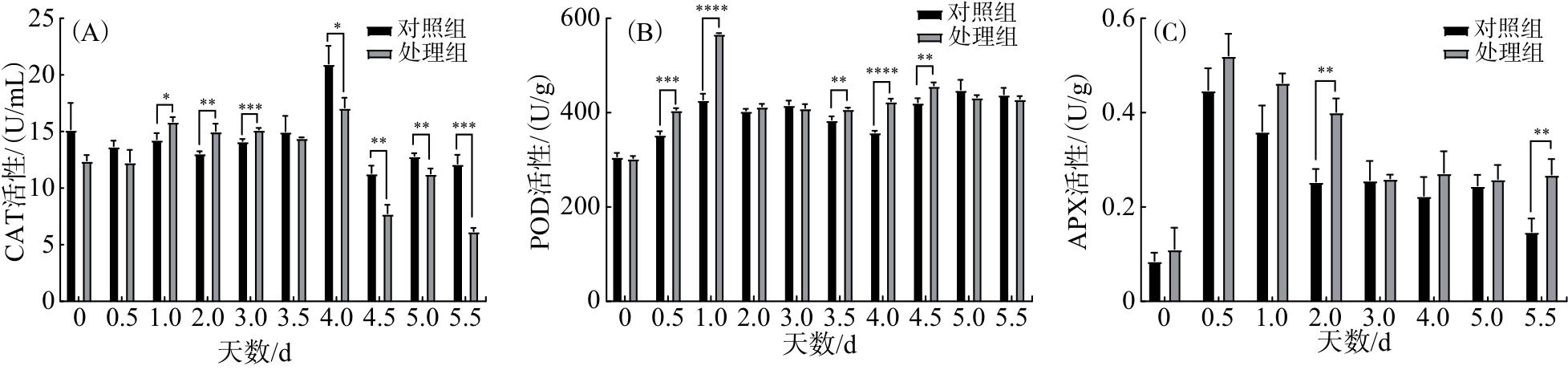
CAT活性在接种后的3.5 d内变化幅度较小,3.5 d时快速上升,在第4天达到最高值后骤降,峰值为处理前的2.4倍(图4A)。POD活性较对照组增强,总体呈先上升后下降的变化;接种1 d达到峰值,是处理前的1.3倍,明显高于对照组(P<0.05),之后开始下降(图4B)。APX活性上升后持续下降,在第0.5天时达到峰值,是处理前的5倍,且含量均高于对照组(图4C)。病原菌胁迫条件下,植株体内产生大量ROS并积累,植株需产生大量的抗氧化相关酶类以分解过氧化氢,导致抗氧化酶类活性呈上升趋势。随着胁迫进程推进,抗氧化酶活性呈下降趋势,其原因是ROS含量减少使得植株通过负反馈下调抗氧化酶类的表达量,减少酶类合成;病害加重使植株失去合成相关酶的能力,最终导致植株体内抗氧化酶活性降低。


3 结论与讨论
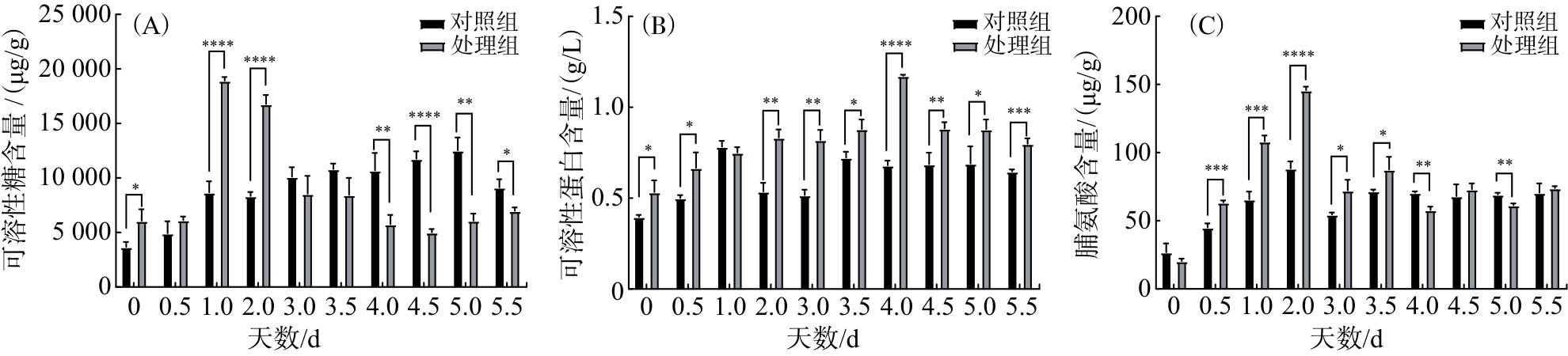
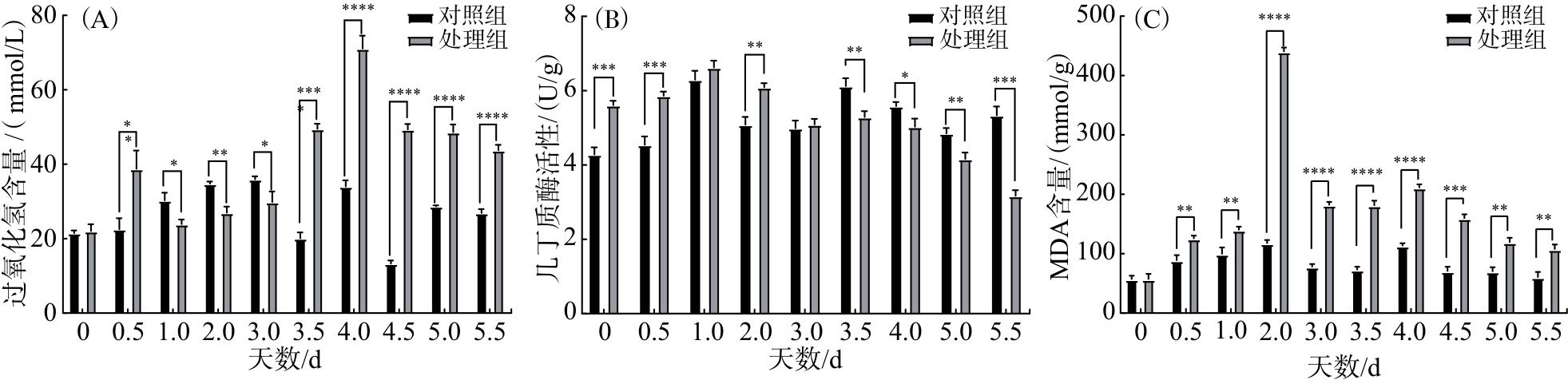
本研究以交链孢菌侵染太子参叶片,间隔采集叶片样本,记录发病情况,并测定植株相关生理指标。结果表明,在渗透系统相关指标中,可溶性糖、可溶性蛋白和Pro含量在胁迫后均呈上升后下降趋势。其中,可溶性糖含量在胁迫第1天到达峰值后开始下降,可溶性蛋白含量在第4天达到峰值后下降,Pro含量在第2天达到峰值。在抗逆性相关指标中,H2O2、MDA含量及几丁质酶活性呈先上升后下降趋势,H2O2含量峰值出现在侵染后的第4天,MDA的峰值出现在第4天,几丁质酶活性峰值出现在第1天。抗氧化酶相关指标均呈先上升后下降的趋势,CAT活性在第4天达到峰值,POD活性在第1天达到峰值,APX活性在侵染后12 h(0.5 d)达到峰值。病原菌侵染后,太子参植株启动防御机制,相关指标显著增加以应对胁迫,随着病原菌浓度的逐步增加,植株抵抗能力下降,各项指标逐渐下降。
病原真菌侵染的分子防御机制,植物激活β-1,3-葡聚糖酶(β-1,3-GA)与几丁质酶组成的细胞壁裂解酶系统。试验证实该双酶体系对真菌细胞壁主要组分(β-葡聚糖与几丁质)具有特异性水解功能,其协同作用可导致菌丝体结构崩解。特别是β-1,3-GA与几丁质酶复合处理组对交格链孢菌的菌丝生长抑制率达(78.6±3.2)%,显著优于单一酶处理效果[12]。李应德等[13]测定了接种茎点霉后苜蓿的生理指标,结果表明,病原菌侵染后,苜蓿抗氧化防御系统活性增强,包括POD、SOD、CAT和多酚氧化酶(PPO)。杨环羽等[14]研究胶孢炭疽菌侵染对灵武长枣抗氧化物质的影响,发现接种病原菌后MDA质量摩尔浓度显著提高且持续积累;SOD、POD、PPO 3种酶的活性均呈先升高后降低的趋势;POD和PPO具有协同效应;不同防御酶对病原菌侵染的响应有先后差异,POD和PPO酶活性峰值较SOD 提早12 h。